Automatic and Revolving Doors
Summary
Automatic and revolving doors are entrance assemblies opened by motion sensors, push plates, or rotation, including full-power sliding and swinging doors, low-energy operators, and manual or powered revolving doors. They are consulted for high-traffic, accessible, and air-controlled entrances, where egress breakout, BHMA compliance, and power and sensor coordination govern the design.
Cols
Terminology
- Full-power operator: opens at full speed on sensor activation; governed by ANSI/BHMA A156.10
- Low-energy operator: slow, low-force opening on knowing act (push plate, wave switch); ANSI/BHMA A156.19 (swinging) or A156.38 (sliding and folding)
- Power assist: reduces manual opening force; no automatic opening
- Bi-parting / single slide / telescoping: sliding door panel arrangements
- Breakout (breakaway): sliding panels and sidelites that swing out in the egress direction under push force
- Activation sensor: microwave or infrared sensor that opens the door
- Presence / threshold sensor: sensor that holds the door open or stops motion when someone is in the path
- Knowing act switch: push plate or touchless switch for low-energy doors
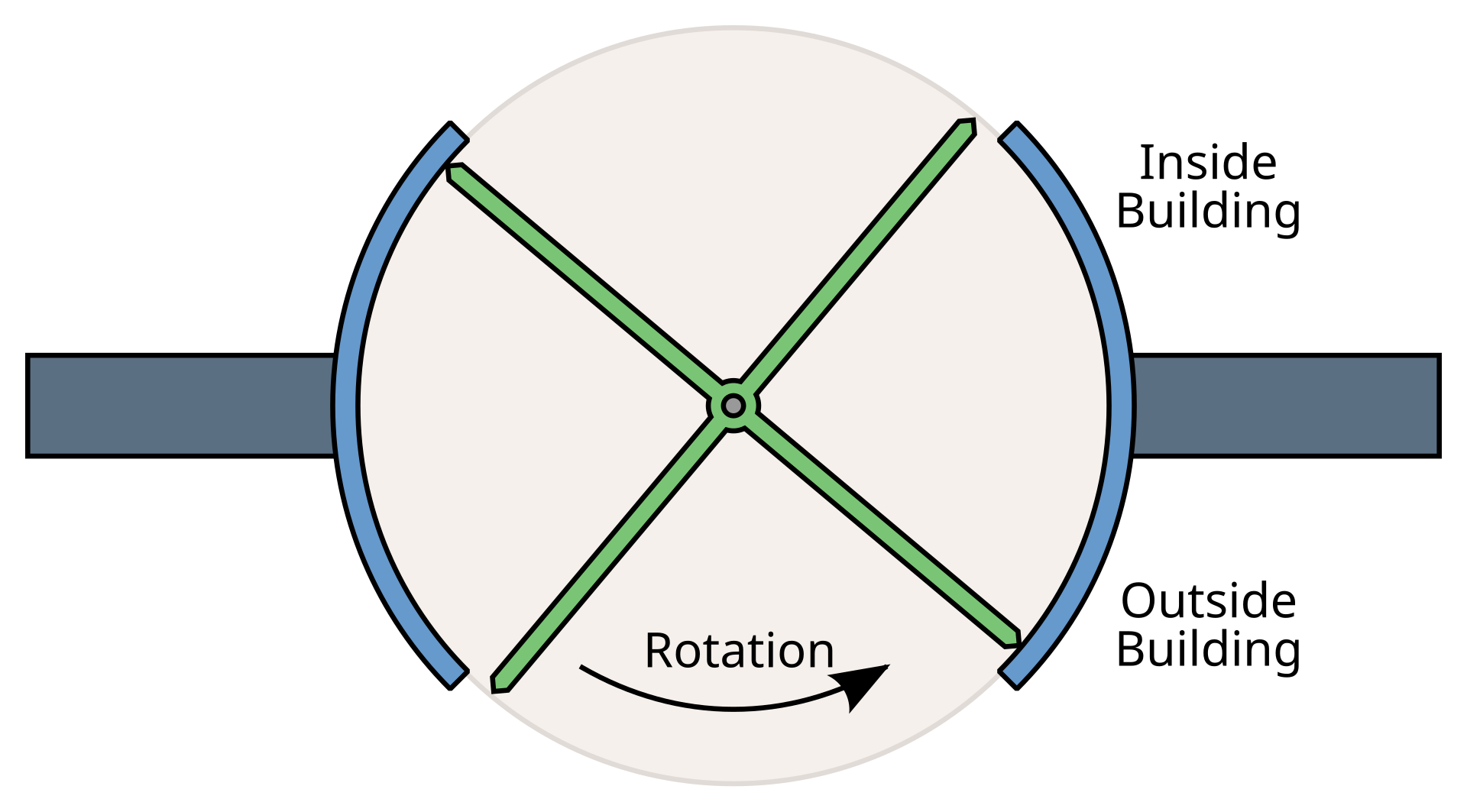
- Wing / drum / canopy: revolving door leaves, curved enclosure walls, and ceiling assembly
- Speed control: governor limiting revolving door rpm
- Collapsible wings (book-fold): revolving wings that fold flat for emergency egress
- AAADM: American Association of Automatic Door Manufacturers; certifies inspectors for annual safety checks
Standards
Sizes
- Sliding doors: single slide 3'-0" to 4'-0" clear; bi-parting 4'-0" to 8'-0" clear; height 7'-0" to 8'-0"
- Swing operators: single leaves 3'-0" to 4'-0"
- Revolving doors: manual 6'-0" to 10'-0" diameter; automatic 8'-0" and larger; large-diameter units to 16'-0" and more; 3-wing and 4-wing configurations
Test standards
- ANSI/BHMA A156.10-2024: power-operated pedestrian doors
- ANSI/BHMA A156.19: power assist and low-energy power-operated doors
- ANSI/BHMA A156.38: low-energy power-operated sliding and folding doors
- ANSI/BHMA A156.27-2024: power and manual operated revolving pedestrian doors
- UL 325: door operators, where applicable
Types
| Type | Standard | Typical use | Key limitation |
|---|---|---|---|
| Full-power sliding | A156.10 | Retail, healthcare, airports | Needs breakout panels for egress |
| Full-power swinging | A156.10 | Back-of-house, corridors | Swing path guarding and sensors |
| Low-energy swinging | A156.19 | Accessible entrances and toilets | Slow opening; poor for high volume |
| Low-energy sliding or folding | A156.38 | Patient rooms, small entrances | Limited speed and force |
| Manual revolving | A156.27 | Office lobbies, hotels | Not accessible; adjacent swing door required |
| Automatic revolving | A156.27 | High-traffic lobbies | Large diameter, emergency stop, high cost |
| Security revolving | A156.27 | Secure lobbies, data centers | Throughput limited; specialist design |
Materials
- Aluminum framing: anodized or painted to match storefront
- All-glass panels: tempered or laminated glass with minimal rails
- Stainless steel cladding: high-end lobbies and revolving drums
- Glass: tempered or laminated, flat or curved for revolving drums
- Operators and headers: concealed in an aluminum header; electromechanical drives with battery backup options
Uses
Specific uses
- Grocery, retail, and big-box entrances (bi-parting sliders)
- Hospital entrances and emergency departments (sliders, telescoping, ICU doors)
- Office tower lobbies where stack effect and wind are high (revolving)
- Accessible entrances retrofitted with low-energy swing operators
- Airports and transit terminals with continuous traffic
Pros and cons
Pros
- Hands-free, accessible operation
- High throughput at sliding and large automatic revolving doors
- Revolving doors limit air infiltration and stack-effect drafts
- Vestibule pairs with sliders reduce energy loss and wind entry
Cons
- Need power, controls, and integration with access control and fire alarm
- Annual inspection and service needed to stay safe and compliant
- Revolving doors are not part of an accessible route; adjacent swing door required
- Higher first cost and larger header and floor coordination
- Sensor misadjustment creates safety and liability risk
Manufacturing and cost
Construction
- Header houses operator, controller, and carriage; supported by jambs or structure
- Sliding panels hang from header rollers with floor guides; breakout panels pivot on header and floor pivots
- Revolving doors set in a recessed floor pan with a ceiling canopy; drum glass is curved and laminated or tempered
- Activation and presence sensors set and tested after installation; signage per A156.10 and A156.19
- Revolving doors are specified under MasterFormat 08 42 33, Revolving Door Entrances
Main manufacturers and suppliers
- ASSA ABLOY Entrance Systems
- STANLEY Access Technologies
- dormakaba
- Horton Automatics
- Boon Edam
- NABCO Entrances
- Record USA
Trade association: American Association of Automatic Door Manufacturers.
Typical costs
- Low-energy swing operator added to an existing door, installed: $3,000 to $6,000
- Bi-parting automatic sliding door package, installed: $6,000 to $12,000
- Healthcare or telescoping sliding doors, installed: $10,000 to $25,000
- Revolving door, installed: $30,000 to $150,000; manual units at the low end, automatic and security units at the high end
Sources
- BHMA: IBC revisions regarding door operations and door hardware, 2015 to 2024 IBC, http://buildershardware.com/Portals/0/BHMA, IBC Revisions RE Door Operations and Door Hardware 2015 to 2024 IBC 20240208_1.pdf
- I Dig Hardware: decoded, automatic sliding doors, https://idighardware.com/2025/01/decoded-automatic-sliding-doors/
- NBS: BHMA publication index (A156.10-2024 current), https://www.thenbs.com/publicationindex/documents?Pub=BHMA
- Corada: 2010 ADA Standards Section 404 doors, https://www.corada.com/documents/2010ADAStandards/404
- Buildings: Horton manual revolving door product listing, https://buildings.com/products/doors-hardware/product/55133138/horton-automatics-this-manual-revolving-door-returns-to-home-position-after-every-use-for-maximum-energy-savings
- BNP Media continuing education: the ins and outs of revolving doors, https://continuingeducation.bnpmedia.com/courses/boon-edam/the-ins-and-outs-of-revolving-doors/6
- I Dig Hardware: decoded, IECC requirements for vestibule doors, https://idighardware.com/2020/04/decoded-international-energy-conservation-code-requirements-for-vestibule-doors/
- Boon Edam: what does a revolving door cost, https://help.boonedam.com/en/what-does-a-revolving-door-cost
- Wikimedia Commons: Revolving door plan view.svg, by AJakeS and Life of Riley (CC BY-SA 3.0), https://commons.wikimedia.org/wiki/File:Revolving_door_plan_view.svg