Hot-Humid Climates
Summary
Hot-humid climates receive more than 20 in. of annual precipitation and stay warm and wet through the cooling season, covering the moist parts of IECC zones 1 to 3 such as Miami and Houston. Humidity, not temperature, sets the mechanical and envelope strategy, so dehumidification, air sealing, and decay and termite resistance must be designed in from the start.
Cols
Definition
- Building America criteria: over 20 in. annual precipitation, plus a wet-bulb temperature of 67 F or higher for 3,000 or more hours, or 73 F or higher for 1,500 or more hours, during the warmest 6 consecutive months
- Maps to the moist (A) portions of IECC zones 1, 2, and 3 below the warm-humid line
- Representative cities: Miami, FL (1A) and Houston, TX (2A)
Design implications
- Latent load: air conditioning removes moisture less effectively than it removes heat; a thermostat set low is a poor fix
- Dehumidification: provide it separate from sensible cooling, such as a whole-house dehumidifier
- Oversizing: short run cycles from oversized equipment leave indoor moisture uncontrolled; size to the load
- Air leakage: reducing building and duct leakage, or placing ducts inside the conditioned space, cuts both latent and sensible cooling load
- Ventilation: running outside air ventilation well below the design rate has been linked to high indoor humidity in field studies
- Controls: coordinating cooling, dehumidification, and ventilation in central ducted systems through control settings and lower airflows has held indoor humidity within goals using conventional equipment
Example locations
Zones are from ANSI/ASHRAE Standard 169-2020, Addendum a (October 29, 2021), Tables A-3 to A-6.
- North America: Miami, FL (1A); Houston, TX (2A); San Juan, Puerto Rico (0A)
- South America: Belem, Brazil (0A); Rio de Janeiro, Brazil (1A)
- Asia: Singapore (0A); Kuala Lumpur, Malaysia (0A); Mumbai, India (0A); Hong Kong (1A); Guangzhou, China (2A)
- Africa: Lagos, Nigeria (0A); Abidjan, Cote d'Ivoire (0A); Dar es Salaam, Tanzania (0A)
- Oceania: Port Moresby, Papua New Guinea (0A); Brisbane, Australia (2A)
- Europe: no station among the cities checked falls in zones 0A to 2A; the nearest are zone 3A cities such as Barcelona, Spain, Rome, Italy, and Sochi, Russia
Flora and fauna
- Southeastern coastal plain: longleaf, slash, and loblolly pine; southern live oak; pond and bald cypress in wetlands
- Understory: wiregrass and scrub oaks in sandhills; saw palmetto and gallberry in flatwoods
- Wildlife: red-cockaded woodpecker and gopher tortoise in mature longleaf forest
- Climate: humid subtropical, with rainfall peaking in the warmest months
- Building pests: Formosan subterranean termite colonies can hold several million workers and forage widely around a structure; in a Charleston survey of 50 infested structures, about 94 percent were infested from ground-based colonies; control methods match those for native subterranean termites
Sources
- Wikipedia: Tropical rainforest climate, https://en.wikipedia.org/wiki/Tropical_rainforest_climate
- Wikipedia: Humid subtropical climate, https://en.wikipedia.org/wiki/Humid_subtropical_climate
- U.S. Department of Energy: Climate zones, https://www.energy.gov/eere/buildings/climate-zones
- ASHRAE: ANSI/ASHRAE Addendum a to Standard 169-2020, Climatic Data for Building Design Standards (October 29, 2021), Tables A-3 to A-6
- U.S. Department of Energy: Advanced HVAC humidity control for hot-humid climates, https://www.energy.gov/cmei/buildings/advanced-hvac-humidity-control-hot-humid-climates-0
- U.S. Department of Energy: whole-house dehumidifier case study, https://www.energy.gov/sites/prod/files/2013/11/f5/case_study_wholehouse_dehumidifier.pdf
- Wikipedia: Southeastern conifer forests, https://en.wikipedia.org/wiki/Southeastern_conifer_forests
- Clemson Cooperative Extension: Formosan subterranean termites, https://hgic.clemson.edu/factsheet/formosan-subterranean-termites/
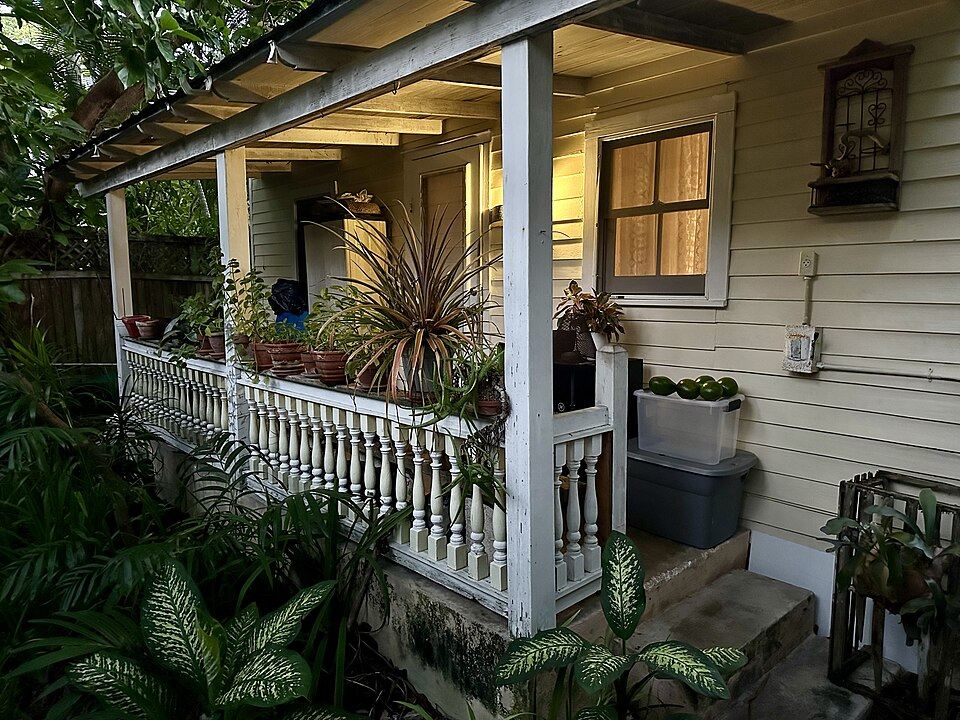
- Wikimedia Commons: Our Conch House - Front porch - Key West Florida November 2023.jpg, by Cayobo (CC BY 2.0), https://commons.wikimedia.org/wiki/File:Our_Conch_House_-_Front_porch_-_Key_West_Florida_November_2023.jpg