Environmental Product Declarations
Summary
An environmental product declaration reports a product's life cycle impacts in a standard format, verified by a third party against product category rules. EPDs are comparable only when built to the same rules, so check the PCR, declared unit, and validity date before using one.
Cols
Terminology
- PCR (product category rules): rules for a product group, defining system boundaries, calculation methods, and data quality
- Program operator: organization that publishes the verified EPD
- Industry-wide EPD: average for a group of manufacturers
- Manufacturer-specific EPD: declaration for one manufacturer's product
Standards
- ISO 14025: EPD framework; EPDs are verified by an independent verifier against the PCR and the standard
- Comparability: EPDs made to the same PCR are comparable; EPDs made to different rules or programs are not automatically comparable
- Validity: program operators typically set five years, and an EPD can be extended five more years if no significant process changes occurred; sources differ on whether the period is set by the standard or the operator
Selection
- Most recent EPD: use the most recently published EPD for the product type
- Boundary: product EPDs usually cover cradle-to-gate; add transport and construction impacts in the building assessment
Sources
- Kiwa: product category rules for EPDs, https://www.kiwa.com/en/de/areas-of-expertise/sustainable-solutions/product-category-rules-pcr/
- IBU: how an EPD is created, https://ibu-epd.com/en/faq-items/how-is-an-epd-created/
- Oregon Department of Transportation: EPD 101, https://www.oregon.gov/odot/Construction/Documents/HB4139/02_EPD 101.pdf
- Brick Development Association: EPD FAQ, https://www.brick.org.uk/better-with-brick/sustainability/environmental-product-declarations/faq
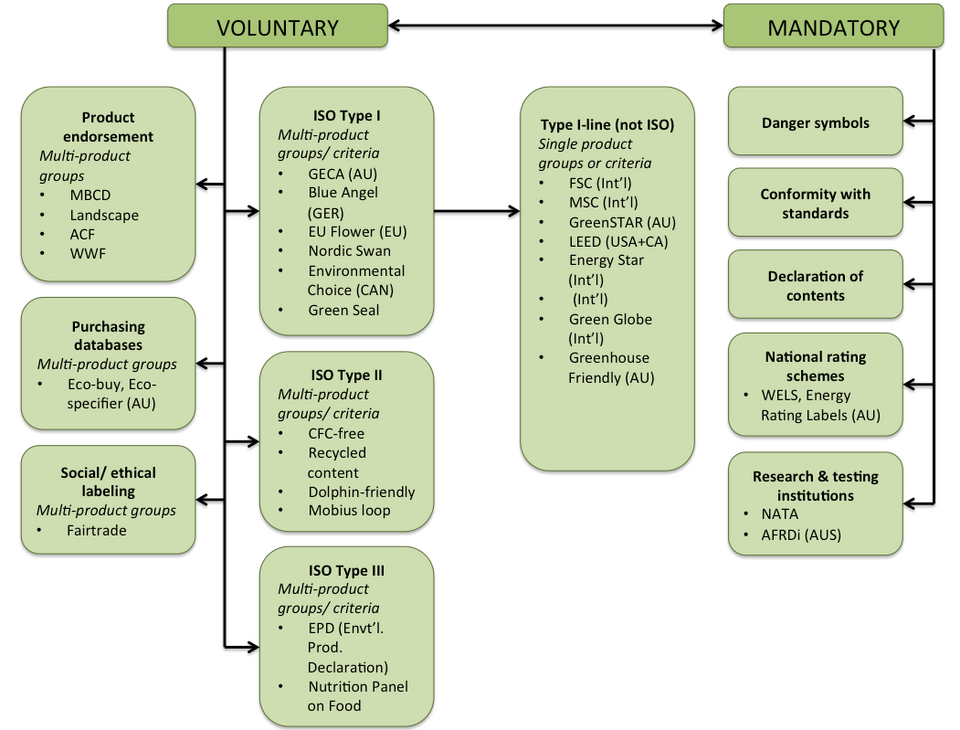
- Wikimedia Commons: Classification of eco labels.png, by Ecogirls (CC BY-SA 3.0), https://commons.wikimedia.org/wiki/File:Classification_of_eco_labels.png