Slab on Grade
Summary
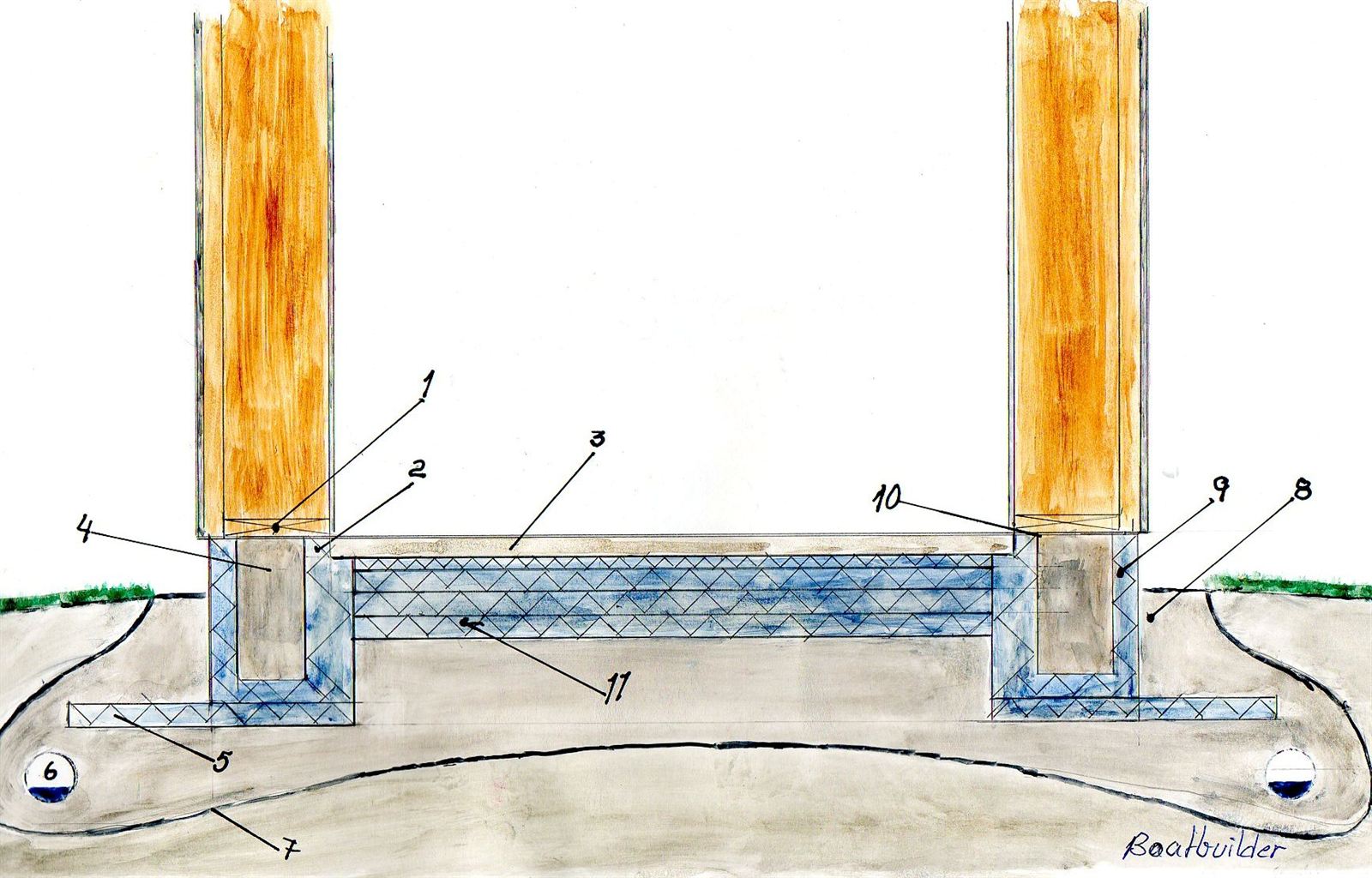
A slab on grade is a concrete floor placed over a compacted granular base, usually with a vapor retarder, reinforced with fibers, mesh, or bars, and cut or tooled with joints to control shrinkage cracking. It is the default ground floor, but vapor retarder location, joint layout, flatness, and slab moisture decide whether finish flooring performs.
Cols
Terminology
- Subgrade / base course: compacted native soil and the granular layer above it
- Vapor retarder: polyolefin sheet under the slab limiting moisture rising from the ground
- Contraction (control) joint: saw cut or tooled groove that sets where shrinkage cracks form
- Isolation joint: full-depth joint separating the slab from columns, walls, and footings
- Construction joint: joint between placements, often doweled or keyed
- Armored joint: steel-edged joint for forklift and heavy wheel traffic
- Curling: upward warping of slab edges from differential drying
- FF / FL: floor flatness and levelness numbers measured by ASTM E1155
- Moisture vapor emission rate (MVER): calcium chloride test result in lb/1,000 sq ft/24 hr
- In-situ RH: relative humidity measured in drilled holes per ASTM F2170
- Post-tensioned slab: slab with tensioned tendons; common on expansive soils
- Structural slab on grade: slab that carries vertical loads or lateral forces to soil
Standards
Thicknesses
- 4 in. to 6 in. common for commercial and residential floors; thicker for warehouses, racking, and heavy equipment
- Joint spacing set by slab thickness, mix shrinkage, and reinforcement; a common rule of thumb is 24 to 36 times the slab thickness (in feet per inch of thickness)
Ratings
- Vapor retarder: ASTM E1745 class; Class A is the strongest and least permeable; place the slab directly on the retarder where moisture-sensitive flooring is planned (ACI 302 guidance)
- Flatness: specify FF and FL by use; tighter values for polished concrete and narrow-aisle warehouses
- Moisture limits for flooring: commonly 75 to 80 percent RH (ASTM F2170) or 3 lb/1,000 sq ft/24 hr (ASTM F1869); the flooring manufacturer's limits govern
Test standards
- ACI 302.1R: guide to concrete floor and slab construction
- ACI 360R: design of slabs on ground
- ASTM E1745: vapor retarders in contact with soil
- ASTM E1155: floor flatness and levelness
- ASTM F2170 and F1869: slab moisture testing
Materials
- Concrete: normal-weight; low water-cement ratio and shrinkage-reducing mixes for flooring-sensitive slabs
- Reinforcement: welded wire, deformed bars, or macro-synthetic or steel fibers
- Vapor retarder: 10 mil minimum recommended; thicker Class A products under moisture-sensitive floors
- Base course: compacted crushed stone or gravel
- Under-slab insulation: extruded or expanded polystyrene where energy code requires slab insulation
- Joint fillers: semi-rigid epoxy or polyurea in traffic joints
Detailing
- Lay out joints on column lines and at reentrant corners; keep panels near square
- Isolate columns and walls with diamond or circular blockouts
- Tape and seal vapor retarder laps and penetrations
- Specify cure method compatible with future flooring adhesives and coatings
- Test moisture before flooring; plan time or moisture mitigation in the schedule
- Coordinate depressions for tile, terrazzo, and recessed mats
Uses
Specific uses
- Ground floors of commercial, institutional, and residential buildings
- Warehouses and distribution floors with racking and forklifts
- Garages and service areas
- Exposed polished or sealed concrete floors
- Substrate for resilient, tile, carpet, and resinous finishes
Pros and cons
Pros
- Lowest-cost ground floor
- Durable and fire resistant
- Thermal mass; works with radiant heating
- Can be the finished floor
Cons
- Shrinkage cracking and curling without good joint design
- Moisture problems under flooring if vapor control and drying are poor
- Expansive or weak soils need special design
- Hard to modify for buried utilities later
Manufacturing and cost
Construction
- Subgrade proof-rolled and compacted; base placed; utilities and vapor retarder installed
- Concrete placed, screeded, floated, and troweled; saw-cut joints within hours of finishing
- Cured with moisture retention or compound; joints filled after shrinkage
Main manufacturers and suppliers
- Stego Industries (vapor retarders)
- W. R. Meadows
- Euclid Chemical
- Sika USA
Trade associations: American Concrete Institute and American Society of Concrete Contractors.
Typical costs
- 4 in. slab on grade, installed: $4.50 to $12 per sq ft
- Commercial 6 in. reinforced slab with higher-strength mix, installed: $10 to $18 per sq ft
- Each added inch of thickness: about $0.50 to $1.25 per sq ft
Sources
- Prairie Material: vapor retarders under slabs on grade, https://www.prairie.com/wp-content/uploads/sites/4/2024/12/29p_VaporBarriersUnderSlabsonGrade.pdf
- Palm Beach County School District: 07 26 00 vapor retarders specification, https://www.palmbeachschools.org:443/cms/lib/FL50010848/Centricity/Domain/388/07 26 00 Vapor Retarders.pdf
- GCP: what's the best concrete moisture test method, https://ca.gcpat.com/en/news/blog/what-s-best-concrete-moisture-test-method
- Terrapin Construction Group: commercial flooring moisture testing guide, https://terrapincg.com/commercial-flooring-moisture-testing-guide
- UpCodes: 2024 IBC Chapter 19 concrete (slabs on ground), https://up.codes/viewer/department-of-defense/ibc-2024/chapter/19/concrete
- Estimators.us: concrete slab cost, 2026, https://estimators.us/concrete-slab-cost/
- Wikimedia Commons: Slab on grade.1.jpg, by Boatbuilder (CC BY-SA 3.0), https://commons.wikimedia.org/wiki/File:Slab_on_grade.1.jpg