Polycarbonate
Summary
Polycarbonate is an amorphous thermoplastic with a density of 1.20 to 1.22 g/cm³ and Izod impact strength of 600 to 850 J/m. It is specified for glazing and skylights where impact resistance matters, with UV stabilization and thermal expansion the key detailing issues.
Cols
Terminology
- PC: polycarbonate
- Makrolon / Lexan: trade names (Bayer, GE)
- BPA: bisphenol A, a monomer released by hydrolysis
- LOI: limiting oxygen index
- Domelight: formed dome skylight
History and demand
Invention
- 1953: Hermann Schnell of Bayer patented the first linear polycarbonate; Daniel Fox of General Electric synthesized a branched version about a week later
- 1958: Bayer began commercial production as Makrolon; 1960: GE followed with Lexan
Sourcing
- Asia-Pacific holds an estimated 65 to 75 percent of about 8.1 million tons of global capacity; China's capacity was under 2 million tons in early 2020 and is projected near 4 million tons by the end of 2025 (market research)
- GlobalData's country ranking by capacity lists China first, then the United States, South Korea, Thailand, and Germany (2022)
Demand trend
- About one billion kilograms produced annually; construction is the second-largest consumer (domelights, glazing, roofing sheets, and sound walls)
Properties
Physical
- Density: 1.20 to 1.22 g/cm³ (about 75 to 76 lb/ft³)
- Light transmission: essentially amorphous and highly transparent, better than many glasses
Mechanical
- Tensile strength: 55 to 75 MPa (8.0 to 10.9 ksi)
- Modulus of elasticity: 2.0 to 2.4 GPa (290 to 350 ksi)
- Impact strength: Izod 600 to 850 J/m; notched Charpy 20 to 35 kJ/m²
Thermal and moisture
- Coefficient of thermal expansion: 65 to 70 × 10⁻⁶ per K, about 36 to 39 × 10⁻⁶ in./in./°F
- Glass transition: about 147°C (297°F); flow above about 155°C (311°F)
Fire behavior
- Rating: HB-V2 as given; limiting oxygen index 25 to 29 percent
Durability
- UV: fair; standard resins are unsuitable for long-term UV exposure, so UV stabilizers are often added
Standards
Test methods
- ASTM D635, D1929, D2843: burning extent, self-ignition, and smoke density (plastics classification)
Uses in buildings
Building elements
- Skylights and Roof Windows: dome and pyramid glazing
- Overhead Sectional Doors: glazing in full-view sections
- Greenhouse and Canopy Glazing: multiwall and solid sheet roofing and domelights
Pros and cons
Pros
- Izod impact strength 600 to 850 J/m
- Light transmission better than many glasses
- Lighter than glass (1.20 to 1.22 g/cm³)
Cons
- Fair UV resistance; needs stabilizers
- High thermal expansion
- Hydrolysis at high temperature releases BPA
Design considerations
Movement
- Expansion about 0.43 to 0.47 in. per 10 ft for a 100°F swing (calculated from 36 to 39 × 10⁻⁶ in./in./°F)
Sustainability
Health
- Hydrolysis at high temperature releases bisphenol A; alkali cleaners and bleach can accelerate release
Manufacturing and cost
Main manufacturers and suppliers
Trade association: American Chemistry Council.
Sources
- Wikipedia: Polycarbonate, https://en.wikipedia.org/wiki/Polycarbonate
- UpCodes: 2024 IBC Chapter 26 plastic, https://up.codes/viewer/department-of-defense/ibc-2024/chapter/26/plastic
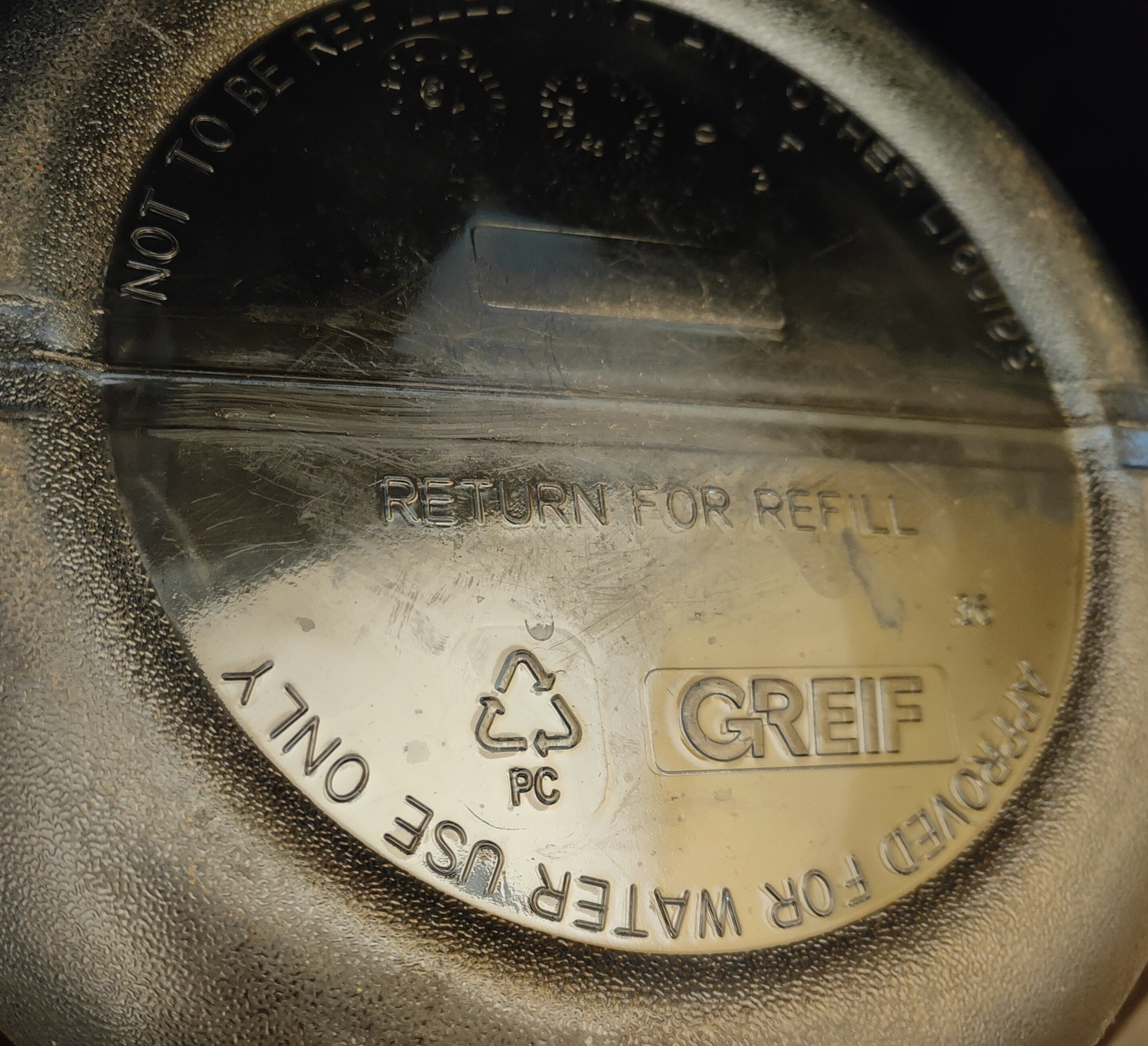
- Wikimedia Commons: Bottom of 18.9 Liter (5 Gallon) jug made by GREIF, plastic type PC (polycarbonate).jpg, photo by Yerachmiel C (CC0), https://commons.wikimedia.org/wiki/File:Bottom_of_18.9_Liter_(5_Gallon)_jug_made_by_GREIF,_plastic_type_PC_(polycarbonate).jpg
- GlobalData: China to lead global polycarbonate capacity additions through 2030, https://www.globaldata.com/media/oil-gas/china-to-lead-global-polycarbonate-capacity-additions-through-2030-says-globaldata/
- GII Research: polycarbonate resins global market overview, https://cn.gii.tw/report/inde1207187-polycarbonate-pc-resins-global-market-overview.html