Hollow Metal Doors
Summary
Cols
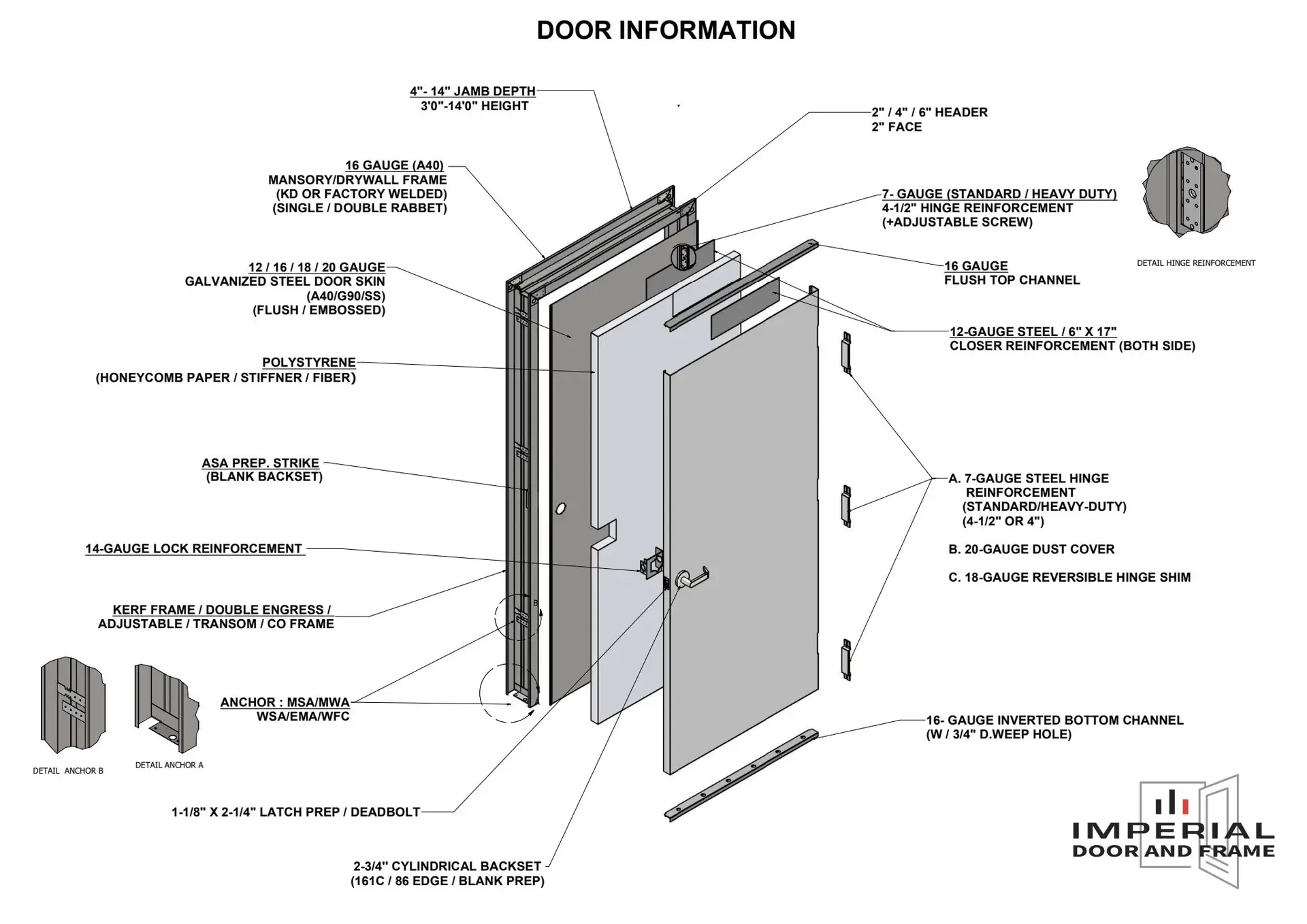
Terminology
- HM / HMD / HMF: hollow metal, hollow metal door, hollow metal frame
- Face sheet: the steel skin on each side of the door; its thickness sets the SDI level
- Core: the material between the faces (honeycomb, polystyrene, polyurethane, steel stiffeners, mineral board)
- Stiffener: vertical steel channel or hat section bonded to the faces in steel-stiffened doors
- Seam: the vertical edge joint; visible on full flush doors, welded and filled on seamless doors
- Lite kit: metal frame and stops that hold a glass or louver insert in the door
- Hardware reinforcement: steel plates welded or bonded inside the door at hinge, lock, closer, and exit device locations
- Frame (jamb, head, throat): the steel surround; throat size matches wall thickness
- KD / welded frame: knock-down (field-assembled) versus welded (shop-assembled, rigid) frame
- ga: steel gauge; a lower number is thicker steel
- Galvanneal (A40 / A60): zinc-iron coated steel, with A60 carrying the heavier coating
- SDI: Steel Door Institute
- Label: the permanent mark on a fire-rated door or frame from a listing agency such as UL
Standards
Sizes
- Commonly 3'-0" wide by 7'-0" high; other widths and heights (such as 8'-0" tall doors) are widely available, often as custom orders
- Plan for a minimum 32 in. clear opening where accessibility applies; a 3'-0" leaf generally achieves this
- Standard leaf size and hardware locations follow ANSI/SDI A250.8, with hinge and strike locations in SDI 129
Thicknesses
- Door thickness: 1-3/4 in. is standard; 1-3/8 in. exists for Level 1 only
- Steel face sheet by SDI level (ANSI/SDI A250.8):
| Level | Duty | Face gauge | Typical use |
|---|---|---|---|
| 1 | Standard | 20 ga | Light interior, low traffic |
| 2 | Heavy | 18 ga | Medium traffic interiors |
| 3 | Extra heavy | 16 ga | High traffic, interior egress |
| 4 | Maximum | 14 ga | Severe use, security, exterior |
- Approximate sheet thickness: 18 ga is 0.042 in., 16 ga is 0.053 in., 14 ga is 0.067 in., and 20 ga is about 0.032 to 0.035 in.
Models (edge construction)
- Full flush: vertical seam is permitted on the edge
- Seamless: no visible edge seam
- Stile and rail: stiles and rails with flush or glazed panels
Test standards
- ANSI/SDI A250.4: physical endurance test for doors and frames
- ANSI/SDI A250.6: hardware reinforcing
- ANSI/SDI A250.7: nomenclature
- ANSI/SDI A250.11: frame installation
- ANSI/BHMA A156.115 and DHI A115 series: hardware preparation
Materials
- Cold-rolled steel for interior openings
- Galvanized or galvannealed steel (ASTM A653) for exterior, humid, or corrosive conditions
- Stainless steel for healthcare, food service, and laboratory settings
- Cores: honeycomb (economical), polystyrene or polyurethane (insulated), steel-stiffened (strength and security), mineral board (fire-rated and temperature-rise doors)
- Factory primer; finish paint is applied in the field unless a factory finish is ordered
Uses
Specific uses
- Stairwells, exit enclosures, and mechanical rooms
- Corridor, shaft, and fire barrier openings (rated doors)
- Exterior service doors, loading areas, and utility rooms
- Schools, hospitals, and other high-traffic or high-abuse facilities
- Secure rooms and openings needing forced-entry resistance
Pros and cons
Pros
- Durable and dimensionally stable
- Available with fire ratings from 20 minutes to 3 hours
- Wide range of levels, cores, and glazing options
- Low maintenance and long service life
Cons
- Heavier than wood or aluminum doors, so hinges and closers must be selected accordingly
- Can dent or rust if the steel, coating, or paint is under-specified
- Uninsulated cores and thermal bridging through the steel can be a problem at exterior openings unless a thermally broken or insulated assembly is chosen
- Hardware must be specified before fabrication, since preps are made at the factory
- Appearance is utilitarian compared with wood or aluminum-and-glass doors
Manufacturing and cost
Construction
- Two formed steel face sheets joined at the edges, with internal reinforcement and core
- Hardware reinforcements are installed at the factory based on the hardware schedule
- Frames are formed from steel sheet and shipped welded or knock-down, with anchors suited to the wall type
- Fire-rated assemblies must carry a label and use a rated door, rated frame, and compatible hardware
Main manufacturers and suppliers
SDI-member manufacturers include:
The Steel Door Institute maintains the full member list. Verify manufacturer links and product availability before relying on them.
Typical costs
Estimates only. Online cost guides vary widely and many are low quality, so get supplier quotes for real budgeting.
- Door leaf only: roughly $400 to $1,500 depending on gauge, core, size, and glazing; a retail example is an 18 ga, 3'-0" by 6'-8" narrow-lite door at about $1,550
- Door and frame supplied: roughly $900 to $2,500
- Installed, with standard hardware: roughly $1,500 to $4,500 per opening, higher for fire-rated, glazed, security, or access-controlled openings
- Hardware, fire labels, and field painting are often priced separately
Sources
- Steel Door Institute: ANSI/SDI A250.8 overview, https://steeldoor.org/articles/13-July-1/
- Steel Door Institute: SDI 108, selection and usage guide for standard steel doors, https://steeldoor.org/sdi-108/
- Steel Door Institute: Steel Doors and Frames 101, https://steeldoor.org/wp-content/uploads/2020/05/Steel-Doors-and-Frames-101.pptx.pdf
- Steel Door Institute: member list, https://steeldoor.org/members/
- Steelcraft (Allegion): door levels and models, https://kc.allegion.com/kb/article/what-are-door-levels-and-models
- Curries: hollow metal door product summary, https://riccilumber.myeshowroom.com/brochure/17125
- WBDG: VA hollow metal doors and frames specification, https://www.wbdg.org/FFC/VA/VANCAS/VANCA081113.pdf
- Global Industrial: CECO hollow steel door listing (price data point), https://www.globalindustrial.com/p/hollow-steel-narrow-light-glass-door-cylindrical-curries-hinge-18-ga-36w-x-80h