Gravel
Summary
Gravel is a loose aggregation of rock fragments, from 2 mm to about 64 mm in the Udden-Wentworth scale, formed by erosion or produced as crushed stone. It drains freely (hydraulic conductivity above 1 cm/s in natural deposits) and is a base, fill, and concrete aggregate, so gradation and angularity set its use.
Cols
Terminology
- Pebble gravel / granular gravel: Udden-Wentworth classes of 4 to 64 mm and 2 to 4 mm
- USCS gravel: coarse fraction more than 50 percent retained on the No. 4 sieve (4.75 mm); groups GW, GP, GM, GC
- Pea gravel: clean gravel about the size of garden peas
- Shingle: smooth rounded beach or alluvial gravel, 20 to 200 mm
- Conglomerate: rock formed when sediment with over 30 percent gravel hardens
History and demand
Sourcing
- United States 2025: about 870 million tons of construction sand and gravel, down from about 880 million tons in 2024, valued at $12.6 billion; the top states in 2023 were Texas, California, Minnesota, Michigan, and Arizona (USGS)
Demand trend
- United States 2020: about 960 million tons of construction sand and gravel, about 23 percent of industrial mineral production by value ($12.6 billion)
- Almost half of gravel goes into concrete as aggregate; the rest is road base, road surfacing and blacktop, and construction fill
- Crushed stone is replacing natural gravel in the eastern United States, and recycled gravel is becoming more important
Composition and production
Raw materials
- Mostly weathered bedrock; quartz is the most common mineral because it is hard, chemically inert, and lacks cleavage planes
- Rivers round fragments within a few tens of kilometers of the source; gravel accumulates in stream channels, alluvial fans, near-shore marine settings, and deltas
Product forms
- Pea gravel, bank and bench gravel, crushed stone, and graded base material
Grades and types
- Other definitions: ISO 14688 grades gravel as fine (2 to 6.3 mm), medium, or coarse (20 to 63 mm); USDA uses 2 to 80 mm; the Army Corps of Engineers uses particles under 76 mm retained on the No. 4 sieve
- Crushed stone: mechanically crushed and graded rock, often granite or limestone
Properties
Physical
- Bulk density: about 1,460 to 1,920 kg/m³ (91 to 120 lb/ft³)
Thermal and moisture
- Hydraulic conductivity: natural gravel sometimes above 1 cm/s; porous deposits act as aquifers
Standards
Test methods
- ASTM D2487: soil classification (Unified Soil Classification System)
Uses in buildings
Building elements
- Slab on Grade: base under slabs
- Retaining Walls, Site Drainage: free-draining backfill
- Built-Up Roofing: aggregate surfacing embedded in the flood coat
- Site Paving: road base, surfacing, and fill
Pros and cons
Pros
- High hydraulic conductivity
- Large supply: about 960 million tons of construction sand and gravel in the United States in 2020
- Crushed forms interlock
Cons
- Gravelly soils hold little moisture and few nutrients, so plants grow sparsely
- Natural gravel is being displaced by crushed stone in parts of the United States
Manufacturing and cost
Main manufacturers and suppliers
Trade association: National Stone, Sand and Gravel Association.
Sources
- Wikipedia: Gravel, https://en.wikipedia.org/wiki/Gravel
- Wikipedia: Unified Soil Classification System, https://en.wikipedia.org/wiki/Unified_Soil_Classification_System
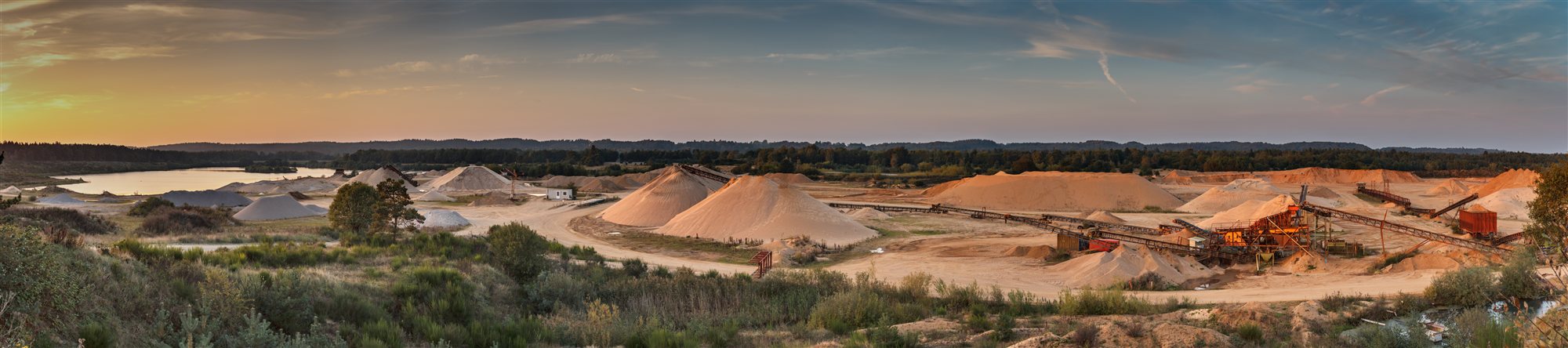
- Wikimedia Commons: Kongensbro gravel pit 2014-09-17.jpg, photo by Slaunger (CC BY-SA 3.0), https://commons.wikimedia.org/wiki/File:Kongensbro_gravel_pit_2014-09-17.jpg
- USGS: Mineral Commodity Summaries 2026, sand and gravel (construction), https://pubs.usgs.gov/periodicals/mcs2026/mcs2026-sand-gravel.pdf