Perlite
Summary
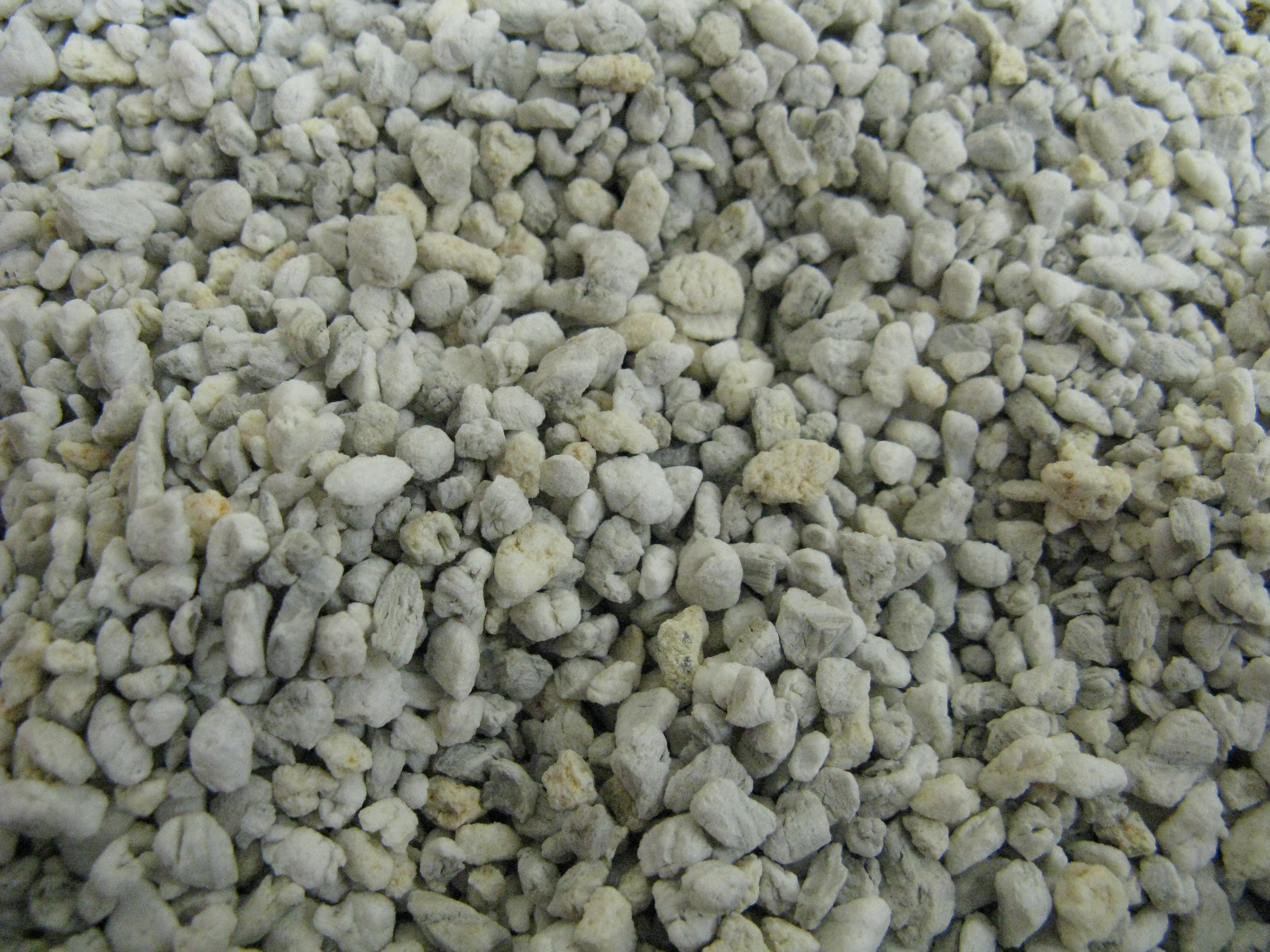
Perlite is an amorphous volcanic glass with high water content that expands 7 to 16 times when heated to 850 to 900°C. The expanded product is a very light aggregate, 2 to 9 lb/ft3, used in plaster, mortar, concrete, and loose-fill insulation.
Cols
Terminology
- Expanded perlite: perlite popped by heating
- Obsidian: volcanic glass from which perlite forms by hydration
History and demand
Sourcing
- 2018: about 4.6 million tonnes produced worldwide; China, Turkey, Greece, USA, Armenia, and Hungary lead; world reserves about 700 million tonnes
Composition and production
Raw materials
- Amorphous volcanic glass, typically formed by hydration of obsidian
Manufacturing process
- Softens at 850 to 900°C (1,560 to 1,650°F) and expands to 7 to 16 times its original volume
Properties
Physical
- Density, raw: about 1,100 kg/m3 (about 69 lb/ft3)
- Density, expanded: about 30 to 150 kg/m3 (about 1.9 to 9.4 lb/ft3)
Uses in buildings
Building elements
- Interior Plaster: lightweight plaster aggregate
- Wall and Roof Insulation: loose-fill insulation
- Acoustic Wall and Ceiling Panels: ceiling tile component
Pros and cons
Pros
- Very low expanded density
- Used in plaster, concrete, mortar, and insulation
Cons
- Silica dust requires goggles and filtering masks when handling large quantities
Sustainability
Health
- Contains silicon dioxide; OSHA limit 15 mg/m3 total and 5 mg/m3 respirable (8 hours); NIOSH 10 mg/m3 total and 5 mg/m3 respirable
Manufacturing and cost
Main manufacturers and suppliers
Trade association: Perlite Institute.
Sources
- Wikipedia: Perlite, https://en.wikipedia.org/wiki/Perlite
- Wikimedia Commons: Perlite1.jpg, photo by KENPEI (CC BY-SA 3.0), https://commons.wikimedia.org/wiki/File:Perlite1.jpg