Plywood
Summary
Plywood is an engineered panel made by gluing thin veneer plies with the grain of each layer at right angles to its neighbors, usually in an odd number of plies. Cross-graining reduces splitting and limits swelling and shrinkage, so face grade and glue line (interior or exterior) are the key specifications.
Cols
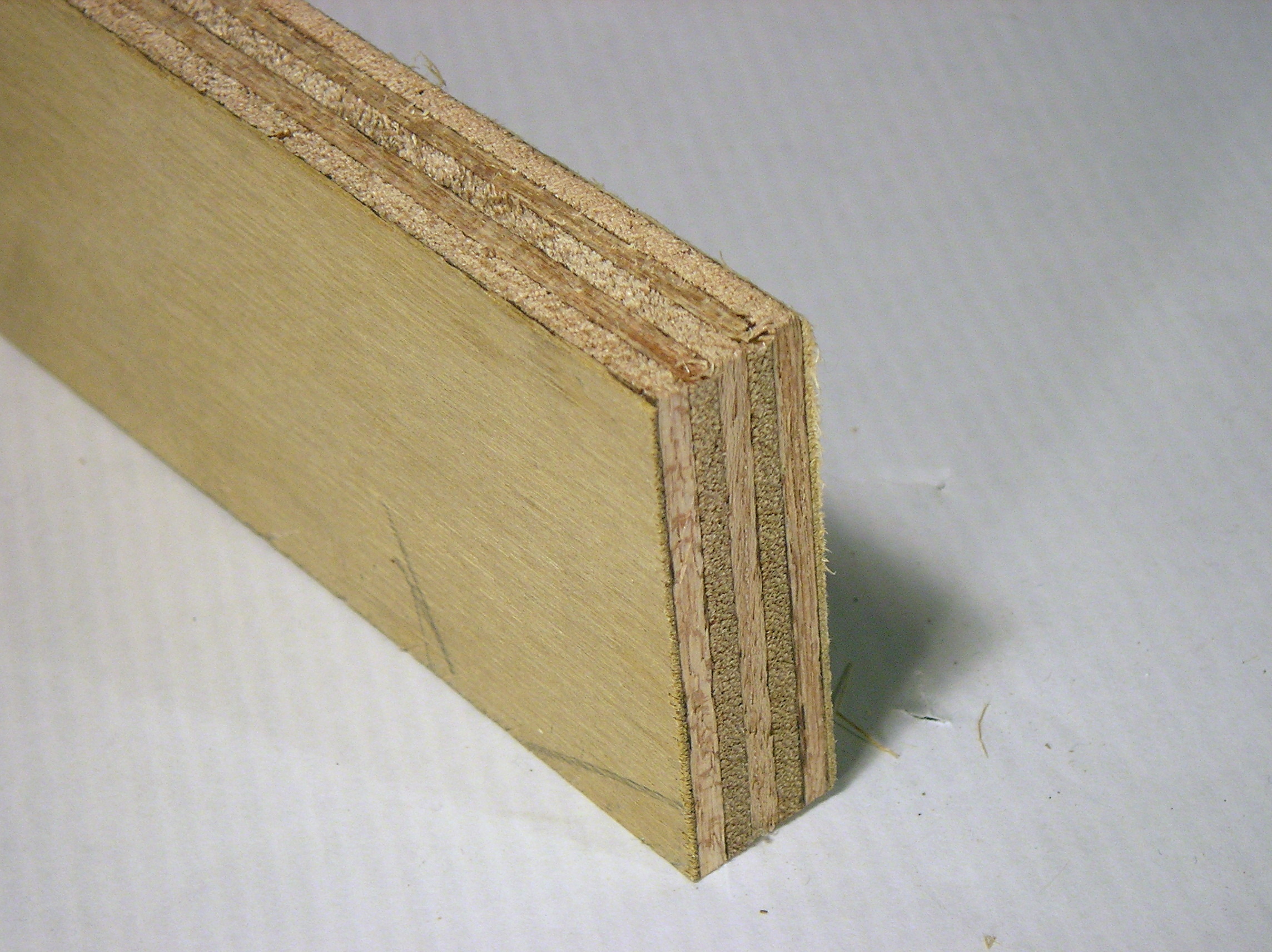
Terminology
- Ply: a veneer layer
- Face / back veneer: outer plies graded A, B, BB, C/D, WG, X, WBP (Western grades)
- Interior / exterior glue: urea-formaldehyde / phenol-formaldehyde or resorcinol-formaldehyde
- E0: low-emission product with effectively zero formaldehyde emissions
- Marine plywood: graded under BS 1088 or IS:710
- 4 × 8 ft sheet: standard 1,220 × 2,440 mm panel
History and demand
Invention
- About 2600 BC: rudimentary plywood in ancient Egypt
- 1850s: industrial use began; 1858 John Henry Belter patented a chair-back technique; 1880s larger-scale use
First uses in construction
- 1905: the 4 × 8 ft sheet size first used by the Portland Manufacturing Company for the Portland World Fair
Sourcing
- China made 73.1 percent of world plywood in 2017 (FAO data via IndexBox); China's capacity was about 205 million m3 in 2023
- 2023 exports by value: China 34 percent, Indonesia about 12.3 percent, Brazil about 5 percent
Composition and production
Raw materials
- Thin wood veneer and adhesive; interior panels typically use urea-formaldehyde, outdoor and marine panels use water-resistant resorcinol- or phenol-formaldehyde
Manufacturing process
- Logs peeled into veneer, dried, glued, and pressed at 140°C (284°F) or higher and up to about 1.9 MPa
Product forms
- Panels 1/8 to 3 in. thick (3.2 to 76.2 mm); aircraft plies as thin as 0.40 mm total
Properties
Physical
- Density (European): birch about 680 kg/m³ (42 lb/ft³), mixed 620 kg/m³ (39 lb/ft³), conifer 460 to 520 kg/m³ (29 to 32 lb/ft³)
Mechanical
- Core layers increase separation between the outer layers, raising bending resistance
Standards
Material specifications
- DOC PS 1, DOC PS 2, and ANSI/APA PRP 210: wood structural panel standards named in the building code
Uses in buildings
Building elements
- Wood-Framed Walls, Wood-Framed Floors, Shear Walls: wall, roof, and floor sheathing and structural panel diaphragms
- Wood I-Joists: web material
- Cast-in-Place Concrete Walls: form facing for concrete placement
- Cabinetry and Casework: casework panels
Pros and cons
Pros
- Cross-graining reduces splitting when nailed and limits swelling and shrinkage
- Strength is more uniform in all directions
- Large panels in thicknesses up to 3 in.
Cons
- Interior-glue panels have limited water resistance
- Formaldehyde glues (low-emission E0 products exist)
Manufacturing and cost
Main manufacturers and suppliers
Trade association: APA – The Engineered Wood Association.
Sources
- Wikipedia: Plywood, https://en.wikipedia.org/wiki/Plywood
- UpCodes: 2024 IBC Chapter 23 wood, https://up.codes/viewer/department-of-defense/ibc-2024/chapter/23/wood
- Wikimedia Commons: Plywood.jpg, photo by Rotor DB (CC BY-SA 3.0), https://commons.wikimedia.org/wiki/File:Plywood.jpg
- Timber Industry News: China plywood production companies fell in 2023, https://timberindustrynews.com/?p=13359
- IndexBox: world plywood market, https://indexbox.co.uk/store/world-plywood-market-report-analysis-and-forecast-to-2020/