NFPA 72 Fire Alarm and Signaling
Summary
NFPA 72 sets how fire alarm and signaling systems are designed, installed, tested, and documented, from detectors and pull stations to horns, strobes, and voice systems. The building code decides where alarms are required (see the fire protection systems note), and NFPA 72 decides how, so alarm devices, panels, and pathways show up in the ceiling plans and rooms the architect draws.
Cols
Scope
- Edition noted: NFPA 72, 2025; the edition in force is the one the adopted code references. Always verify the adopted code edition and local amendments for the project jurisdiction
- Covers fire alarm and signaling systems in buildings, including initiating devices, notification appliances, control units, circuits, documentation, and testing
- Household and single-station smoke alarms are covered by a chapter of NFPA 72 and by the residential code
- The 2025 edition is expected to be referenced by the 2027 IBC
- This note describes the document's structure and changes; the standard itself is not reproduced
Terminology
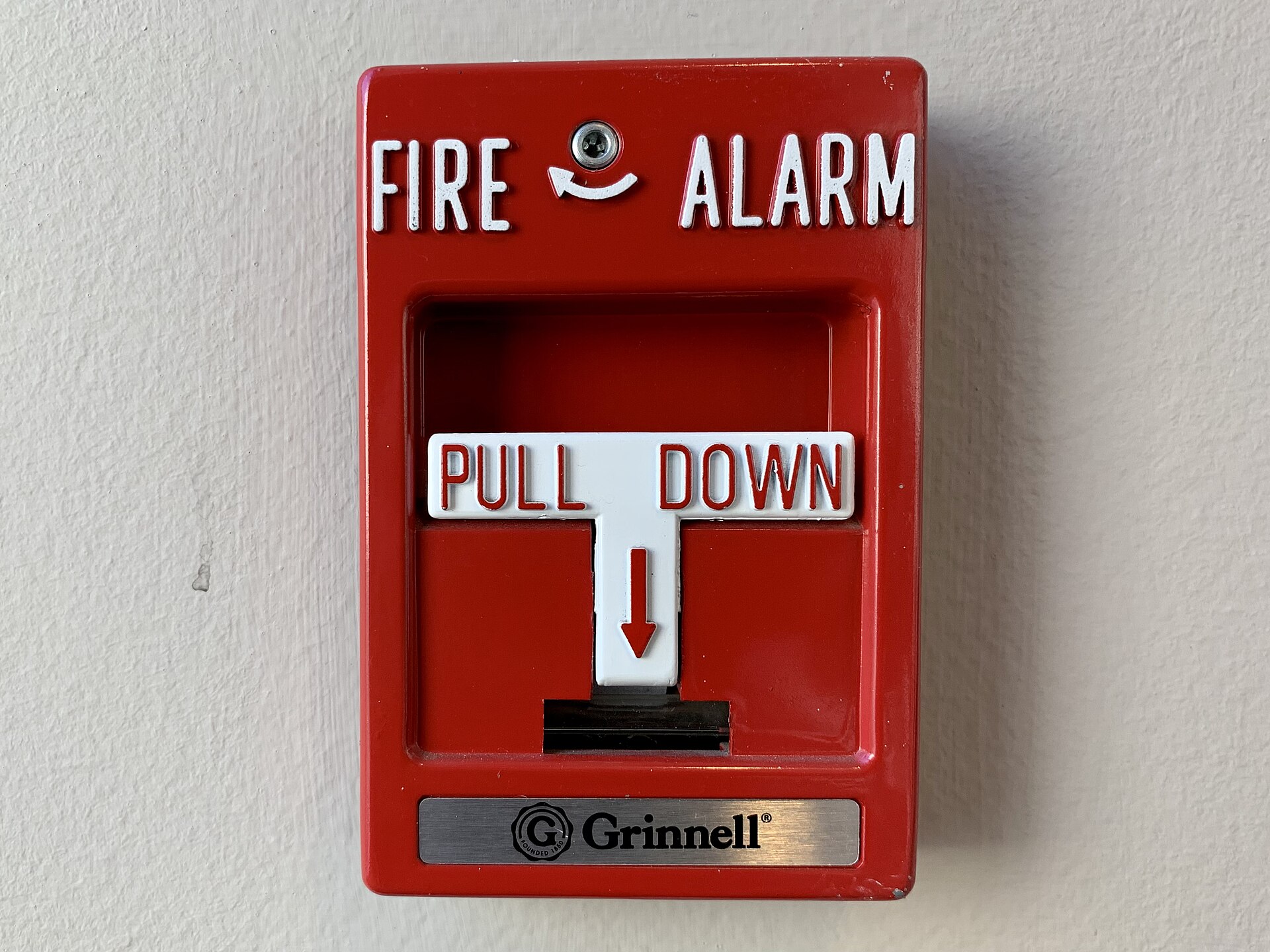
- Initiating device: a detector or manual pull station that starts an alarm
- Notification appliance: a horn, strobe, speaker, or other device that alerts occupants
- Fire alarm control unit (FACU): the panel that receives signals and runs the system
- Supervising station: an off-site monitoring station that receives alarm signals
- Emergency control function interface: the connection that tells doors, elevators, and fans what to do in an alarm
- Voice evacuation: spoken instructions over the notification speakers
- Class A, B, and X circuits: circuit classes with different survivability when wiring is cut or shorted
- Restricted audible mode operation (RAMO): a new 2025 mode for lower sound levels in places like early education classrooms
- Voltage drop: loss of voltage along long circuits that can leave devices underpowered
- Authority having jurisdiction (AHJ): the official who accepts the system
Requirements
Structure of the 2025 edition
| Chapter | Holds |
|---|---|
| 3 | Definitions |
| 7 | Documentation |
| 10 | Fundamentals |
| 11 | Cybersecurity |
| 14 | Inspection, testing, and maintenance |
| 17 | Initiating devices |
| 18 | Notification appliances |
| 21 | Emergency control function interfaces |
| 23 | Protected premises alarm and signaling systems |
| 26 | Supervising station alarm systems |
| 29 | Single- and multiple-station alarms and household signaling systems |
2025 edition changes
- Chapter 11, cybersecurity: recommendations that were in Annex J of the 2022 edition moved into the body, covering security levels, shared pathways, unused data ports, and software updates
- Chapter 7, documentation: Section 7.6.7 requires a maintenance plan for network-connectable equipment, with access log maintenance and annual owner review; Section 7.3.4.7 adds documentation for RAMO
- Chapter 18, RAMO: a quieter audible mode, requiring a risk analysis or AHJ direction, with low-frequency signals; RAMO requires annual testing and documentation
- Section 18.3.7: voltage drop calculations for DC and AC powered notification appliances, with Class A, B, and X circuit length criteria
- Definitions and documentation: distributed changes in Chapters 3 and 7 for clarity and accountability
Where the building code requires alarms
- IBC 2024, Section 907.2: triggers by occupancy, such as Group A (occupant load 300 or more), Group B (500 or more), Group E, Group M, Group R-1, and Group R-2 (more than 16 units); the full list is in the fire protection systems note
- IBC 2024, Section 907.5.2.2: emergency voice/alarm communication, required in Group A with 1,000 or more occupants and in high-rise buildings
Worked examples
Classroom signals
A kindergarten classroom wing in a school with a fire alarm system.
| Step | Source | Result |
|---|---|---|
| Standard audible signal | Notification appliances in Chapter 18 | Horn or speaker at standard levels |
| Quieter option | RAMO, with risk analysis or AHJ direction | Low-frequency signals at reduced level |
| Documentation | Section 7.3.4.7 | Record the RAMO decision and annual testing |
Long circuit check
A strobe circuit runs 400 ft to the far end of a corridor.
| Step | Check | Result |
|---|---|---|
| Voltage drop | Section 18.3.7 calculation | Confirm the last device has enough voltage |
| Fix | Larger wire, a booster power supply, or shorter circuits | Shown on the engineer's riser diagram |
| Circuit class | Class A, B, or X per the design | Per the AHJ and design basis |
Architect's submittal checklist
| Item | Where it shows |
|---|---|
| Panel location and room | Floor plan with clearances |
| Detector, strobe, and speaker locations | Reflected ceiling plans |
| Door holders and elevator recall | Door hardware schedule and elevator coordination |
| Pathways | Risers, conduit, and shafts |
| Annunciator at the entrance | Entrance elevation |
Coordination
- Fire protection engineer: the system design is by a licensed engineer or technician; the architect supplies room data, ceiling heights, and occupancy
- Ceiling layout: devices must be placed without conflicting with lights, diffusers, and sprinklers
- Door hardware: magnetic door holders, delayed egress, and electrified locks release on alarm
- Elevators and mechanical: recall, fan shutdown, and smoke control interfaces
- Electrical: the panel needs a dedicated circuit and standby batteries
- Fire department: annunciator, key box, and monitoring contract
- Owner: documentation, maintenance plans, and cybersecurity responsibilities under the 2025 edition
Common issues
- Edition mismatch: the installer follows 2025 while the jurisdiction enforces 2022
- Devices blocked: furniture, partitions, and ceilings added after layout
- Voltage drop ignored on long runs: strobes at corridor ends underpowered
- Quiet classrooms: requests for lower sound levels without a risk analysis or AHJ approval
- Documentation gaps: missing sequence of operations and as-built drawings at acceptance
- Network equipment: cybersecurity and access plans for connected systems
Standards
- NFPA 72: National Fire Alarm and Signaling Code
- NFPA 70: electrical code for the wiring of fire alarm circuits
Sources
- Consulting-Specifying Engineer: what you need to know about the 2025 edition of NFPA 72, https://www.csemag.com/what-you-need-to-know-about-the-2025-edition-of-nfpa-72/
- UpCodes: 2024 IBC Chapter 9 (Department of Defense adoption), https://up.codes/viewer/department-of-defense/ibc-2024/chapter/9/fire-protection-and-life-safety-systems
- Image: Grinnell Fire Alarm Pull Station.jpg, Jstark7, CC BY-SA 4.0, https://commons.wikimedia.org/wiki/File:Grinnell_Fire_Alarm_Pull_Station.jpg