Granite
Summary
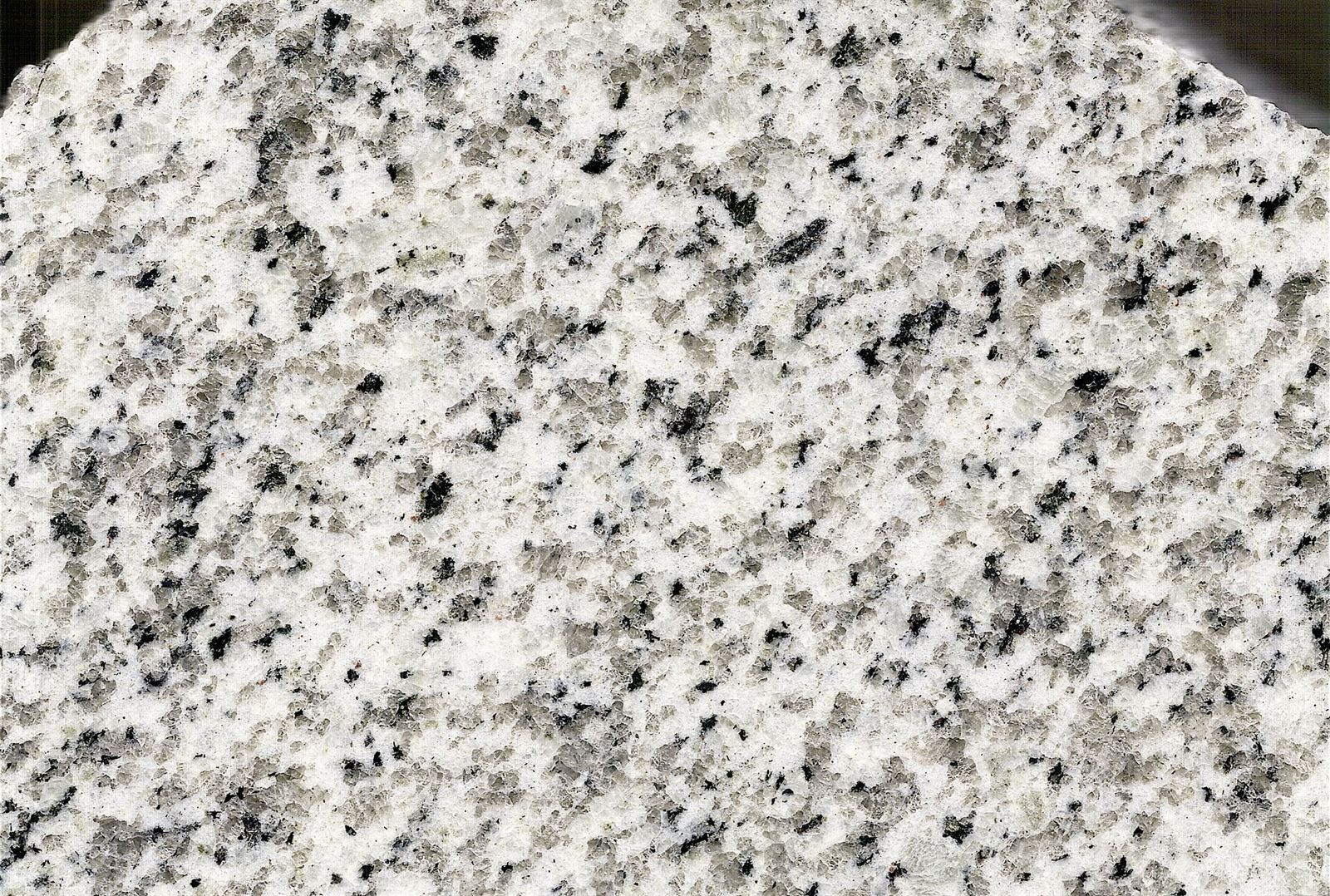
Granite is a coarse-grained igneous rock made mainly of feldspar and quartz, cut and finished as dimension stone. Its hardness suits wear surfaces and exteriors, so specify the stone name, finish, thickness, and ASTM C615 properties together.
Terminology
- True granite: igneous rock with 20 to 60 percent quartz by volume, with 35 to 90 percent of its feldspar as alkali feldspar
- Dimension stone: stone sawed, cut, split, or shaped to size; molded or cast units made from crushed stone are excluded
- Quarry source: the named quarry or region; color and veining vary between sources
History and demand
First uses in construction
- About 2510 BC, the Pyramid of Menkaure at Giza used granite blocks alongside limestone (Wikipedia)
- Granite and marble working are among the world's oldest stone industries, dating to ancient Egypt
- Imperial Roman granite came mainly from Egypt, with other sources in Turkey and on the islands of Elba and Giglio
Sourcing
- Leading quarrying countries: China, India, Italy, Brazil, Canada, Germany, Sweden, Spain, and the United States (Wikipedia, undated)
- United States dimension stone imports, 2021 to 2024, by value: Brazil 21 percent, Italy 19, China 17, India 16 (USGS, all dimension stone)
- United States 2025: granite was about 18 percent by tonnage of the 2.3 million tons of dimension stone sold or used, from 215 quarries and 150 companies (USGS)
- USGS does not publish state-level dimension stone output because most states have only one or two producers
Demand trend
- US producers sold or used about 2.3 million tons of dimension stone valued at $460 million in 2025, with limestone 46 percent, granite 18, and sandstone 17 (USGS)
Grades and types
- By color and pattern: named stones from named quarries, such as Red Aswan granite from Egypt
Properties
Physical
- Density: about 165 to 172 lb/ft3 (2.65 to 2.75 g/cm3)
- Composition: potassium feldspar, plagioclase feldspar, and quartz, with mica, pyroxene, and amphibole; average silica about 72 percent
Mechanical
- Compressive strength: usually above about 29,000 psi (200 MPa)
Standards
Material specifications
- ASTM C615: granite dimension stone for general building and structural purposes; properties are absorption, density, compressive strength, modulus of rupture, abrasion resistance, and flexural strength
Test methods
- ASTM C97: absorption and bulk specific gravity
- ASTM C170: compressive strength
Uses in buildings
Building elements
- Wall Cladding: anchored stone veneer and panels
- Countertops: polished and honed counter tops, valued for acid resistance and appearance
- Site Paving: paving, steps, and curbs
- Terrazzo: granite chips as aggregate
- Retaining Walls: cut stone and stacked stone walls
Pros and cons
Pros
- Very hard and durable
- Resists acids better than limestone and marble
- Wide range of colors and finishes
Cons
- Heavy and costly to quarry and transport
- Color and pattern vary between quarries and blocks
- Cutting releases crystalline silica dust, a worker health concern
Manufacturing and cost
Main manufacturers and suppliers
Trade association: Natural Stone Institute.
Sources
- Wikipedia: Granite, https://en.wikipedia.org/wiki/Granite
- USGS: Mineral Commodity Summaries 2026, stone (dimension), https://pubs.usgs.gov/periodicals/mcs2026/mcs2026-stone-dimension.pdf
- Stone World: how much natural stone does the US actually quarry, https://www.stoneworld.com/articles/95709-how-much-natural-stone-does-the-us-actually-quarry
- ASTM International: C615 granite dimension stone, https://store.astm.org/c0615_c0615m-23.html
- Image: Granite (cut & polished surface).jpg, James St. John, CC BY 2.0, https://commons.wikimedia.org/wiki/File:Granite_(cut_%26_polished_surface).jpg