Solar Thermal and Geothermal
Summary
Solar thermal systems heat water with collectors, and geothermal heat pumps exchange heat with the ground or a water body. Climate and available land decide the system type, because freeze risk limits solar water heaters and lot area limits ground loops.
Cols
Types
Solar water heating
- Active, direct circulation: pumps move household water through collectors; suited to climates that rarely freeze
- Active, indirect circulation: pumps move a heat-transfer fluid through collectors, with a heat exchanger to the potable water; drainback designs empty to a reservoir when pumps stop
- Passive, integral collector-storage: tanks in an insulated glazed box; best where temperatures rarely fall below freezing
- Passive, thermosyphon: natural convection; collector must sit below the tank, and roof structure must carry the heavy tank
- Collectors: flat-plate is most common; integral collector-storage and evacuated-tube are the other options
- Passive versus active: passive systems are generally cheaper and may last longer; active systems are more efficient
Geothermal heat pumps
- Horizontal closed loop: trenches about 5 to 10 ft deep below the frost line; generally most cost-effective for residential new construction with enough land
- Vertical closed loop: drilled boreholes; used where land for horizontal loops is limited, such as larger buildings
- Pond or lake closed loop: needs a water body at least 8 to 10 ft deep; potentially the lowest cost where available
- Open loop: pumps groundwater or surface water through the heat exchanger and returns it; the EPA regulates open-loop systems
Common issues
- Freeze protection: drainback, glycol indirect loops, or recirculation; recirculation needs electrical power and is not SRCC-approved
- Site constraints: ground loops need land or boreholes; confirm local drilling and well rules
Sources
- U.S. Department of Energy: geothermal heat pumps, https://www.energy.gov/sites/default/files/2021-08/ES-Geothermal heat pumps_080221.pdf
- Montana Department of Environmental Quality: geothermal heat pump fact sheet, https://deq.mt.gov/files/Water/WPB/NRISReports/Fact Sheets/Factsheet_120_Geothermal.docx
- U.S. Department of Energy (archived): everything you wanted to know about solar water heating systems, https://webarchive.library.unt.edu/web/20170122064830/https://energy.gov/energysaver/articles/everything-you-wanted-know-about-solar-water-heating-systems
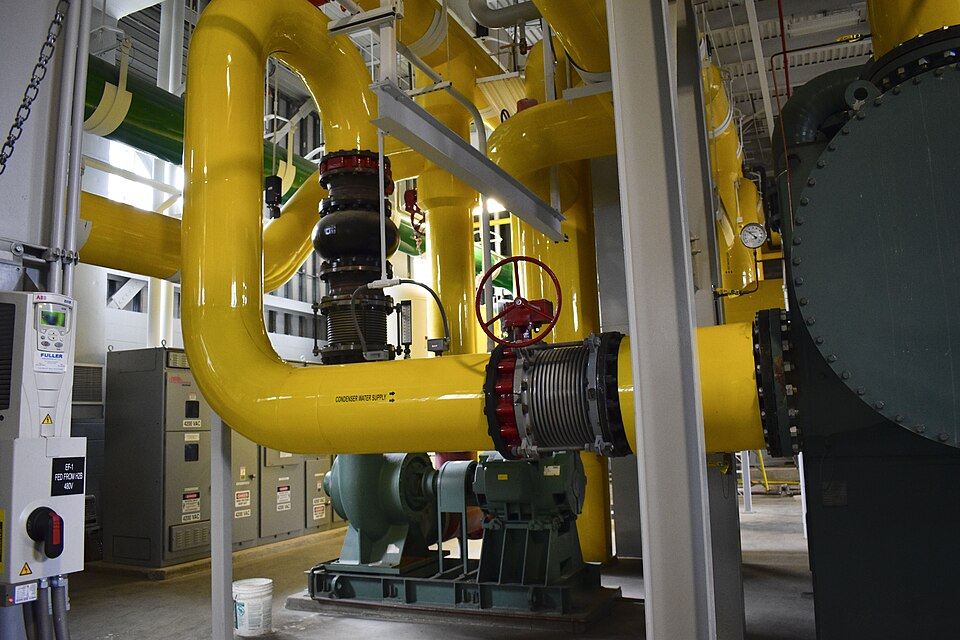
- Wikimedia Commons: 20190425-BSU Heat-Pump-04.jpg, by Paul Gipe (CC BY-SA 4.0), https://commons.wikimedia.org/wiki/File:20190425-BSU_Heat-Pump-04.jpg