Whole-Building Life Cycle Assessment
Summary
Whole-building life cycle assessment totals the environmental impact of a building across its life stages, using the module structure of EN 15978. Results depend on which modules are counted, so the boundary and study period must be stated before any carbon figure is compared.
Cols
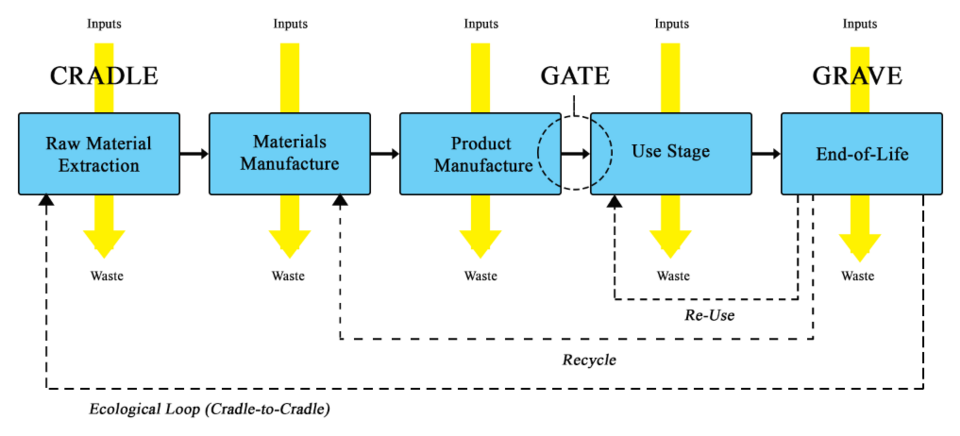
Terminology
- Product stage (A1 to A3): raw material supply, transport, and manufacturing
- Construction stage (A4 to A5): transport to site and construction
- Use stage (B1 to B7): use, maintenance, repair, replacement, refurbishment, operational energy and water
- End of life (C1 to C4): demolition, transport, waste processing, disposal
- Module D: benefits and loads beyond the system boundary; reported separately and never added to totals
- Upfront carbon: modules A1 to A5, emitted before the building is handed over
- Whole-life carbon: the sum of modules A to C over the reference study period
Standards
- EN 15978: module structure for whole-building assessment
- Cradle-to-gate (A1 to A3): the usual boundary for product EPDs
- Cradle-to-grave (A1 to C4): the boundary for whole-life assessment
- Convention differences: some sources include B1 to B5 in embodied carbon and treat B6 to B7 as operational; others use the full B1 to B7 range; confirm the convention before comparing results
Coordination
- Inputs: quantities from the design model and EPDs or generic data for each material
- Operational energy: modeled separately; see the energy modeling note
Sources
- Green Calculus: EN 15978 whole-building methodology, https://greencalculus.com/methodology/en-15978-whole-building-methodology/
- Studio Matrx: life cycle stages of a building, https://www.studiomatrx.org/students/embodied-carbon-and-life-cycle-design/life-cycle-stages-of-a-building
- Wikimedia Commons: Example Life Cycle Assessment Stages diagram.png, by MtW17 (CC BY-SA 4.0), https://commons.wikimedia.org/wiki/File:Example_Life_Cycle_Assessment_Stages_diagram.png