Medium-Density Fiberboard
Summary
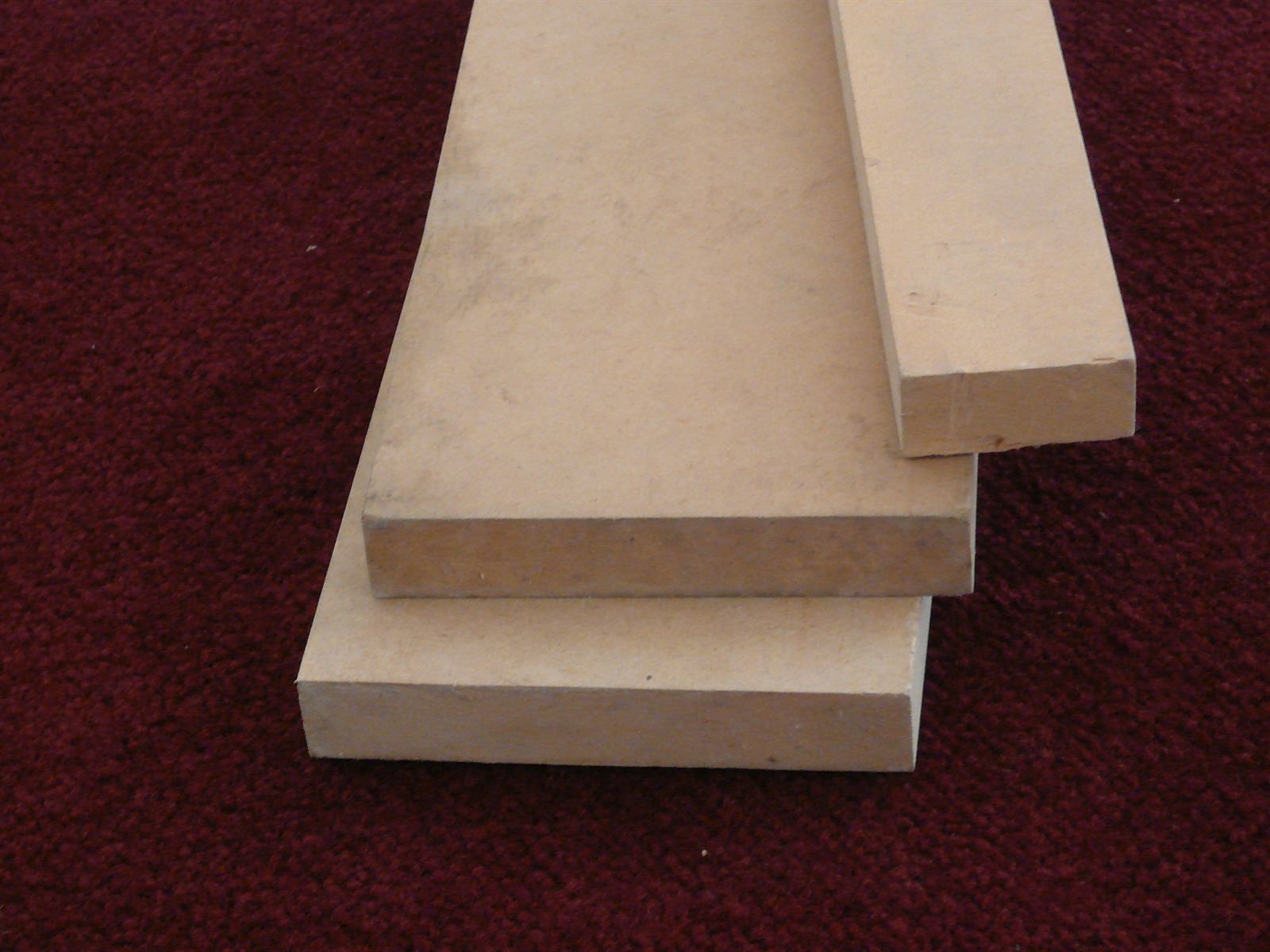
Medium-density fiberboard is an engineered panel made from hardwood or softwood residuals broken into fiber, combined with wax and a resin binder and hot-pressed, at a typical density of 600 to 800 kg/m³. Its uniform, smooth surface suits painted trim and cabinetry, but poor moisture resistance limits it to interior use and edges need sealing.
Cols
Terminology
- MDF: medium-density fiberboard
- MDF.H / MDF.LA: European classes for humid use / load-bearing dry use (EN 622-5)
- E0 / E1 / E2: formaldehyde emission classes
- Blowline: where wax and resin are blended with the fiber
- Veneered MDF: lower-cost alternative to hardwood
History and demand
Invention
- Large-scale production began in the 1980s in North America and Europe
Sourcing
- Wood-based panels overall: China about 41 to 45 percent of world output, the United States about 8 to 12 percent, India and Russia about 4 to 5 percent each (FAO editions); world panel production was 381 million m3 in 2023
- One market report puts China at about 55 million m3 of MDF, 54 percent of the total, with Turkey second at 4.8 million m3 and Brazil third at 4.5 million (IndexBox, year not stated)
Composition and production
Manufacturing process
- Chips briefly heated and defibrated, blended with wax and urea-formaldehyde resin in a blowline, dried, formed into a mat, and hot-pressed in stages, giving denser faces and a less dense core
Properties
Physical
- Density: generally 500 to 1,000 kg/m³ (31 to 62 lb/ft³); typical 600 to 800 kg/m³ (37 to 50 lb/ft³)
Mechanical
- Typical modulus of rupture: 40 MPa (5.8 ksi); modulus of elasticity: 3 GPa (435 ksi)
- Uniform, no knots, holds screws well in the face; edge screws may split without pilot holes; dulls tools quickly
Thermal and moisture
- Poor moisture resistance; low-grade boards swell when saturated and unsealed boards may warp in humid conditions; moisture-resistant grades exist
Standards
Material specifications
- ANSI A208.2: medium-density fiberboard
- EN 622-5: European MDF classes
Uses in buildings
Building elements
- Stile and Rail Wood Doors: paint-grade stiles, rails, and panels
- Interior Millwork: painted trim and moldings
- Cabinetry and Casework: cabinet doors and carcases
Pros and cons
Pros
Cons
- Poor moisture resistance
- Cutting releases large amounts of dust
- Emits formaldehyde and other VOCs for at least several months after manufacture
Sustainability
Health
- IARC classifies formaldehyde as a known human carcinogen; sealing all sides when painting is recommended
Sources
- Wikipedia: Medium-density fibreboard, https://en.wikipedia.org/wiki/Medium-density_fibreboard
- Wikimedia Commons: MDF Sample.jpg, photo by Vaderluck (CC BY-SA 3.0), https://commons.wikimedia.org/wiki/File:MDF_Sample.jpg
- FAO: global forest products facts and figures 2023, https://sfcs.fao.org/newsroom/detail/global-forest-products-facts-and-figures-2023-shows-fall-in-global-trade-in-wood-and-paper-products/en
- FAO: forest product data, https://www.fao.org/forestry/statistics/data/en