Cross-Laminated Timber
Summary
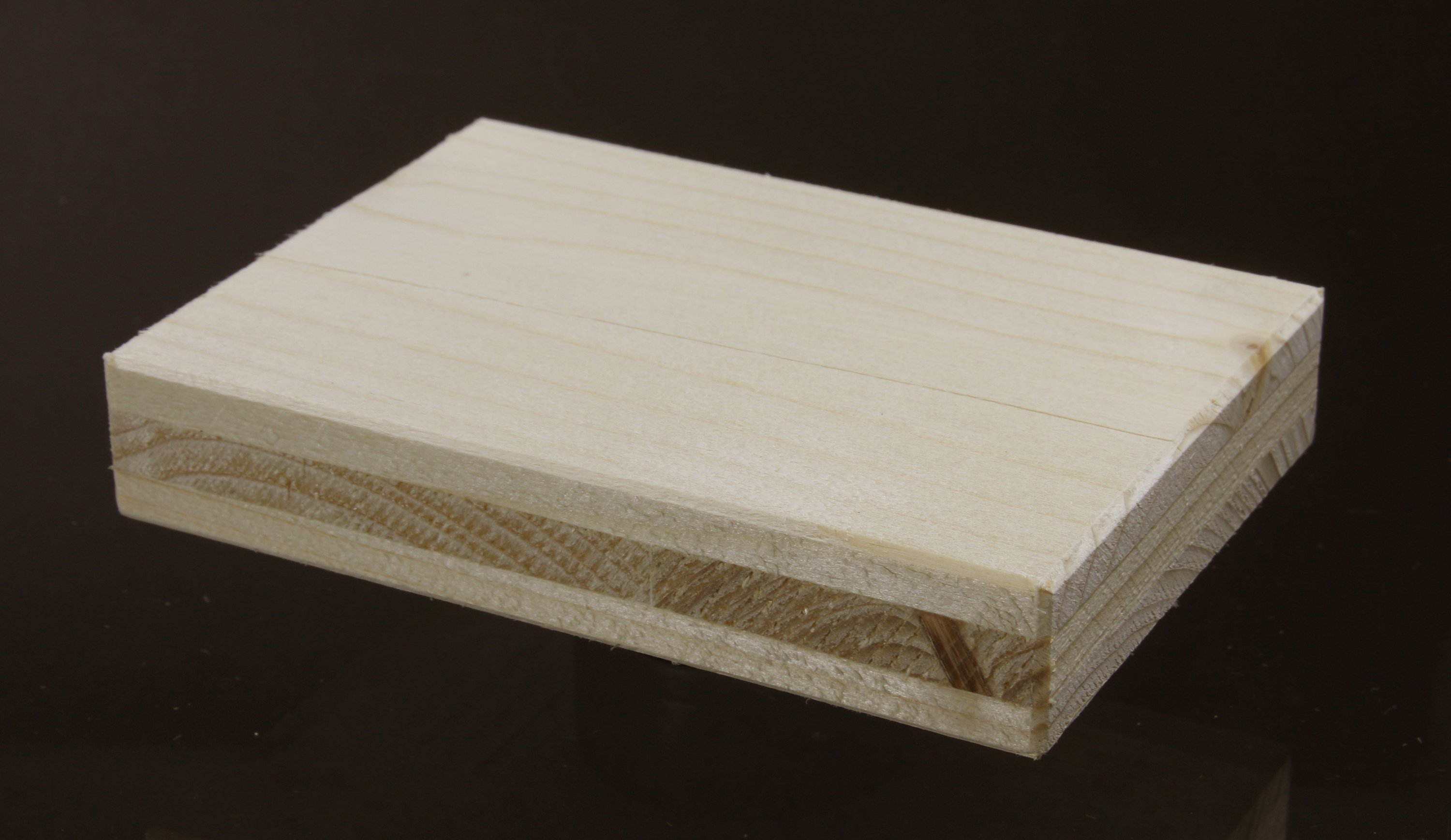
Cross-laminated timber is an engineered panel made by gluing at least three layers of solid-sawn lumber at angles to each other, usually with the grain rotated 90 degrees between layers. Its in-plane and out-of-plane strength is comparable to a reinforced concrete slab, so it frames walls, floors, and roofs in mass timber buildings.
Cols
Terminology
- CLT: cross-laminated timber
- Mass timber: large engineered wood panels and members (CLT, glulam)
- Layer (lamella): a board layer; layers are thicker than plywood plies
- PRF / PUR: phenol resorcinol formaldehyde / polyurethane-reactive adhesives
- REI 90: keeps load-bearing capacity and integrity for 90 minutes
- C-CLT: Circular CLT made from reclaimed wood (Netherlands, 2024)
History and demand
Invention
- 1920s: early United States patents; 1985: French patent
- 1994: Gerhard Schickhofer's doctoral research led to Austrian approval in 1998 and growth in Germany and elsewhere
First uses in construction
- 2002: Austria issued the first national CLT guidelines; 2015: EN 16351, the first European product standard
- 2015: CLT entered the International Building Code; 2021 IBC added mass timber Types IV-A, IV-B, and IV-C
- Examples: Stadthaus, London (2009); Forte Living, Melbourne (2012); Ascent MKE, Milwaukee (2022)
Sourcing
- Austria, Germany, Switzerland, Italy, and the Czech Republic produced about 1.42 million m3 of CLT in 2024; Austria exported 467,000 m3 and Germany about 84,000 m3
- German-speaking countries held just under 80 percent of global capacity in 2015, with Austria about 60 percent; one market report now puts Austria near 30 percent (Timber-Online)
Demand trend
- Rising: Katerra opened a large CLT modular factory in Spokane, Washington, in 2019; Circular CLT introduced in the Netherlands in 2024
Composition and production
Raw materials
- Sawn lumber layers glued with PRF or PUR adhesive, applied by extruder heads or side-by-side nozzles
Manufacturing process
- Planing removes about 2.5 mm from the top and bottom faces and 3.8 mm from the sides; sanding holds thickness to a 1 mm tolerance
Product forms
- Panels limited in length by site storage and transport
Properties
Mechanical
- Perpendicular layers give high in-plane and out-of-plane strength and stiffness, comparable to a reinforced concrete slab; performs well under seismic forces
Fire behavior
- Combustible; D-class reaction to fire but REI 90; unprotected steel loses load-bearing capacity after about 15 minutes
Standards
Material specifications
- ANSI/APA PRG 320: cross-laminated timber
- EN 16351: European CLT product standard
Uses in buildings
Building elements
- Mass Timber Walls: load-bearing wall and shear panels
- Mass Timber Floors and Roofs: floor and roof slabs spanning between beams or walls
- Timber Bridges: bridge decks and parking garage slabs
Pros and cons
Pros
- Strength and stiffness comparable to a reinforced concrete slab
- Sequesters carbon
- Prefabricated
Cons
- Combustible, though it chars predictably
- Panel length limited by transport
Sustainability
Embodied carbon
- Sequesters carbon because it is wood
Sources
- Wikipedia: Cross-laminated timber, https://en.wikipedia.org/wiki/Cross-laminated_timber
- UpCodes: 2024 IBC Chapter 23 wood, https://up.codes/viewer/department-of-defense/ibc-2024/chapter/23/wood
- Wikimedia Commons: Fichte Dreischichtplatte 2009.jpg, photo by Elke Wetzig (elya) (CC BY-SA 3.0), https://commons.wikimedia.org/wiki/File:Fichte_Dreischichtplatte_2009.jpg
- Timber-Online: cross-laminated timber as export success, https://www.timber-online.net/wood_products/2025/04/cross-laminated-timber-as-export-success.html
- Timber-Online: biggest CLT producers, https://www.timber-online.net/blog/biggest-clt-producers.html