Daylighting Metrics
Summary
Spatial daylight autonomy (sDA) measures how much floor area gets enough daylight, and annual sunlight exposure (ASE) measures how much gets too much direct sun. They are read together, because high sDA with high ASE signals glare, and rating systems score both.
Cols
Terminology
- DA (daylight autonomy): percent of occupied hours (8 AM to 6 PM) a sensor point reaches 300 lux
- sDA 300/50: share of regularly occupied floor area that reaches 300 lux for at least 50 percent of occupied hours (IES LM-83-12)
- ASE 1000,250: share of floor area receiving direct sun of 1,000 lux or more for more than 250 occupied hours per year
- UDI (useful daylight illuminance): companion metric for the useful illuminance range
Standards
- Desirable range: 300 to 3,000 lux
- LEED v4.1 sDA thresholds: 40 percent for 1 point, 55 percent for 2 points, 75 percent for 3 points; thresholds differ between LEED versions
- Glare limit: ASE above 10 percent must be addressed or the project fails all LEED daylighting credits; target 10 percent or less for minimum glare protection
Coordination
- Glazing and shading: control ASE with shading and glazing selection
- Model: daylight metrics come from a climate-based simulation
Sources
- Kalwall: daylighting metrics, https://kalwall.com/daylight-modeling/daylighting-metrics
- LEEDuser: daylighting credit guidance, https://leeduser.buildinggreen.com/credit/CI-v4.1/EQc7
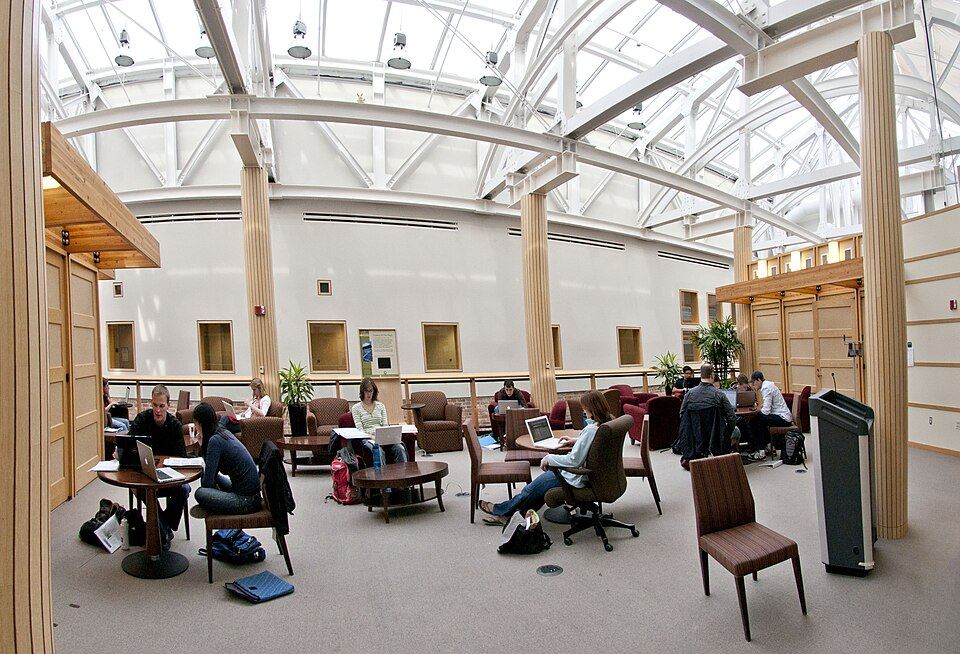
- Wikimedia Commons: Dana Building, Dow Commons (6505430137).jpg, by University of Michigan School for Environment and Sustainability from Ann Arbor (CC BY 2.0), https://commons.wikimedia.org/wiki/File:Dana_Building,_Dow_Commons_(6505430137).jpg