Quartz
Summary
Quartz is the silicon dioxide mineral found in granite, sandstone, and sand, and the name used for engineered quartz surfaces made of stone aggregate bound in resin. Engineered quartz is a manufactured product with its own production process, so specify it as a surfacing material and treat fabrication dust as a silica hazard.
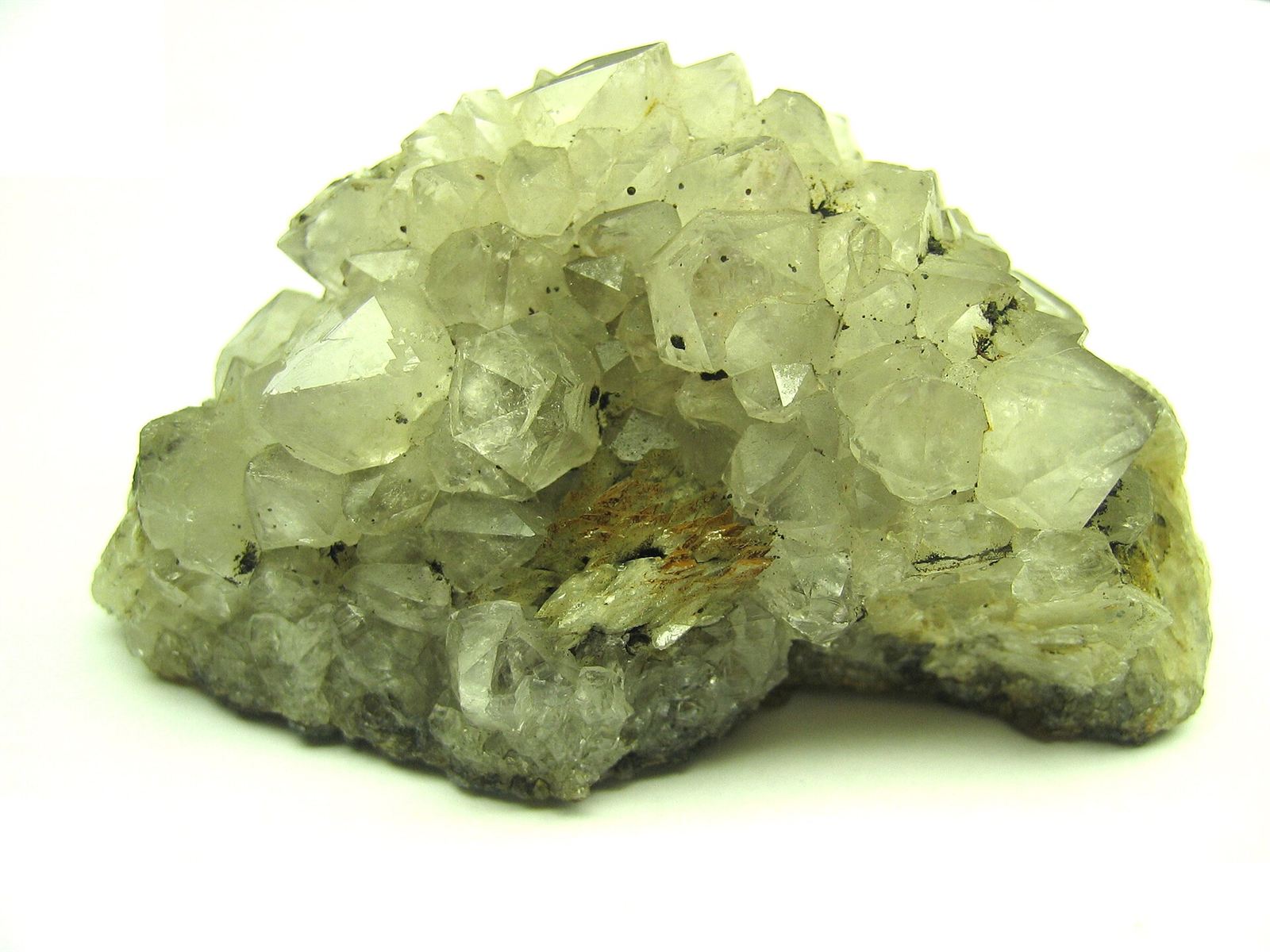
Terminology
- Quartz (mineral): silicon dioxide (SiO2) in a framework of silicon-oxygen tetrahedra
- Alpha and beta quartz: the room-temperature and high-temperature forms; beta converts to alpha at 573 degrees C
- Engineered quartz: slab surfacing made of stone aggregates and polyester resin
- Bretonstone: the vibrocompression process developed by Breton
History and demand
Invention
- Breton, founded in 1963 in Castello di Godego, Treviso, by Marcello Toncelli, began as a maker of natural stone machinery and calls its engineered product the first mineral surface produced on an industrial scale
- Sources disagree on when the engineered-stone process was developed: one places it in the early 1970s, another credits Breton with introducing the resin-bound composite in the late 1980s
- The process uses vibrocompression under vacuum: the mix is vibrated, pressed, and heated
First uses in construction
- Engineered quartz slabs entered building use as counter and surfacing material after the Breton process; the sources checked give no dated first project
- No dated first construction use of the quartz mineral itself was found in the sources checked
Sourcing
- Quartz mineral: Brazil is the most frequently named source; the Spruce Pine district of North Carolina is a major source of high-purity quartz
- Engineered quartz is made in slab plants; the sources checked did not give a verified producer-country breakdown
Demand trend
- No dated demand figure was found in the sources checked
Composition and production
Raw materials
- Engineered quartz: about 93 percent stone aggregates and 7 percent polyester resin by weight in one description; a manufacturer also puts resin at about 7 percent
Manufacturing process
- Aggregate and resin are mixed, then vibrated, pressed, and heated under vacuum into slabs
Properties
Physical
- Hardness: Mohs 7 for the quartz mineral
- Specific gravity: about 2.65 for quartz (about 165 lb/ft3)
Standards
Material specifications
- ASTM C616: quartz-based natural dimension stone, such as sandstone and quartzite
Uses in buildings
Building elements
- Countertops: engineered quartz slabs for counter and vanity tops
- Wall Cladding: quartz-based natural stone panels
Pros and cons
Pros
- Consistent color and pattern in engineered slabs
Cons
- Less tolerant of extreme heat than granite
- Cutting and grinding releases respirable crystalline silica; OSHA sets a limit of 50 micrograms per cubic meter as an 8-hour average
Manufacturing and cost
Main manufacturers and suppliers
Trade association: Natural Stone Institute.
Sources
- Wikipedia: Quartz, https://en.wikipedia.org/wiki/Quartz
- Breton: the story of Bretonstone, https://breton.it/services/articles/story-of-bretonstone
- Stone World: more than three decades of progression, https://www.stoneworld.com/articles/86906-more-than-three-decades-of-progression-
- MSI: what is quartz and how is it made, https://www.msistone.com/blogs/post/2016/12/01/tips-from-the-trade-what-is-quartz-and-how-is-it-made.aspx
- OSHA: silica hazard alert, https://www.osha.gov/dts/hazardalerts/silica_hazard_alert.html
- Image: Unknown Quartz crystal 67.JPG, Jon Zander (Digon3), CC BY-SA 3.0, https://commons.wikimedia.org/wiki/File:Unknown_Quartz_crystal_67.JPG