Energy and Heat Recovery Ventilators
Summary
Energy recovery ventilators and heat recovery ventilators bring in outdoor air and exhaust stale air through a heat exchanger, a plate core or rotating wheel, that transfers sensible heat (HRV) or heat and moisture (ERV) between the streams. They cut the energy cost of required ventilation and are often required by energy codes for high outdoor air systems, but intake and exhaust separation, frost control, filtration, and duct routes must be coordinated.
Cols
Terminology
- HRV: heat recovery ventilator; sensible heat transfer only
- ERV: energy recovery ventilator; sensible and latent (moisture) transfer
- Enthalpy wheel: rotating desiccant-coated wheel; common in commercial units
- Plate (fixed) core: cross-flow or counterflow heat exchanger, often enthalpy membrane for ERVs
- Run-around coil / heat pipe: recovery between separated airstreams without mixing
- Effectiveness / recovery ratio: fraction of energy recovered
- EATR: exhaust air transfer ratio; leakage of exhaust into supply
- Frost control: preheat, bypass, or defrost cycles in cold climates
- DOAS with energy recovery: dedicated outdoor air unit with integral wheel or core
Standards
Ratings
- Commercial wheels can recover up to about 80 percent of the energy in the exhaust stream
- One utility program defines qualifying ERVs at 75 percent enthalpy recovery and HRVs at 75 percent sensible recovery at design conditions
- Energy recovery reduces cooling capacity by roughly 2.5 tons per 1,000 cfm of outdoor air as a rule of thumb
Test standards
- AHRI 1060: air-to-air energy recovery ventilation equipment ratings
- ASHRAE 84: test method for air-to-air heat and energy exchangers
- HVI ratings: residential HRV and ERV performance
Components
- Heat exchanger: wheel, plate core, or heat pipe
- Supply and exhaust fans: ECM motors
- Filters: on both airstreams
- Bypass dampers: for economizer and frost control
- Controls: schedules, CO2 or occupancy-based ventilation where allowed
Detailing
- Separate outdoor air intakes from exhaust outlets per code distances
- Use ERVs where humidity control matters; HRVs where moisture should be removed in winter
- Avoid ERVs where contaminants could transfer (lab, toilet exhaust with wheels needs care)
- Provide access for filter and core service
- Insulate outdoor air and exhaust ducts inside the building
Uses
Specific uses
- High-performance and multifamily homes
- Schools and offices with high ventilation rates
- DOAS for VRF and fan coil buildings
- Hotels and dormitories
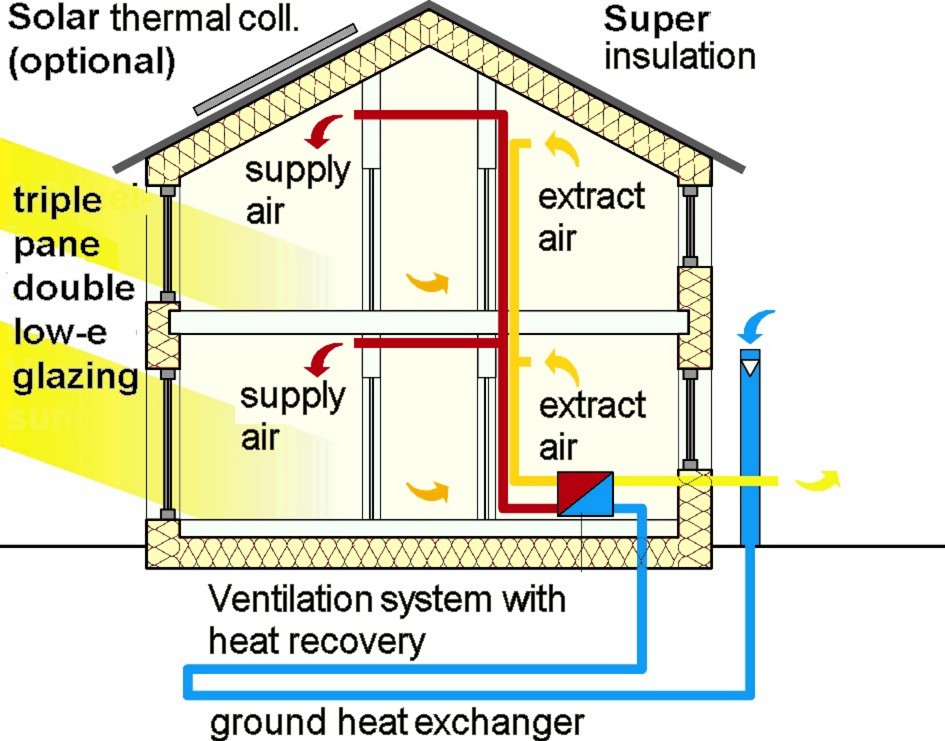
- Passive house projects
Pros and cons
Pros
- Lower heating and cooling energy for ventilation
- Smaller heating and cooling equipment
- Balanced ventilation and better indoor air quality
- ERVs moderate indoor humidity
Cons
- More equipment, ducts, and maintenance
- Frost control needed in cold climates
- Cross-contamination risk with some wheels
- Fan energy and pressure drop
Manufacturing and cost
Construction
- Units installed in mechanical rooms, ceilings, or on roofs; ducted to outdoors and to spaces; balanced at commissioning
Main manufacturers and suppliers
Trade associations: AHRI and ASHRAE.
Sources
- Facility Executive: the HVAC factor, energy recovery ventilation, https://facilityexecutive.com/the-hvac-factor-energy-recovery-ventilation
- Mass Save: commercial energy recovery ventilators, https://www.masssave.com/business/rebates-offers-services/heating-and-cooling/energy-recovery-ventilators
- Green Building Advisor: HRV or ERV, https://www.greenbuildingadvisor.com/question/hrv-or-erv-or-neither
- VA: 23 72 00 air-to-air energy recovery equipment specification, https://www.wbdg.org/FFC/VA/VAASC/VA 23 72 00.docx
- Wikimedia Commons: Passivhaus section en.jpg, by Passivhaus Institut (CC BY-SA 3.0), https://commons.wikimedia.org/wiki/File:Passivhaus_section_en.jpg