Lightweight Aggregate
Summary
Lightweight aggregate is made by heating clay in a rotary kiln at about 1,200°C so trapped gases form bubbles, giving rounded particles of 250 to 510 kg/m³. It cuts dead load in concrete and fill and gives drainage and some insulation, with thermal conductivity as low as 0.097 W/(m·K).
Cols
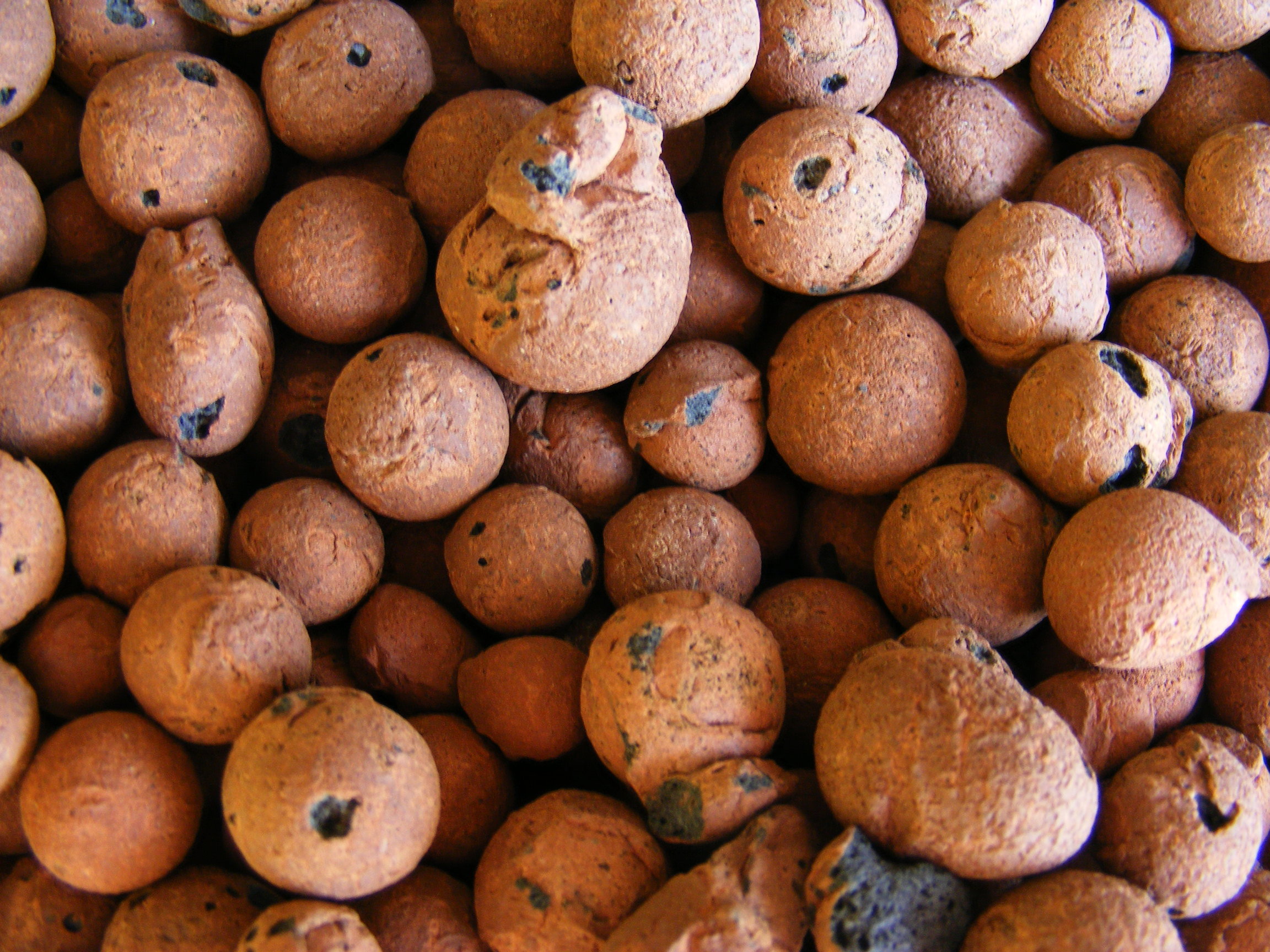
Terminology
- LECA: lightweight expanded clay aggregate
- Haydite: early patented expanded-shale aggregate
- Boulder LECA: 100 to 500 mm pieces at about 500 kg/m³
- Specialty lightweight aggregates: clay, pumice, perlite, vermiculite
History and demand
Invention
- About 1917: developed in Kansas City, Missouri, following the patented aggregate haydite; used in the SS Selma, launched in 1919
- The technology later spread to Denmark, Finland, Germany, the Netherlands, and the United Kingdom
Sourcing
- Arcosa Lightweight is the largest producer of rotary-kiln expanded shale and clay lightweight aggregate in North America (market research)
Composition and production
Manufacturing process
- Clay heated to about 1,200°C (2,190°F) in a rotary kiln; gases expand into thousands of small bubbles; the kiln's circular motion rounds the particles
Product forms
- Particles from 0.1 to 25 mm, commonly 0 to 4, 4 to 10, and 10 to 25 mm
Properties
Physical
- Density: 250, 280, 330, and 510 kg/m³ (about 16, 17.5, 21, and 32 lb/ft³) for listed grades
Thermal and moisture
- Thermal conductivity: as low as 0.097 W/(m·K), about 0.67 Btu·in./(h·ft²·°F)
Mechanical
- Compression: incompressible under permanent pressure and gravity loads
Uses in buildings
Building elements
- CMU Walls: lightweight concrete block
- Vegetated Roofs: lightweight drainage and growing media
- Site Drainage: drainage and groundwater control fill
Pros and cons
Pros
- Density 250 to 510 kg/m³
- Low thermal conductivity
- Rounded, free-draining particles
Cons
- Production needs a 1,200°C kiln
Manufacturing and cost
Main manufacturers and suppliers
Trade association: Expanded Shale, Clay and Slate Institute.
Sources
- Wikipedia: Expanded clay aggregate, https://en.wikipedia.org/wiki/Expanded_clay_aggregate
- Wikipedia: Construction aggregate, https://en.wikipedia.org/wiki/Construction_aggregate
- Wikimedia Commons: Hydroton.jpg, photo by Lucis (CC BY-SA 3.0), https://commons.wikimedia.org/wiki/File:Hydroton.jpg
- MarketsandMarkets: lightweight aggregates companies, https://www.marketsandmarkets.com/ResearchInsight/lightweight-aggregates-companies.asp