NEC EV Charging, Solar PV, and Energy Storage
Summary
EV charging, solar PV, and energy storage are covered by NEC Articles 625, 690, 705, and 706 (with new Articles in 2026), plus fire code roof setbacks and equipment listings. These systems take electrical room space, wall space, roof area, and disconnects, so reserve them in the design even when the equipment is installed later.
Cols
Scope
- Cites the 2023 NEC for Articles 625 and 706 provisions confirmed in 2023 sources, the 2026 NEC changes as described in 2026 summaries, IFC 2024 Section 1205, and IBC 2024 Section 1505.9. Always verify the adopted code edition and local amendments for the project jurisdiction
- Covers requirements that affect space, siting, and coordination. Equipment products and costs are in the Building Elements notes on EV charging equipment and rooftop solar PV
- EV charging readiness requirements in the energy code and accessible EV spaces are not covered because the section text was not verified
- Electrical design of the systems (conductor sizing, inverter selection) is by the electrical engineer or installer
Terminology
- EVSE (electric vehicle supply equipment): the charger and its connectors
- Continuous load: a load expected to run for 3 hours or more; sized at 125 percent
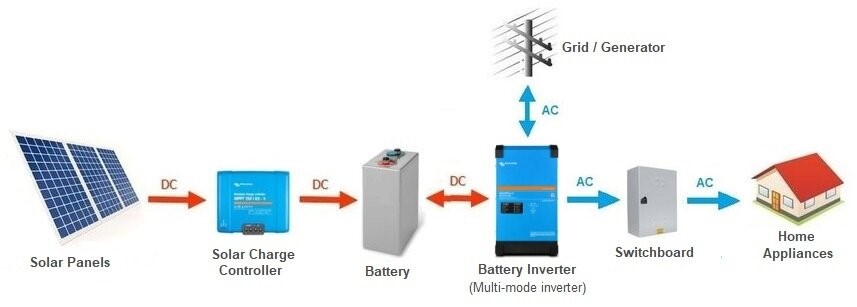
- Photovoltaic (PV) system: modules that make electricity from sunlight, with inverters and wiring
- Rapid shutdown: a function that reduces PV conductor voltage quickly for firefighter safety
- Array boundary: the edge of the PV array, used to define where shutdown limits apply
- Interconnection: the connection of a PV system to the building's wiring and the utility
- Energy storage system (ESS): batteries and associated equipment that store electricity
- Emergency shutdown: a disconnect that de-energizes an ESS
- Power control system: a listed system that limits loads or sources to stay within a rating
- Ridge setback: the clear zone at the roof ridge left free of PV panels for firefighter access
Requirements
EV charging
- NEC 2023, Sections 625.40, 625.41, and 625.42: EVSE needs an individual branch circuit (no other outlets) for equipment above 16 A or 120 V; EVSE is a continuous load; the branch circuit is sized at 125 percent of the maximum continuous load
- NEC 2023, Section 625.54: cord-and-plug EVSE is supplied through a GFCI-protected receptacle; direct-connected EVSE needs GFCI only where the manufacturer's instructions require it
- NEC 2026, Article 625: electric vehicle power transfer systems; the 2026 edition adds Article 624 for self-propelled vehicle power transfer, with circuits supplying them protected under Sections 210.20 and 240.4
- NEC 2026, Section 120.7: a listed power control system may set loads for sizing the service, feeders, and branch circuits
Solar PV
- NEC 2026, Section 690.12: rapid shutdown limits conductors outside the array boundary to 30 V within 30 seconds, and conductors inside the array boundary to 80 V
- NEC 2023, Section 690.12: the 2023 cycle added an exception for non-enclosed detached structures and reorganized the building-related subsections
- NEC 2026, Article 705: interconnected power production sources
- NEC 2026, Section 230.70(D): plaques or directories identify disconnects for alternate energy sources not next to service equipment
- IFC 2024, Section 1205: roof access for solar PV, with ridge setbacks of 18 in. on each side for arrays covering up to 33 percent of the plan roof area and 36 in. above that, with 66 percent thresholds in sprinklered dwellings
- IBC 2024, Section 1505.9: rooftop PV panel systems have a fire classification under UL 2703, are installed per the manufacturer's instructions and listing, and meet the Table 1505.1 classification for the building's construction type
Energy storage
- NEC 2023, Sections 706.15, 706.30, and 706.31: the ESS disconnect is readily accessible and marked, with emergency shutdown in one- and two-family dwellings; overcurrent devices and output conductors are sized at 125 percent of the ESS current rating
- NEC 2026, Section 706.16: deleted; most energy storage systems fall under Article 702 for optional standby
- NEC 2026, Section 702.4: power control systems for inverter-based systems in dwellings
- ESS emergency shutdown and PV rapid shutdown are separate functions
Worked examples
EV charger circuit
A 7.2 kW charger at 240 V.
| Step | Calculation | Result |
|---|---|---|
| Charger current | 7,200 ÷ 240 | 30 A |
| Branch circuit at 125 percent | 30 × 1.25 | 37.5 A |
| Breaker | Next standard size | 40 A, individual circuit |
| Receptacle option | Cord-and-plug | GFCI protected, EVSE listed receptacle in 2026 |
Rapid shutdown
A rooftop array on a commercial building.
| Step | Requirement | Result |
|---|---|---|
| Outside the array boundary | 30 V within 30 seconds | Module-level shutdown or rapid shutdown device |
| Inside the array boundary | 80 V | Array wiring within the limit |
| Disconnect and labels | Section 230.70(D) plaque | Directory at the service equipment |
Roof layout
A 40 ft by 30 ft plan roof area with a center ridge along the 40 ft dimension.
| Step | Calculation | Result |
|---|---|---|
| Plan roof area | 40 × 30 | 1,200 sq ft |
| Array at 33 percent | 1,200 × 0.33 | 396 sq ft maximum with 18 in. ridge setbacks |
| Larger array | Over 33 percent | 36 in. ridge setbacks |
| Panel area at 400 sq ft | Over 33 percent | Use 36 in. setbacks and fewer panels near the ridge |
Coordination
- Electrical room and wall space: inverters, battery cabinets, EV panels, and disconnects need working space and wall area
- Roof structure and layout: array loads, setbacks for firefighter pathways, equipment curbs, and cable routes
- Fire department: pathways, rapid shutdown labels, and battery room signage may be required locally
- Parking and civil: EV spaces, conduit to future spaces, and trenching affect the site plan
- Utility interconnection: applications and equipment approvals for solar and storage
- Service size: EV charging and electrification loads raise the load calculation; consider power control systems
- Insurance and listing: UL 2703 racking, UL 1741 inverters, and listed batteries
Common issues
- Roof setbacks missed: panel count drops after fire access pathways are drawn
- Battery location: an ESS in a garage or room needs listing, spacing, and protection; coordinate with the fire code official
- Ground-fault protection on EV receptacles: cord-and-plug units need GFCI
- Service upgrade late: EV and storage loads discovered after the electrical design
- Edition changes: 2026 moves energy storage rules between articles
- Missing plaque: other-source disconnect directories are required in 2026
Standards
- UL 2703: mounting systems and clamping devices for PV modules
- UL 1741: inverters, converters, and interconnection equipment
- UL 2202 and UL 2594: EV supply equipment
Sources
- Solar Builder: what to know about the 2026 National Electrical Code, https://solarbuildermag.com/featured/what-to-know-about-the-2026-national-electrical-code/
- SurgePV: NEC 2026 rapid shutdown, https://www.surgepv.com/blog/nec-2026-rapid-shutdown-solar
- IAEI Magazine: NEC 2026 significant code changes, https://iaeimagazine.org/standards/nec-2026-significant-code-changes/
- Douglas County, CO: 2024 Appendix Chapter Q solar provisions (IFC Section 1205), https://www.douglasco.gov/wp-content/uploads/2026/06/Exhibit-E-2024-Chapter-Q.pdf
- UpCodes: 2024 IBC Chapter 15 roof assemblies and rooftop structures (Department of Defense adoption), https://up.codes/viewer/department-of-defense/ibc-2024/chapter/15/roof-assemblies-and-rooftop-structures
- DOE Building America Solution Center: Layout of a DC-coupled solar battery system, https://basc.pnnl.gov/information/pv-battery-storage-power-outages