Fly Ash
Summary
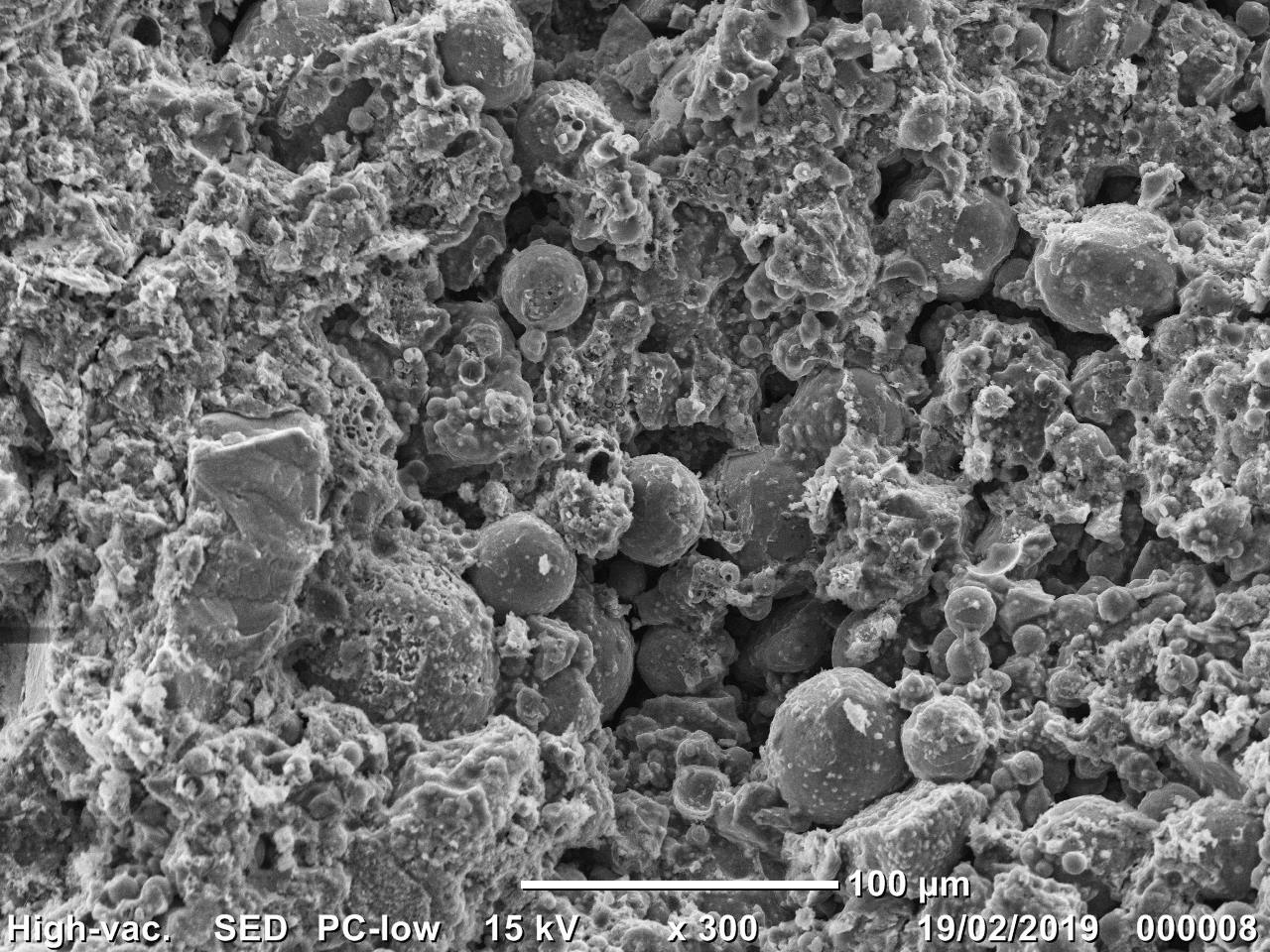
Fly ash is the fine, spherical, mostly glassy particulate captured from the flue gas of coal-fired power plants. It replaces part of the portland cement in concrete, improving workability and durability and lowering heat of hydration.
Cols
Terminology
- Class F (ASTM C618): from anthracite and bituminous coal; CaO below 7 percent; needs an activator or cement to set
- Class C (ASTM C618): from lignite or subbituminous coal; CaO above 20 percent; self-cementing; higher alkali and sulfate
- Pozzolan: silica-rich material that reacts with lime to form cementitious compounds
- Coal combustion products (CCPs): fly ash, flue-gas desulfurization material, bottom ash, and boiler slag
History and demand
First uses in construction
- Pozzolan use recognized as early as 1914; earliest noteworthy study cited as 1937
Sourcing
- 2024: 24.7 million short tons of fly ash produced in the US, 78 percent reused
- China is the largest producer of coal fly ash, about 550 million tons in 2018
Demand trend
- More than 65 percent of fly ash from coal plants worldwide goes to landfills and ash ponds
Composition and production
Raw materials
- Particles spherical, about 0.5 to 300 µm, mostly amorphous glass
- Bituminous: SiO2 20 to 60 percent, Al2O3 5 to 35, Fe2O3 10 to 40, CaO 1 to 12; subbituminous: SiO2 40 to 60, Al2O3 20 to 30, Fe2O3 4 to 10, CaO 5 to 30; lignite: SiO2 15 to 45, Al2O3 20 to 25, Fe2O3 4 to 15, CaO 15 to 40
Properties
Physical
- Fineness (US practice): at least 75 percent passes 45 µm
- Loss on ignition: under 6 percent (US)
Standards
Material specifications
- ASTM C618: coal fly ash and raw or calcined natural pozzolan for use in concrete
Uses in buildings
Building elements
- Cement replacement in all concrete elements, typically up to about 30 percent by mass; high-volume mixes about 50 percent
- Site Paving: embankments, flowable fill, soil stabilization, and asphalt filler
Pros and cons
Pros
- Pozzolanic strength gain, better workability, lower water demand
- Reduced heat of hydration and better chemical resistance
- Diverts coal ash from landfills
Cons
- Class F fly ash needs cement or an activator to set
- Contains trace heavy metals and crystalline silica
Sustainability
Health
- Particles under 2.5 µm can be inhaled deeply; crystalline silica causes silicosis and is an IARC and NTP known human carcinogen
- Lead, mercury (typically 0.01 to 1 ppm), and arsenic are present in trace amounts
Manufacturing and cost
Main manufacturers and suppliers
Trade association: American Coal Ash Association.
Sources
- Wikipedia: Fly ash, https://en.wikipedia.org/wiki/Fly_ash
- Wikimedia Commons: SME fly ash based geopolymers.jpg, photo by Fouad.belayali (CC BY-SA 4.0), https://commons.wikimedia.org/wiki/File:SME_fly_ash_based_geopolymers.jpg
- Fly Ash Resource Center: fly ash, https://sites.google.com/site/flyashresourcecenter/flyash-html