Rainwater Cisterns and Storage Tanks
Summary
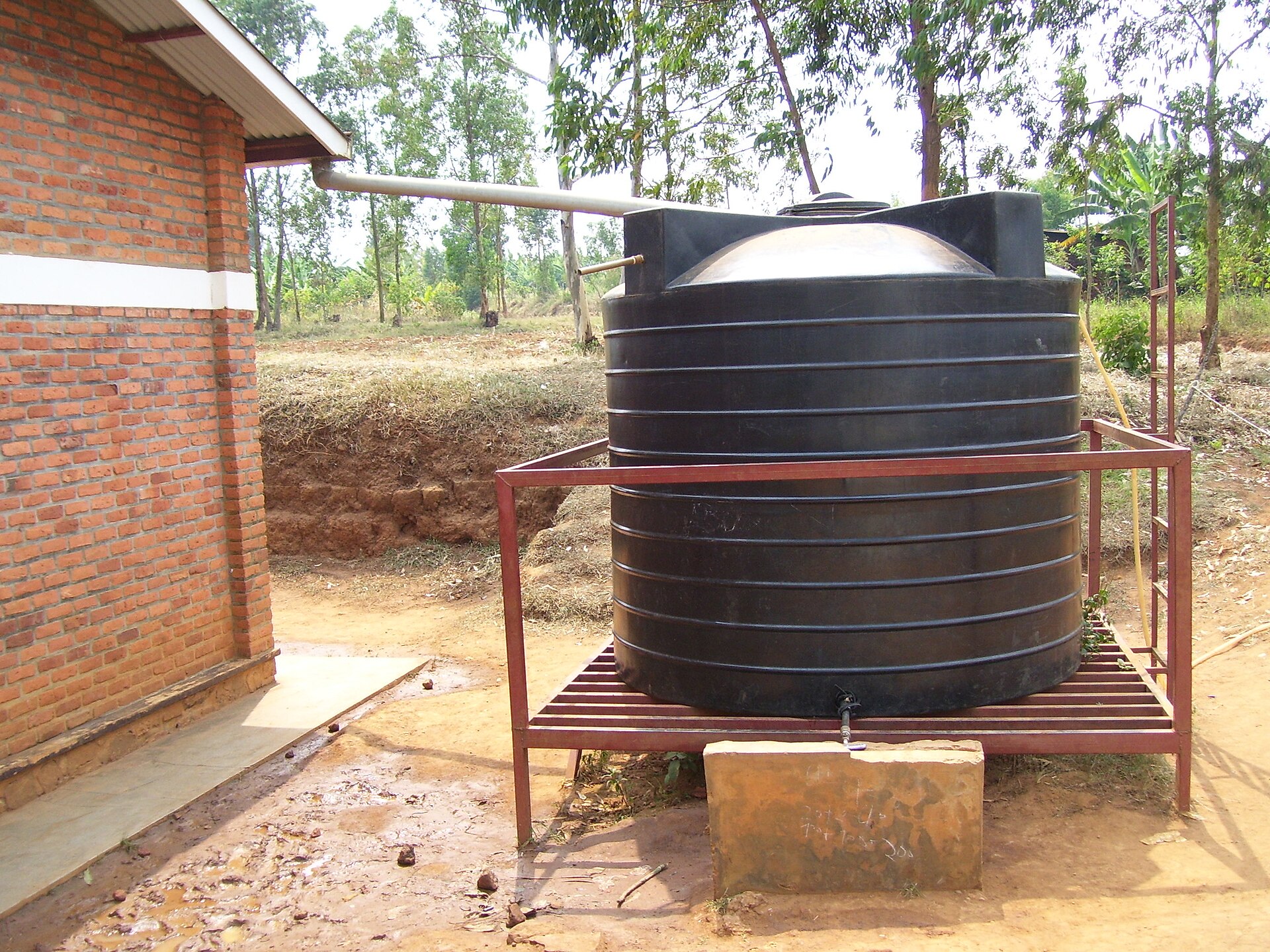
Cisterns and storage tanks hold harvested rainwater between storms and are made of polyethylene, fiberglass, concrete, steel, or other tanks, above or below ground. Tank size, material, location, and the overflow, vent, and access details drive structure, site, and water quality, so they are fixed early in design.
Cols
Terminology
- Cistern: tank for stored rainwater
- Inlet / calming inlet: entry that introduces water with minimal turbulence so settled sediment stays down
- Floating draw-off: intake that pulls water from near the surface, not the bottom
- Overflow: pipe that carries excess water out when the tank is full
- Make-up supply: refill source for dry periods
- Ballast / tie-down: weight or anchors that keep an empty buried tank from floating
- Ferrocement tank: cement or lime with sand applied over metal mesh
- IBC (intermediate bulk container): reused plastic tote in a metal cage
Standards
- Sizing: storage depends on the gap between rains; frequent rain needs less volume and a dry season needs more; use a monthly water balance
- Standards: ARCSA/ASPE/ANSI 63 and CSA B805/ICC 805 cover rainwater system design; tank-specific code provisions are in the plumbing code reference
- Outlet height: one design guide recommends the outlet about 6 in. above the tank bottom to leave room for sediment
- Water quality: a floating draw-off and a series of tanks, drawn from the last, improve quality
- Mosquito control: exclude female mosquitoes from laying eggs, add larvae-eating fish, or treat chemically
Materials
- Polyethylene: least expensive in 5,000 gal sizes; common above ground; the most cost-effective for small and mid-size tanks
- Fiberglass: highly corrosion resistant
- Concrete (precast or cast-in-place): used for large and underground tanks
- Steel: stands up to burial more easily than polyethylene but can rust and corrode
- Ferrocement: custom tanks built on site
- 55 gal drums and IBCs: low-cost small storage
Detailing
- Foundation: base supports full tank weight; buried tanks in saturated soil need ballast or tie-downs
- Sunlight: keep stored water out of light to limit algae
- Inlet and outlet: calm inlet, outlet above the bottom, no turbulence that stirs sediment
- Overflow: sized to the inflow, screened against pests, discharged away from foundations and neighbors, with no shutoff valve
- Vent: screened; kept separate from sanitary vents
- Access: lockable manhole or service port; confined-space warning where people can enter
- Drain: pump or drain at the low point with a cleanout
- Make-up water: backflow protection and an air gap
- Freeze protection: protect tank and piping where sustained freezing occurs
- Labeling: capacity and nonpotable warning on the tank
- Test: fill to the overflow, hold 24 hours, and verify overflow, drain, and make-up shutoff
- Setbacks: from lot lines, septic tanks, seepage pits, and tree roots as the adopted code requires
Uses
Specific uses
- Residential rainwater harvesting for irrigation and flushing
- Commercial and institutional nonpotable supply
- Fire protection storage where permitted
- Stormwater retention for irrigation reuse
- Agricultural and livestock water
Pros and cons
Pros
- Polyethylene and fiberglass tanks are light, available in many sizes, and quick to install
- Concrete tanks can be buried and carry loads
Cons
- Concrete and underground tanks need excavation and structural design
- Steel can corrode; polyethylene is more flexible and may need backfill care
- Large tanks are heavy when full and need engineered foundations
- Sediment and algae need periodic cleaning
Manufacturing and cost
Construction
- Polyethylene tanks are rotationally molded; fiberglass tanks are filament-wound or hand-laid; concrete tanks are precast in sections or cast in place; steel tanks are welded or bolted
Main manufacturers and suppliers
Trade association: ARCSA, American Rainwater Catchment Systems Association.
Typical costs
- 5,000 gal tank, material only: polyethylene about $2,000 to $4,000; fiberglass about $2,000 to $5,000; concrete or steel about $3,000 to $6,000
- Per gallon, 5,000 gal polyethylene or fiberglass: about $0.40 to $0.80 above ground and $0.80 to $1.60 below ground
- 10,000 gal concrete or polyethylene cistern: about $0.50 to $1.00 per gal
- 1,000 gal installed: polyethylene about $2,000 to $4,000; steel or concrete about $4,000 to $8,000
Sources
- Grafman, L.: To Catch the Rain, section 2.5 storage, https://eng.libretexts.org/Bookshelves/Environmental_Engineering_(Sustainability_and_Conservation)/Book%3A_To_Catch_the_Rain_(Grafman)/02%3A_Components/2.05%3A_Storage
- Auburn University Extension: rainwater harvesting, https://ssl.acesag.auburn.edu/natural-resources/water-resources/watershed-planning/stormwater-management/documents/Chapter4-6RainwaterHarvestingPRINT.pdf
- Wikipedia: rainwater harvesting, https://en.wikipedia.org/wiki/Rainwater_harvesting
- North Carolina Department of Agriculture: cistern design manual, https://ncagr.gov/soil-water/swcccap-cistern-design-manual/open
- Fixr: rainwater collection system cost, https://fixr.com/costs/rainwater-collection-system
- Image: Rainwater harvesting tank (5981896147).jpg, SuSanA Secretariat, CC BY 2.0, https://commons.wikimedia.org/wiki/File:Rainwater_harvesting_tank_(5981896147).jpg