Embodied Carbon by Material
Summary
Embodied carbon concentrates in a few material groups, mainly concrete, steel, insulation, and wood. Targeting those groups gives the largest reduction, and EPDs for the specific products give the numbers to compare.
Cols
Scope
- CLF benchmark (2025): 292 US and Canadian buildings; median embodied carbon intensities by use type fell between about 280 and 680 kg CO2e per square meter of gross floor area
- Priority materials: ten material groups account for 90 percent or more of project impacts, including concrete, steel, insulation, and wood
- Material baselines: CLF released a North American Material Baselines report in June 2025 for cement and concrete, masonry, steel, aluminum, wood, and insulation
Selection
- Concrete and steel reinforcement: together up to 90 percent of emissions in one study of 85 projects
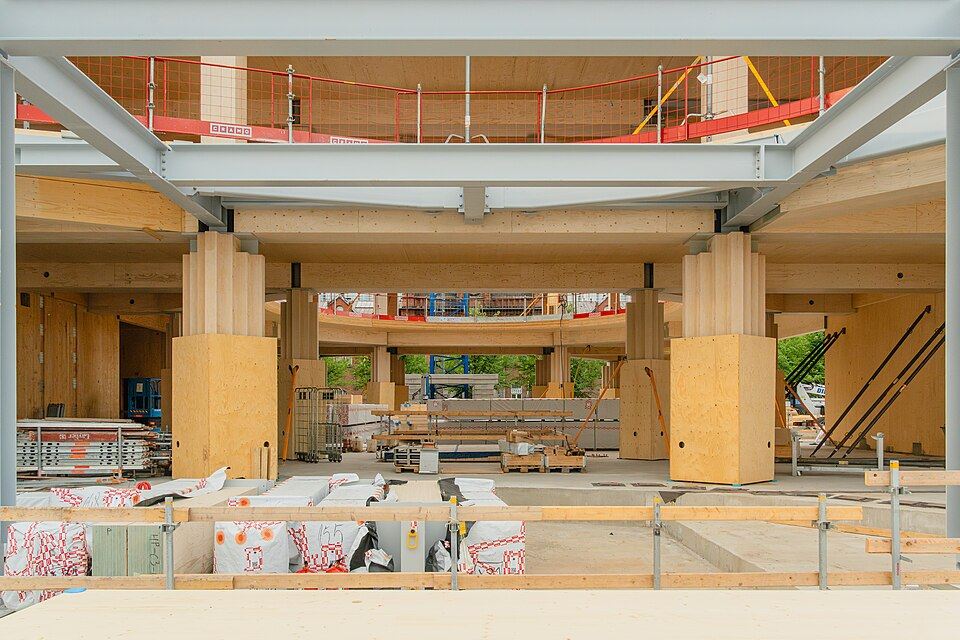
- Timber versus concrete structure: a systematic review of LCAs found timber structures saved about 43 percent of embodied energy and 68 percent of carbon
- Insulation: impacts vary widely by type; compare at the thickness needed for the same R-value; one study found extruded polystyrene highest per volume among envelope materials
Coordination
- Product data: use EPDs for the specific products; the EC3 tool compares declared values
- Check values: pull per-material numbers from the CLF Material Baselines report and EC3, not from this note
Sources
- AIA: embodied carbon benchmarking, https://aiaorg.atlassian.net/wiki/spaces/DDXWIK/pages/1317732357/Embodied+carbon+benchmarking
- Building Transparency: EC3 embodied carbon tool, https://buildingtransparency.org/ec3
- Wikimedia Commons: 20230630 Structure of Katajanokan Laituri - Helsinki, Suomi, Finland.jpg, by Aarni Salomaa (CC BY 4.0), https://commons.wikimedia.org/wiki/File:20230630_Structure_of_Katajanokan_Laituri_-_Helsinki,_Suomi,_Finland.jpg