Bronze
Summary
Bronze is a copper alloy, typically about 88 percent copper and 12 percent tin, often with aluminum, manganese, nickel, or zinc, that is ductile, nonmagnetic, and generally about 10 percent denser than steel. Its protective oxide layer and alloy family (tin, aluminum, silicon, phosphor) set corrosion performance, strength, and appearance for doors, cladding, sculpture, and bearings.
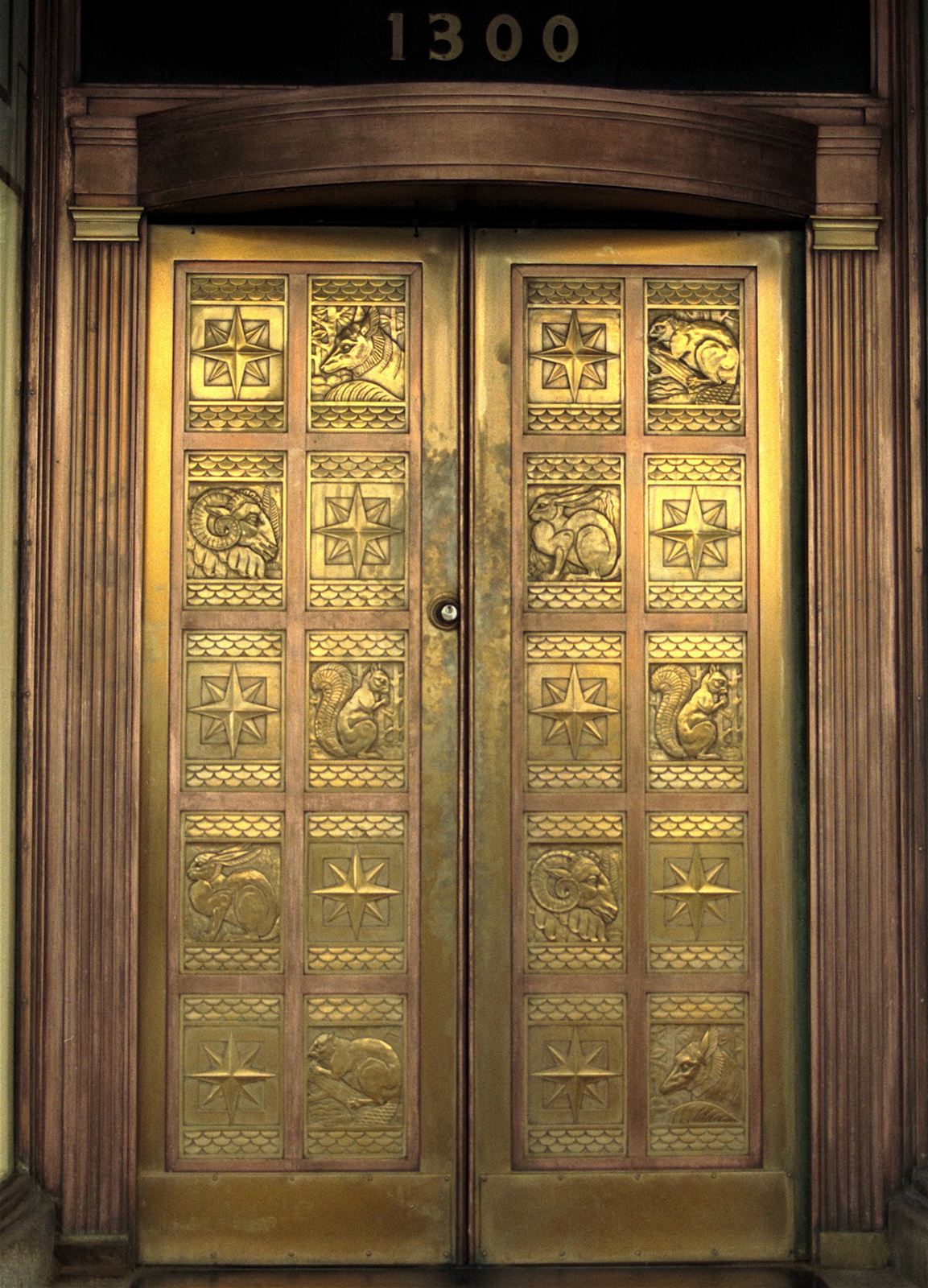
Terminology
- Tin bronze: copper with about 12 percent tin
- Phosphor bronze: tin bronze with a small phosphorus addition; high fatigue strength and spring qualities
- Aluminum bronze: copper with usually 5 to 11 percent aluminum
- Silicon bronze: copper with about 4 percent silicon
- Manganese bronze: high-zinc copper alloy used for forgings
- Gunmetal: about 10 percent tin; called red brass in the United States
- Bell metal: typically about 23 percent tin
- Bronze disease: copper chlorides destroying the metal
History and demand
Invention
- About 3800 to 3400 BCE: arsenic-copper alloys on the Iranian plateau
- About 4650 BCE: earliest tin-copper artifact, from Pločnik, Serbia
- Late 3rd millennium BCE: tin became the major non-copper ingredient
- About 1300 BCE: Iron Age begins; disruption of the tin trade around 1200 to 1100 BCE helped drive the shift to iron
First uses in construction
- The Seagram Building in New York was the first building fully sheathed in bronze; bronze doors include those of the United States Supreme Court
Sourcing
- Bronze is mostly copper with tin; 2025 tin mine output was about 290,000 tonnes, led by China, Indonesia, and Peru, followed by Brazil and Bolivia (USGS 2026 summary)
- Copper mine output is led by Chile, the Democratic Republic of Congo, and Peru (USGS)
Composition and production
Raw materials
- Copper with tin (typically 88 percent copper, 12 percent tin), or with aluminum, manganese, nickel, zinc, silicon, or phosphorus
Manufacturing process
- Cast; common alloys expand slightly just before setting, which helps fill fine mold details
Grades and types
| Alloy | Nominal composition | Deciding difference |
|---|---|---|
| Phosphor bronze | Cu 89.75, Sn 10, P 0.25 | High fatigue strength, spring qualities |
| Aluminum bronze | Cu 92, Al 8 (Al usually 5 to 11) | Higher strength and corrosion resistance, especially marine; low reactivity with sulfur compounds |
| Silicon bronze | Cu about 89 to 90, Si about 4 to 4.5 | Silicon addition in place of tin |
| Manganese bronze | Cu 58.5, Zn 39.2, Fe 1, Sn 1, Mn 0.3 | Forgings |
| Gunmetal | Cu 80 to 90, Zn under 5, Sn about 10 | Called red brass in the United States |
Properties
Physical
- Density: tin bronze (8 to 14 percent Sn) 7,400 to 8,900 kg/m³ (about 462 to 556 lb/ft³); phosphor bronze 8,900 kg/m³ (about 556 lb/ft³); aluminum bronze (3 to 10 percent Al) 7,700 to 8,700 kg/m³
- Generally about 10 percent denser than steel; usually nonmagnetic
Mechanical
- Hardness: Vickers 60 to 258, against 30 to 80 for wrought iron
- Ductile and considerably less brittle than cast iron
Thermal and moisture
- Melting point: about 950°C (1,740°F), varying with composition
- Thermal conductivity: aluminum bronze (95 Cu, 5 Al) 83 W/(m·K), about 575 Btu·in./(h·ft²·°F); phosphor bronze (10 Sn) 50 W/(m·K), about 347; 75 Cu, 25 Sn 26 W/(m·K), about 180; conducts better than most steels
- Coefficient of thermal expansion: bronze 17.5 to 18 × 10⁻⁶/°C, about 9.7 to 10.0 × 10⁻⁶ in./in./°F; phosphor bronze 16.7 × 10⁻⁶/°C, about 9.3
Durability
- Corrosion: surface oxide layer protects against further corrosion; copper chlorides can cause bronze disease
Uses in buildings
Building elements
- Aluminum Storefront Doors, Frameless Glass Doors: bronze cladding on high-end entrances, and fittings and rails
- Backflow Preventers, Floor Drains and Cleanouts: bronze valve bodies, and nickel-bronze strainers and grates
- Metal Wall Panels: bronze sheathing and cladding, as on the Seagram Building
Pros and cons
Pros
- Protective oxide layer
- Conducts heat and electricity better than most steels
- Ductile, less brittle than cast iron
- Alloys for marine corrosion resistance (aluminum bronze) and spring service (phosphor bronze)
Cons
- Bronze disease from copper chlorides
- Denser than steel
- Wide hardness and composition range requires specifying the alloy
Design considerations
Movement
- Expansion about 0.12 in. per 10 ft for a 100°F swing (calculated from 9.85 × 10⁻⁶ in./in./°F)
Manufacturing and cost
Main manufacturers and suppliers
Trade association: Copper Development Association.
Sources
- Wikipedia: Bronze, https://en.wikipedia.org/wiki/Bronze
- Wikipedia: List of copper alloys, https://en.wikipedia.org/wiki/List_of_copper_alloys
- Engineering ToolBox: density of metals and alloys, https://www.engineeringtoolbox.com/metal-alloys-densities-d_50.html
- Engineering ToolBox: thermal conductivity of metals, https://www.engineeringtoolbox.com/thermal-conductivity-metals-d_858.html
- Engineering ToolBox: linear expansion coefficients, https://www.engineeringtoolbox.com/linear-expansion-coefficients-d_95.html
- Wikimedia Commons: Door to Holt Renfrew Montreal.jpg, photo by Colin Rose (CC BY 2.0), https://commons.wikimedia.org/wiki/File:Door_to_Holt_Renfrew_Montreal.jpg
- USGS: Mineral Commodity Summaries 2026, tin, https://pubs.usgs.gov/periodicals/mcs2026/mcs2026-tin.pdf
- TrueSource Metals: tin, https://tsm-hub.pages.dev/metals/tin