Lavatories and Sinks
Summary
Lavatories are hand-washing basins in counters, on walls, or as group wash fixtures, while sinks serve kitchens, janitor closets, labs, and laundry. Rim heights, knee clearance, faucet controls, and tempered water affect casework and restroom design, so accessible lavatories and sinks must be detailed with millwork and wall carriers.
Cols
Terminology
- Lavatory: hand-washing basin (plumbing code term)
- Undermount / drop-in / vessel / wall-hung: mounting types
- Group wash fixture: trough or circular wash fountain; every 20 in. of rim counts as one lavatory
- Service sink / mop sink: janitor fixtures
- Metering faucet: delivers a set volume per cycle
- Sensor faucet: hands-free operation
- Tempered water: mixed hot and cold water delivered at a safe temperature
Standards
Ratings
- Public lavatory faucets 0.5 gpm maximum, or 0.25 gallon per metering cycle; private lavatory and sink faucets 2.2 gpm maximum
- Tempered water required at public lavatories through an ASSE 1070 temperature-limiting device
- Lavatory waste outlets at least 1-1/4 in.; sink outlets at least 1-1/2 in.
- Accessible lavatories and sinks: rim or counter 34 in. maximum, forward approach with knee and toe clearance, and pipes under the fixture insulated or protected
- Hand-operated metering faucets on accessible fixtures stay open at least 10 seconds
Test standards
- ASME A112.19.2/CSA B45.1: ceramic fixtures
- ASME A112.19.3/CSA B45.4: stainless steel fixtures
- ASME A112.18.1/CSA B125.1: faucets and fittings
- ASSE 1070: water temperature limiting devices
- NSF 61 / NSF 372: drinking water components and lead content
Components
- Basin or bowl: vitreous china, stainless steel, enameled cast iron, or solid surface
- Faucet: manual, metering, or sensor
- Supplies and stops: angle valves and risers
- Trap and tailpiece: with strainer or pop-up
- Mixing valve: point-of-use temperature limiting
- Carrier: for wall-hung lavatories
Detailing
- Coordinate counter heights, apron depths, and knee clearance with millwork
- Provide carriers or blocking for wall-hung lavatories
- Insulate or shield exposed supply and drain lines at accessible fixtures
- Locate soap and towel dispensers within reach ranges and splash zones
- Provide service sinks in janitor closets with floor-level receptors where needed
Uses
Specific uses
- Public and employee restrooms
- Residential baths and kitchens
- Commercial kitchens and bars
- Janitor and utility rooms
- Laboratories and healthcare
Pros and cons
Pros
- Wide range of materials and styles
- Low-flow and sensor faucets save water
- Integral counters simplify cleaning
Cons
- Accessible clearances limit casework below
- Sensor faucets need power and maintenance
- Point-of-use mixing valves need access
Manufacturing and cost
Construction
- Vitreous china cast and fired; stainless steel drawn and welded; set on counters or carriers and connected after finishes
Main manufacturers and suppliers
Trade associations: Plumbing Manufacturers International and IAPMO.
Sources
- UpCodes: 2024 IPC Chapter 4 fixtures, faucets, and fixture fittings (GSA adoption without amendments), https://up.codes/viewer/general-services-administration/ipc-2024/chapter/4/fixtures-faucets-and-fixture-fittings
- UpCodes: 2024 IPC Chapter 6 water supply and distribution, https://up.codes/viewer/general-services-administration/ipc-2024/chapter/6/water-supply-and-distribution
- Corada: 2010 ADA Standards Section 606 lavatories and sinks, https://www.corada.com/documents/2010ADAStandards/606
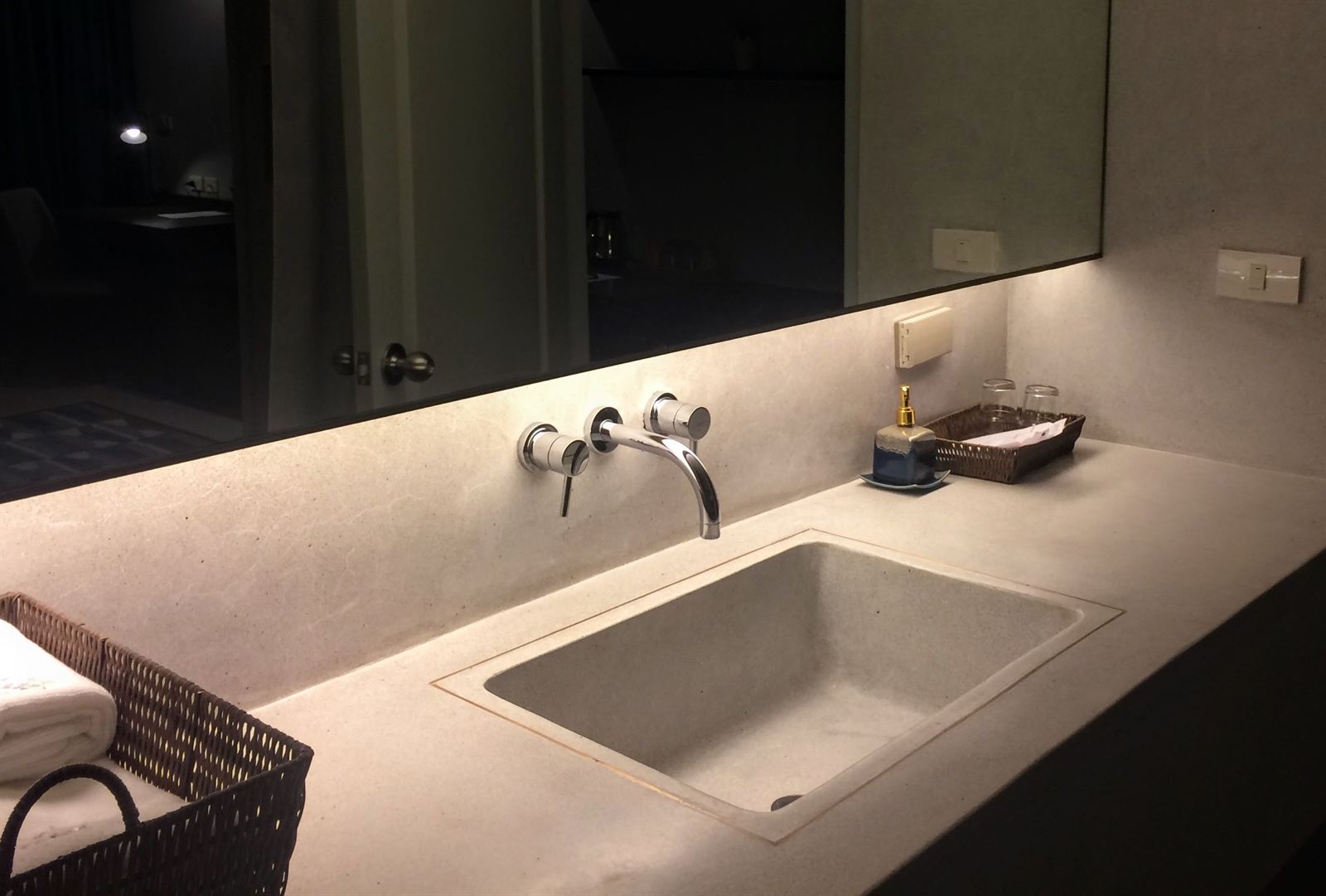
- Wikimedia Commons: Luxury sink.jpg, by Amin (CC BY-SA 4.0), https://commons.wikimedia.org/wiki/File:Luxury_sink.jpg