Glass
Summary
Glass in buildings is mostly soda-lime-silicate float glass, about 70 to 74 percent silica, supplied as annealed, heat-strengthened, tempered, and laminated flat glass. Commercial glass breaks at flaw-limited tensile stresses of 2,000 to 25,000 psi, so thickness, heat treatment, and lamination must be matched to load and safety needs.
Cols
Terminology
- Float glass: flat glass formed by floating molten glass on a tin bath
- Soda-lime glass: about 90 percent of modern manufactured glass
- Annealed: slowly cooled in a lehr to relieve stress
- Cullet: recycled broken glass added to the batch
- Plate glass: older cast, ground, and polished flat glass
- Crown / cylinder glass: older window glass made by spinning discs or blowing cylinders
- Low-iron: float glass with reduced iron for clarity
History and demand
Invention
- At least 3600 BC: glassmaking in Mesopotamia, Egypt, or Syria; sustained production about 1600 BC in Mesopotamia and 1500 BC in Egypt
- 13th century: Murano cristallo, used extensively for windows among other products
- 1953 to 1957: Alastair Pilkington and Kenneth Bickerstaff developed float glass at Cowley Hill Works, St Helens; full-scale profitable sales began in 1960
First uses in construction
- Window glass was made as crown glass until the 16th century, as cylinder glass in the early 19th century, and as costly polished plate; continuous grinding lines appeared in the early 1920s
- 1960s: float glass became widespread
Sourcing
- Flat glass 2024: China made about 1.2 billion m2, 23 percent of about 5.3 billion m2 world output; the United States about 451 million m2 and India about 386 million m2 (IndexBox)
Demand trend
- Float glass is the most widely produced form of glass
Composition and production
Raw materials
- Sand, soda ash, dolomite, limestone, and salt cake, plus cullet
- Soda-lime-silicate glasses are over 75 percent of manufactured glass, with 70 to 74 percent silica by weight
Manufacturing process
- Batch melted with cullet at about 1,500°C (2,730°F), stabilized at about 1,200°C (2,190°F)
- Molten glass pours onto a tin bath, cooling from about 1,100°C to about 600°C (2,010 to 1,110°F) as it spreads into a flat ribbon
- Annealed in a lehr about 100 m long, then cut
Product forms
- Flat glass in varied thickness (set by flow and roller speed), later heat-treated, laminated, or coated
Properties
Physical
- Density (all glasses): 2.2 to 7.2 g/cm³
Mechanical
- Tensile strength: theoretical for flawless glass 14 to 35 GPa; commercial glass 14 to 175 MPa (about 2,000 to 25,400 psi) because of flaws
Thermal and moisture
- Coefficient of thermal expansion (soda-lime): about 9 × 10⁻⁶/°C, or 5.0 × 10⁻⁶ in./in./°F; high expansion and poor heat resistance, against 3.25 × 10⁻⁶/°C for borosilicate
Standards
Material specifications
- ASTM E1300: load resistance of glass in buildings
- ANSI Z97.1: safety glazing
- 16 CFR 1201 (CPSC): architectural glazing
Uses in buildings
Building elements
- Fixed Windows, Casement Windows, Awning Windows, Double-Hung Windows, Horizontal Sliding Windows, Aluminum Windows, Vinyl Windows, Fiberglass Windows, Wood and Clad Wood Windows: insulating glass units
- Curtain Wall Systems, Aluminum Storefront Doors, Sliding and Folding Glass Wall Systems: glazing infill
- Frameless Glass Doors, Automatic and Revolving Doors: tempered glass leaves and glazed panels
- Skylights and Roof Windows: skylight glazing
- Overhead Sectional Doors, Fiberglass Entry Doors, Stile and Rail Wood Doors, Pocket and Sliding Interior Doors: glazed sections, door lites, and glass sliding leaves
- Rooftop Solar PV: module cover glass
- Terrazzo, Wall Sconces: recycled glass aggregate, and shades
- Guards and Railings: laminated glass infill
Pros and cons
Pros
- Transparent and easily formed
- Float process gives flat, even sheets
- Recycled cullet is part of the batch
Cons
- Brittle; commercial tensile strength limited by flaws to 14 to 175 MPa
- High thermal expansion and poor heat resistance
Design considerations
Movement
- Expansion about 0.06 in. per 10 ft for a 100°F swing (calculated from 5.0 × 10⁻⁶ in./in./°F)
Finishes and treatments
- Coated and heat-treated glass: processed beyond the unprocessed flat glass in industry EPD scope
Sustainability
Embodied carbon
- NGA industry-average flat glass EPD (2019, United States, unprocessed clear, tinted, and low-iron): 1,430 kg CO2e per ton
- Guardian North America unprocessed flat glass EPD: about 1,102 kg CO2e per ton (A1 to A3)
- Coated, heat-treated, or otherwise processed glass is outside both declarations
Manufacturing and cost
Main manufacturers and suppliers
Trade association: National Glass Association.
Sources
- Wikipedia: Glass, https://en.wikipedia.org/wiki/Glass
- Wikipedia: Float glass, https://en.wikipedia.org/wiki/Float_glass
- Glass Online: Guardian Glass publishes new EPD for its North America glass products, https://www.glassonline.com/guardian-glass-publishes-new-epd-for-its-north-america-glass-products/
- National Glass Association: flat glass global warming one-pager, https://www.glass.org/sites/default/files/2021-01/NGA Flat Glass Global Warming One Pager Advocacy One-Pager.pdf
- UpCodes: 2024 IBC Chapter 24 glass and glazing, https://up.codes/viewer/department-of-defense/ibc-2024/chapter/24/glass-and-glazing
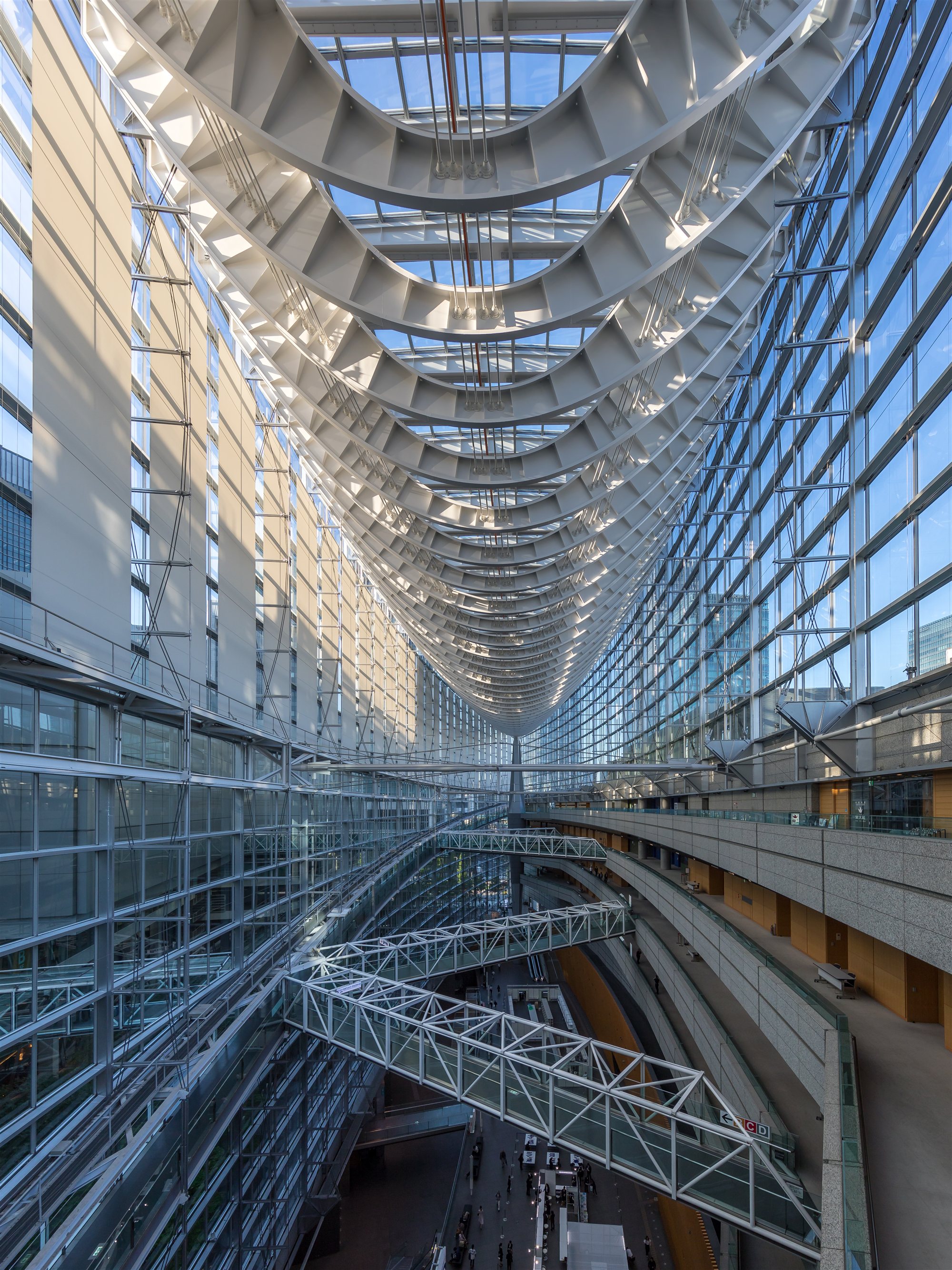
- Wikimedia Commons: Interior of the Tokyo International Forum Glass Building, Japan.jpg, photo by Basile Morin (CC BY-SA 4.0), https://commons.wikimedia.org/wiki/File:Interior_of_the_Tokyo_International_Forum_Glass_Building,_Japan.jpg
- IndexBox: flat glass world market overview 2024, https://www.indexbox.io/blog/flat-glass-world-market-overview-2024-8/