Marble
Summary
Marble is a metamorphic rock of recrystallized calcite or dolomite that polishes to a bright finish, cut as dimension stone for cladding, floors, and decorative work. Specify class, finish, and quarry source together, and check the stone against its exposure.
Cols
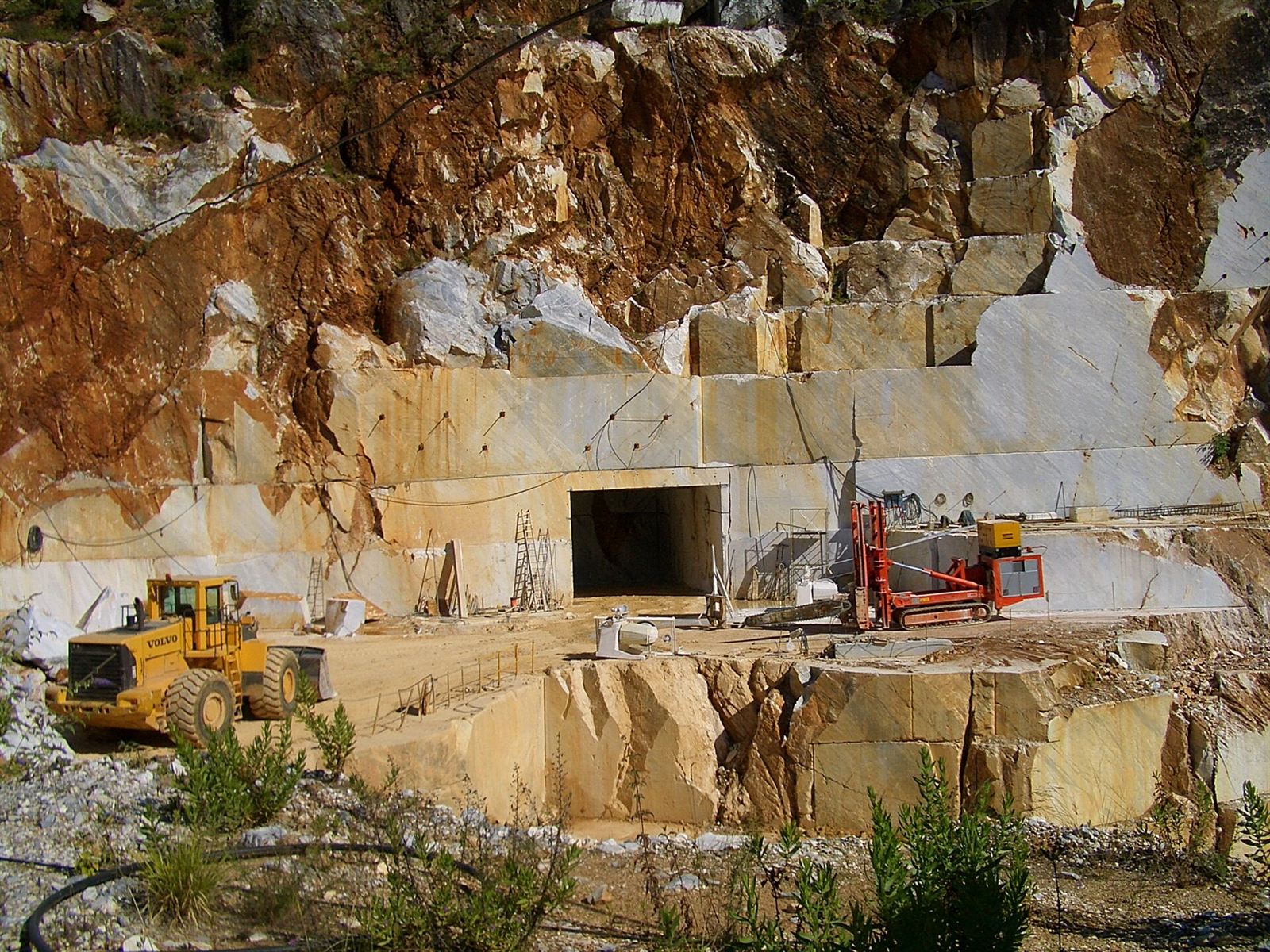
Terminology
- Construction marble: any stone of calcite, dolomite, or serpentine that can take a polish
- Calcite and dolomite marble: marble of CaCO3 or CaMg(CO3)2
- Serpentine marble: serpentine-based decorative stone in the ASTM class system
- Carrara, Parian, Pentelic, Prokonnesos: named marbles from Tuscany, Paros, Attica, and Marmara Island
History and demand
First uses in construction
- White marble was widely used across the Mediterranean in the Roman period, with distribution rising from the late 1st century BC to the end of the 2nd century AD and declining gradually from the 3rd century AD (Wikipedia)
- Pentelic marble from Mount Pentelicus in Attica was used for buildings in ancient Athens, particularly the Acropolis, and was later exported to Rome
- The Taj Mahal is clad entirely in marble
Sourcing
- Production is dominated by China (34 percent), Italy (19), India (16), and Spain (13), together almost half of world marble and decorative stone output (Wikipedia, undated)
- Turkey led marble exports in 2018 with 42 percent, followed by Italy (18) and Greece (10)
- Named quarry sources: Carrara in Tuscany, Paros in Greece, Mount Pentelicus in Attica, Marmara Island in Turkey
- Tile is the largest dimension-marble application in the United States
Demand trend
- Marble is part of the 19 percent of US dimension stone tonnage in 2025 outside limestone, granite, and sandstone (USGS)
Grades and types
- Class I, calcite: ASTM C503
- Class II, dolomite
- Class III, serpentine
- Class IV, travertine
Properties
Physical
- Composition: calcite (CaCO3) or dolomite (CaMg(CO3)2) recrystallized under heat and pressure
- Finish: takes a high polish; hardness and wear resistance are valued in floors
Mechanical
- Compressive strength (ASTM C503, secondary source): minimum 7,500 psi for each class
- Absorption (ASTM C503-10 table): maximum 0.20 percent for Classes I and II
Standards
Material specifications
- ASTM C503: marble dimension stone (exterior), with classes I calcite, II dolomite, III serpentine, IV travertine; C503/C503M-23 is current
Test methods
- ASTM C97: absorption and density
- ASTM C170: compressive strength
Uses in buildings
Building elements
- Wall Cladding: exterior veneer and panels
- Countertops: vanity and counter tops
- Terrazzo: marble chips as aggregate
- Site Paving: steps and paving
Pros and cons
Pros
- Polishes to a bright finish
- Hard and wear resistant
- Long record in prestige buildings
Cons
- Veining and color vary between blocks
Manufacturing and cost
Main manufacturers and suppliers
Trade association: Natural Stone Institute.
Sources
- Wikipedia: Marble, https://en.wikipedia.org/wiki/Marble
- Wikipedia: Pentelic marble, https://en.wikipedia.org/wiki/Pentelic_marble
- USGS: Mineral Commodity Summaries 2026, stone (dimension), https://pubs.usgs.gov/periodicals/mcs2026/mcs2026-stone-dimension.pdf
- iTeh Standards: ASTM C503, https://standards.iteh.ai/catalog/standards/astm/cc7a32d4-6083-433e-a9e6-aa265845ad15/astm-c503-03
- iTeh Standards: ASTM C503-99e1, https://standards.iteh.ai/catalog/standards/astm/a0be2f69-acc1-4794-bc5f-ee7154206367/astm-c503-99e1
- Image: Blocks of marble in Carrara marble quarry 6386.jpg, User:Vmenkov, CC BY-SA 3.0, https://commons.wikimedia.org/wiki/File:Blocks_of_marble_in_Carrara_marble_quarry_6386.jpg