Polystyrene
Summary
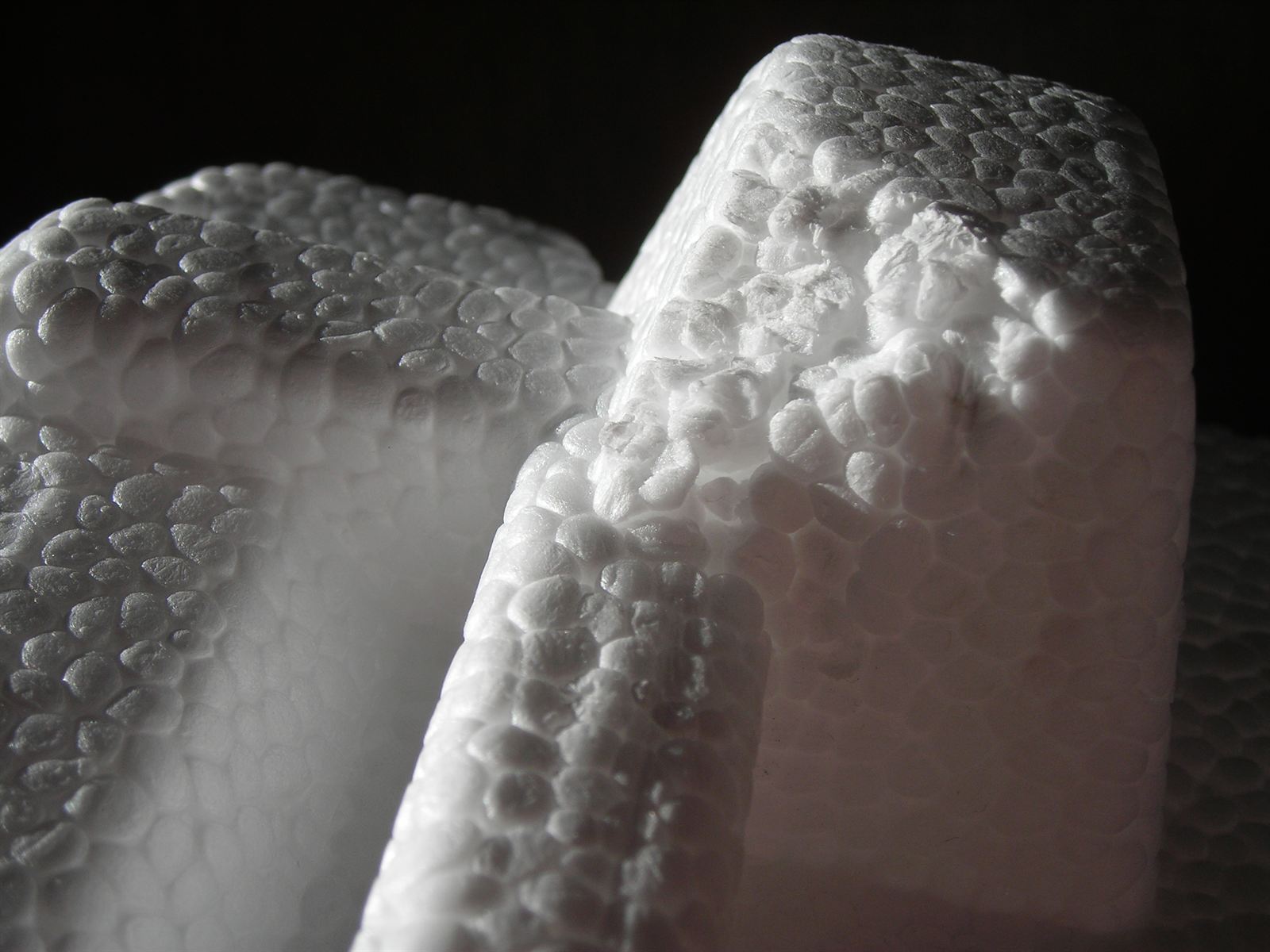
Polystyrene is a thermoplastic from styrene, foamed into expanded (EPS) and extruded (XPS) insulation boards that are 95 to 98 percent air. It gives low-cost closed-cell insulation, but it is easily ignited and needs flame retardant and, for XPS, attention to blowing agents.
Cols
Terminology
- EPS: expanded polystyrene, molded from beads
- XPS: extruded polystyrene, continuous board
- Blowing agent: gas that expands the foam; XPS has used HFC-134a
- Graphite EPS: EPS with graphite filler for lower conductivity
History and demand
Invention
- 1839: Eduard Simon first isolated polystyrene in Berlin
- 1931: I.G. Farben began production in Ludwigshafen
- 1935: Munters and Tandberg patented polystyrene foam insulation (US 2,023,204)
- 1954: Koppers developed EPS under the Dylite name
Sourcing
- Asia-Pacific accounted for about 57 percent of global expandable polystyrene demand in 2022 (Ceresana); China has the largest EPS capacity share (GlobalData)
Composition and production
Raw materials
- Styrene polymer; foams are 95 to 98 percent air
Properties
Physical
- Solid density: 0.96 to 1.05 g/cm3 (60 to 66 lb/ft3)
- EPS density: 11 to 32 kg/m3 (0.7 to 2.0 lb/ft3); 21.6 to 28.8 kg/m3 for insulated concrete forms
- XPS density: about 28 to 34 kg/m3 (1.7 to 2.1 lb/ft3)
- Glass transition: about 100°C (212°F)
Thermal and moisture
- Thermal conductivity: EPS 0.032 to 0.038 W/(m·K), about R-3.8 to R-4.5 per inch; graphite EPS about 0.029; XPS 0.029 to 0.039, average 0.035 (about R-4.1 per inch)
- Vapor diffusion resistance (mu): EPS 30 to 70; XPS 80 to 250
Fire behavior
- EPS limiting oxygen index about 18 percent; ASTM C578 requires more than 24 percent, so flame retardant is added
- Flame-retarded boards: flame spread index below 25 and smoke-developed index below 450 in tunnel testing
- Classed DIN 4102 B3 (easily ignited)
Standards
Material specifications
- ASTM C578: rigid cellular polystyrene thermal insulation
Uses in buildings
Building elements
- Wall and Roof Insulation: EPS and XPS board
- Insulated concrete forms use EPS
Pros and cons
Pros
- Low thermal conductivity at very low density
- XPS has higher vapor resistance than EPS
Cons
- Easily ignited; needs flame retardant
- XPS blown with HFC-134a has a global warming potential of about 1,000 to 1,300 times CO2
Sustainability
Embodied carbon
- CO2-blown XPS has ozone depletion potential 0 and global warming potential below 5; the EU banned HFC-134a from 2022
Recycled content and end of life
- Compaction raises EPS scrap density from about 30 to 330 kg/m3
Health
- Burning at 800 to 900°C yields over 90 compounds
Manufacturing and cost
Main manufacturers and suppliers
Trade association: EPS Industry Alliance.
Sources
- Wikipedia: Polystyrene, https://en.wikipedia.org/wiki/Polystyrene
- Wikimedia Commons: Polistirolo.JPG, photo by Phyrexian (CC BY-SA 3.0), https://commons.wikimedia.org/wiki/File:Polistirolo.JPG
- Ceresana: expanded polystyrene market report, https://ceresana.com/en?p=3352