Epoxy
Summary
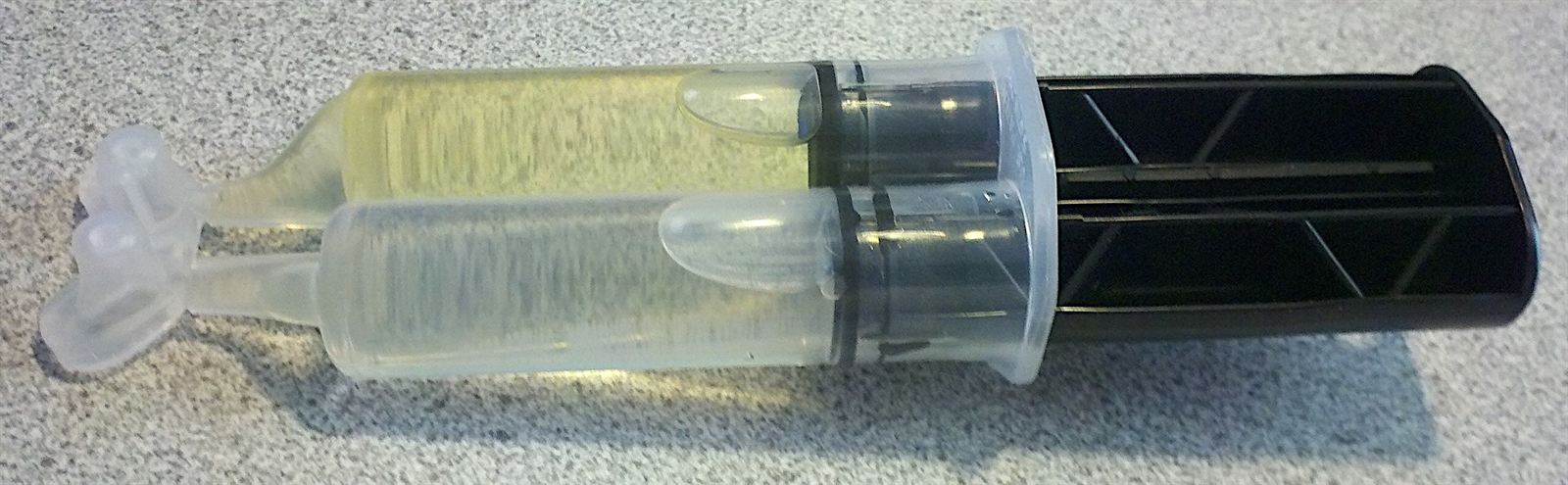
Epoxy is a thermoset made by cross-linking epoxy resin, most often bisphenol A diglycidyl ether, with an amine or other hardener. Cure temperature, mix ratio, and worker exposure to uncured resin drive performance and safety on resinous floors, coatings, and anchoring work.
Cols
Terminology
- DGEBA / BADGE: bisphenol A diglycidyl ether, the most common epoxy resin
- Hardener / curative: amine, acid, anhydride, phenol, alcohol, or thiol that cross-links the resin
- EEW: epoxy equivalent weight; higher EEW corresponds to higher Tg in some systems
- Tg: glass transition temperature
- Stoichiometric mix: hardener amount matched to resin for best physical properties
- Chip flooring: colored aggregate or chip broadcast in epoxy
History and demand
Invention
- 1934: Paul Schlack of Germany patented the condensation of epoxides and amines
- 1943: Pierre Castan claimed the bisphenol A resin, later licensed by Ciba
- 1946: Sylvan Greenlee of Devoe & Raynolds patented a resin from bisphenol A and epichlorohydrin
Sourcing
- China is the largest producer: about 29 percent of 3.1 million tons of 2024 world production by one count (IndexBox) and about 45 percent by another market report, with South Korea about 15 percent
- Asia-Pacific holds over 60 percent of capacity; China's capacity was expected to reach 3.76 million tonnes a year by the end of 2024, up 90 percent from 2017 (OilChem via Mysteel)
Demand trend
- Global market about $8 billion in 2016; Asia-Pacific about 55 percent, China almost 35 percent of resin consumption; Europe made about 323,000 tonnes in 2017
- Trends toward bio-based monomers, waterborne systems, and recycled raw materials
Composition and production
Raw materials
- Epichlorohydrin reacted with bisphenol A (or bisphenol F, for lower viscosity and better chemical resistance) using sodium hydroxide
- Hardeners: amines are the most important class; aliphatic amines are more reactive, aromatic amines give more heat-resistant networks
Manufacturing process
- Exothermic cross-linking cure; many systems cure at room temperature, many need heat up to about 150°C (300°F), specialist systems up to 200°C (390°F)
- Too little heat leaves an incompletely cross-linked network with reduced mechanical, chemical, and heat resistance
- One-component products use latent hardeners that need heat only
Properties
Mechanical
- Cured epoxies show excellent adhesion, good to excellent mechanical properties, and very good electrical insulation
Thermal and moisture
- Glass transition: cure temperature should reach the Tg of the fully cured network for maximum properties
Durability
- Chemical and heat resistance: excellent when fully cured
Uses in buildings
Building elements
- Resinous Flooring: epoxy coatings and mortars
- Terrazzo: epoxy resinous matrix, the most common terrazzo binder today
- Post-Installed Anchors: structural adhesives and rock bolt anchors
- Paint and Coatings: heavy-duty metal coatings and primers
Pros and cons
Pros
- Excellent adhesion and chemical resistance
- Cures at room temperature in many systems
- Usable as a concrete or mortar additive
Cons
- Uncured resin irritates skin and eyes and is a sensitizer
- Added cost as a concrete additive
- Improper mix ratio or low cure heat degrades properties
Sustainability
Health
- Uncured liquid resins irritate the eyes and skin; sensitization (dermatitis, occupational asthma) is the main concern, stronger with low-molecular-weight diluents
- Vapors and sanding dust from incompletely cured material add risk; solid epoxy resins are generally safer
- Bisphenol A is being replaced in some accelerators because of health concerns
Manufacturing and cost
Main manufacturers and suppliers
Trade association: American Chemistry Council.
Sources
- Wikipedia: Epoxy, https://en.wikipedia.org/wiki/Epoxy
- Wikimedia Commons: FiveMinEpoxy.jpg, photo by Taktoa (CC BY-SA 3.0), https://commons.wikimedia.org/wiki/File:FiveMinEpoxy.jpg
- Mysteel: China's epoxy resin industry, shift from oversupply to global reach, https://www.mysteel.net/analysis/5057737-chinas-epoxy-resin-industry-shift-from-oversupply-to-global-reach
- IndexBox: epoxide resin world market overview 2024, https://www.indexbox.io/blog/epoxide-resin-world-market-overview-2024-2/