Cement
Summary
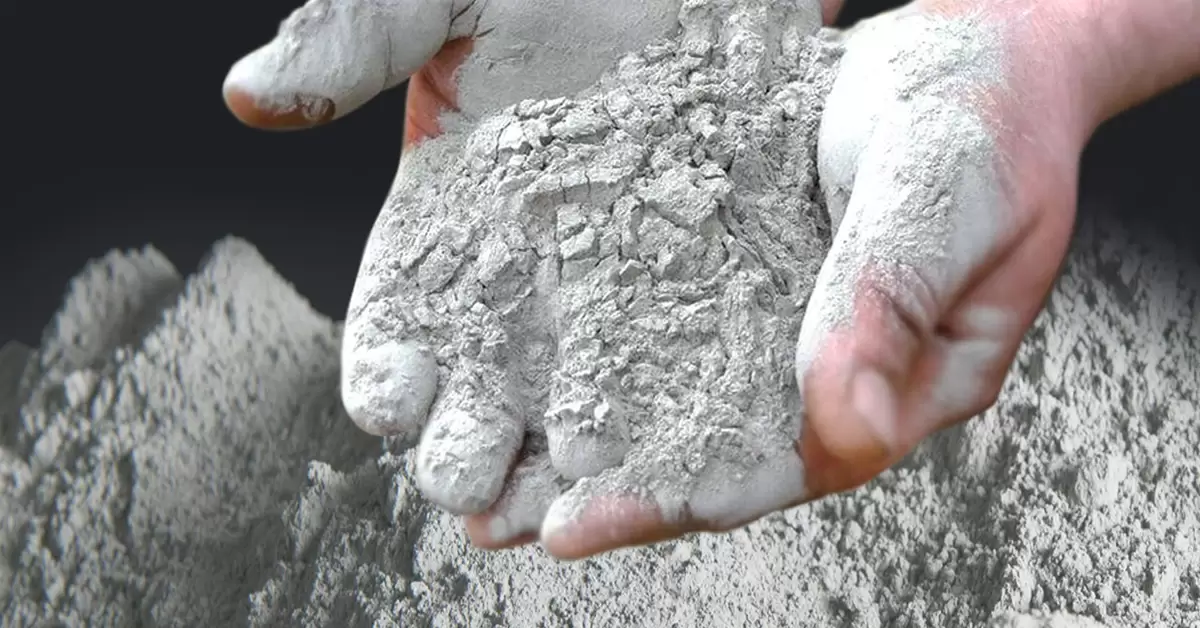
Cement is a fine powder, more than 90 percent portland clinker ground with about 5 percent calcium sulfate, that sets and hardens when mixed with water. It is the binder in concrete, mortar, grout, and terrazzo, and the main source of concrete's embodied carbon, so type and supplementary-material replacement matter.
Terminology
- Clinker: nodules produced by heating limestone with clay or shale in a kiln
- C3S / C2S / C3A / C4AF: the main clinker phases (alite, belite, aluminate, ferrite)
- ASTM C150 Types I to V: portland cement types by use
- PLC: portland-limestone cement, a blended cement with added limestone
- Hydration: reaction with water that sets and hardens the paste
- SCM: supplementary cementitious material, such as fly ash, slag, or silica fume, replacing part of the cement
History and demand
Invention
- 1756: John Smeaton tested limestone blends for the Smeaton's Tower lighthouse
- About 1818: Louis Vicat developed an artificial hydraulic lime, the principal forerunner of portland cement
- 1824: Joseph Aspdin patented "portland cement," named for its resemblance to Portland stone; William Aspdin's 1840s product is regarded as the first modern portland cement
- 1885 to 1886: Frederick Ransome's rotary kiln patent enabled continuous, more uniform production
First uses in construction
- 1850s: portland cement largely replaced Roman cement
- 1875: first United States portland cement produced, at Coplay, Pennsylvania
- Early 20th century: American-made portland cement displaced most imports
Sourcing
- 2024 world production was about 4.0 billion tonnes; China made about 1.9 billion tonnes, 47.5 percent, the first year since 2008 below half of world output (Global Cement)
- India is second at about 450 million tonnes in 2024, up 7.1 percent; China and India together make about 58.8 percent (USGS data via Global Cement)
- United States production, including Puerto Rico, was 84 million tonnes in 2025 (USGS)
Demand trend
- Rising: 4.4 billion tons manufactured in 2023, third by mass after sand and gravel; the IEA estimates production will rise 12 to 23 percent by 2050
- Cement production contributes about 10 percent of world CO2 emissions
Composition and production
Raw materials
- Clinker more than 90 percent; calcium sulfate (gypsum or anhydrite) about 5 percent (2 to 8 percent) to control setting; up to 5 percent minor constituents
- Typical clinker phases: C3S 25 to 50 percent, C2S 20 to 45 percent, C3A 5 to 12 percent, C4AF 6 to 12 percent
- United States industry average portland cement is 91.4 percent clinker by weight (PCA EPD, 2021)
Manufacturing process
- Limestone heated with clay or shale in a kiln at 3.3 to 3.6 GJ per ton of clinker, then ground with calcium sulfate
- Rotary kilns allow continuous production
Grades and types
| Type (ASTM C150) | Use | C3A limit |
|---|---|---|
| I | General purpose | 15 percent |
| II | Moderate sulfate resistance, lower heat | 8 percent |
| III | High early strength, ground finer | None stated |
| IV | Low heat of hydration | 7 percent (C3S 35 percent) |
| V | High sulfate resistance | 5 percent |
Properties
Mechanical
- Strength gain: typical portland cement reaches 8 MPa at 24 hours, 15 MPa at 3 days, 23 MPa at 1 week, 35 MPa at 4 weeks, and 41 MPa at 3 months (1,160, 2,180, 3,340, 5,080, and 5,950 psi)
Thermal and moisture
- Set and hardening: typically sets in about 6 hours and hardens over several weeks
Standards
Material specifications
- ASTM C150: portland cement (Types I to V)
- ACI 318: lists the cement standards that apply to structural concrete
Uses in buildings
Building elements
- Terrazzo: portland cement matrix in cementitious terrazzo
- CMU Walls, Brick Veneer Walls: mortar and grout
- Exterior Plaster and Stucco: cement plaster over lath
- Cement is also the binder in every concrete element; see Concrete
Pros and cons
Pros
- Hydraulic: sets and hardens under water
- Five standard types for strength, heat, and sulfate exposure
- Blendable with SCMs and limestone to lower clinker content
Cons
- About 0.80 kg CO2 per kg of finished cement (about 0.50 from limestone, 0.30 from kiln fuel)
- Slow strength gain compared with high-early-strength Type III
- Sulfate exposure requires Type II or V cement
Design considerations
Compatibility
- Type selection follows exposure: Type II or V for sulfates, Type III for early strength, Type IV for mass concrete heat
Sustainability
Embodied carbon
- About 800 kg CO2 per metric ton of finished portland cement; limestone decarbonation about 0.50 kg per kg and kiln fuel about 0.30 kg per kg
- PCA publishes a Type III industry-average portland cement EPD for United States members; a new EPD under the updated PCR is expected in 2026
Manufacturing and cost
Main manufacturers and suppliers
Trade association: Portland Cement Association.
Sources
- Wikipedia: Portland cement, https://en.wikipedia.org/wiki/Portland_cement
- Portland Cement Association: sustainability and EPDs, https://www.cement.org/
- Heidelberg Materials: PCA industry-average portland cement EPD (2021), https://www.heidelbergmaterials.us/docs/default-source/epds/627-epd_for_pca_portland_athena_03262021_final_revised.pdf
- UpCodes: 2024 IBC Chapter 19 concrete, https://up.codes/viewer/department-of-defense/ibc-2024/chapter/19/concrete
- USGS: Mineral Commodity Summaries 2026, cement, https://pubs.usgs.gov/periodicals/mcs2026/mcs2026-cement.pdf
- Global Cement: top 100 2026, https://globalcement.com/magazine/articles/1390-global-cement-top-100-2026