Plaster
Summary
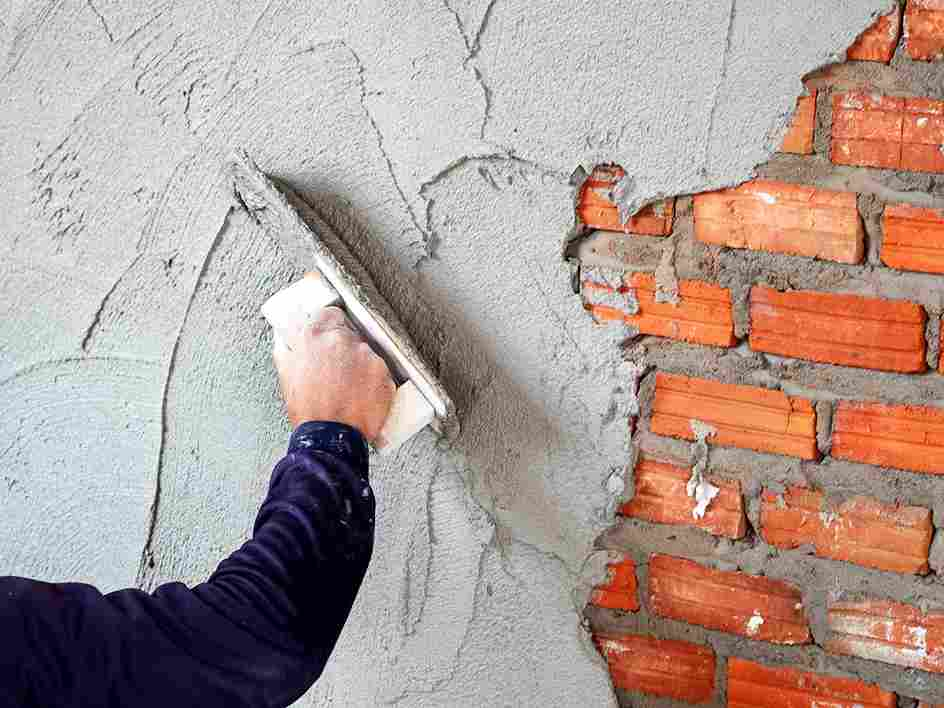
Terminology
- Gypsum plaster: calcined gypsum (hemihydrate) mixed with water
- Lime plaster: slaked lime and sand, hardening by carbonation
- Cement plaster: Portland cement, lime, and sand, used outdoors as stucco
- Clay plaster: clay and sand, historic and earthen walls
- Lath and plaster: plaster keyed into lath
History and demand
First uses in construction
- Plaster used in the Middle East at least 5,000 years ago
- 79 AD: plasterwork at Pompeii
- Circa 1675: Massachusetts contract specifying clay and lime plaster
- Circa 1909: cement plaster first introduced in America
Composition and production
Raw materials
- Gypsum plaster: gypsum heated to about 120 to 180°C (250 to 355°F); hemihydrate forms at 130 to 180°C, gamma anhydrite at about 180°C, beta anhydrite above 250°C
- Lime plaster: limestone heated above about 850°C (1,560°F) to produce quicklime
Properties
Physical
- Gypsum setting: begins about 10 minutes after mixing, complete in about 45 minutes; crystal transformation continues about 72 hours
- Gypsum heat of setting: slight volume expansion; mix can exceed 140°F (60°C)
- Lime plaster cure time on lath: about one month
Fire behavior
- Gypsum plaster releases water vapor in fire, slowing spread for up to 1 to 2 hours depending on thickness
Uses in buildings
Building elements
- Interior Plaster: gypsum and lime plaster on lath or masonry
- Exterior Plaster and Stucco: cement and lime plaster
- Gypsum Board Ceilings: plaster ceilings
Pros and cons
Pros
- Monolithic, jointless surface
- Gypsum plaster sets in about 45 minutes
- Fire-slowing water release from gypsum
Cons
- Lime plaster needs about a month to cure
- Wet application and long drying
Sustainability
Health
- OSHA workplace limit 15 mg/m3 total and 5 mg/m3 respirable dust over 8 hours; NIOSH recommends 10 mg/m3 total and 5 mg/m3 respirable
Manufacturing and cost
Main manufacturers and suppliers
Trade association: Gypsum Association.
Sources
- Wikipedia: Plaster, https://en.wikipedia.org/wiki/Plaster