PTFE
Summary
PTFE is polytetrafluoroethylene, a fluoropolymer with a melting point of 327°C, a very low friction coefficient, and near-total chemical inertness. It coats glass-fiber fabric for tensile roofs and forms slide bearings, but it is a PFAS material that is on the Living Building Challenge Red List.
Terminology
- PTFE: polytetrafluoroethylene
- Teflon: registered trademark, 1945
- PFAS / PFOA: per- and polyfluoroalkyl substances used in processing
- Polymer fume fever: illness from inhaling fumes of decomposing PTFE
History and demand
Invention
- 1938: Roy J. Plunkett found PTFE at DuPont (6 April); patented by Kinetic Chemicals in 1941
- 1945: Teflon registered as a trademark
- 1948: output over 910,000 kg per year at Parkersburg, West Virginia
Sourcing
- China was about half of PTFE consumption in 2025 (S&P Global); Asia-Pacific holds nearly 54 percent of fluoropolymer capacity (market summary)
- In 2018 Chemours (United States) was regarded as the largest fluoropolymer maker, and Shandong Dongyue Group in China ran the world's largest PTFE plant at 45,000 tonnes a year
Demand trend
- Over half of all fluoropolymer production; about 50 percent of PTFE goes to wire insulation
Properties
Physical
- Density: 2,200 kg/m3 (137 lb/ft3)
- Melting point: 327°C (621°F); glass transition about 115°C (239°F)
- Coefficient of friction: 0.05 to 0.10 against polished steel
Mechanical
- Yield strength: 23 MPa (3.3 ksi); Young's modulus 0.5 GPa (73 ksi)
Thermal and moisture
- Thermal expansion: 112 to 125 x 10-6 /K, about 62 to 69 x 10-6 in./in./°F
- Thermal conductivity: 0.25 W/(m·K)
- Deterioration begins near 260°C (500°F); decomposes above 350°C (662°F)
Durability
- Affected only by alkali metals at higher temperatures, aluminum, magnesium, and fluorinating agents
Uses in buildings
Building elements
- Glass-fiber fabric coated with PTFE for tensile membrane roofs; the Metrodome roof used 20 acres (81,000 m2)
- Plain bearings, bushings, gaskets, and slide plates
- Thread seal tape in plumbing, largely replacing paste thread dope
Pros and cons
Pros
- Very low friction, 0.05 to 0.10 against polished steel
- Chemically inert
Cons
- PFAS material; added to the Living Building Challenge Red List in 2016
- Decomposition fumes cause polymer fume fever
Sustainability
Health
- Polymer fume fever: flu-like symptoms that usually resolve within a day or two
- PFOA blood levels fell 70 percent (PFOA) and 84 percent (PFOS) between 1999 and 2014
- GenX contamination found in the Cape Fear River, a drinking water source for 500,000 people
Sources
- Wikipedia: Polytetrafluoroethylene, https://en.wikipedia.org/wiki/Polytetrafluoroethylene
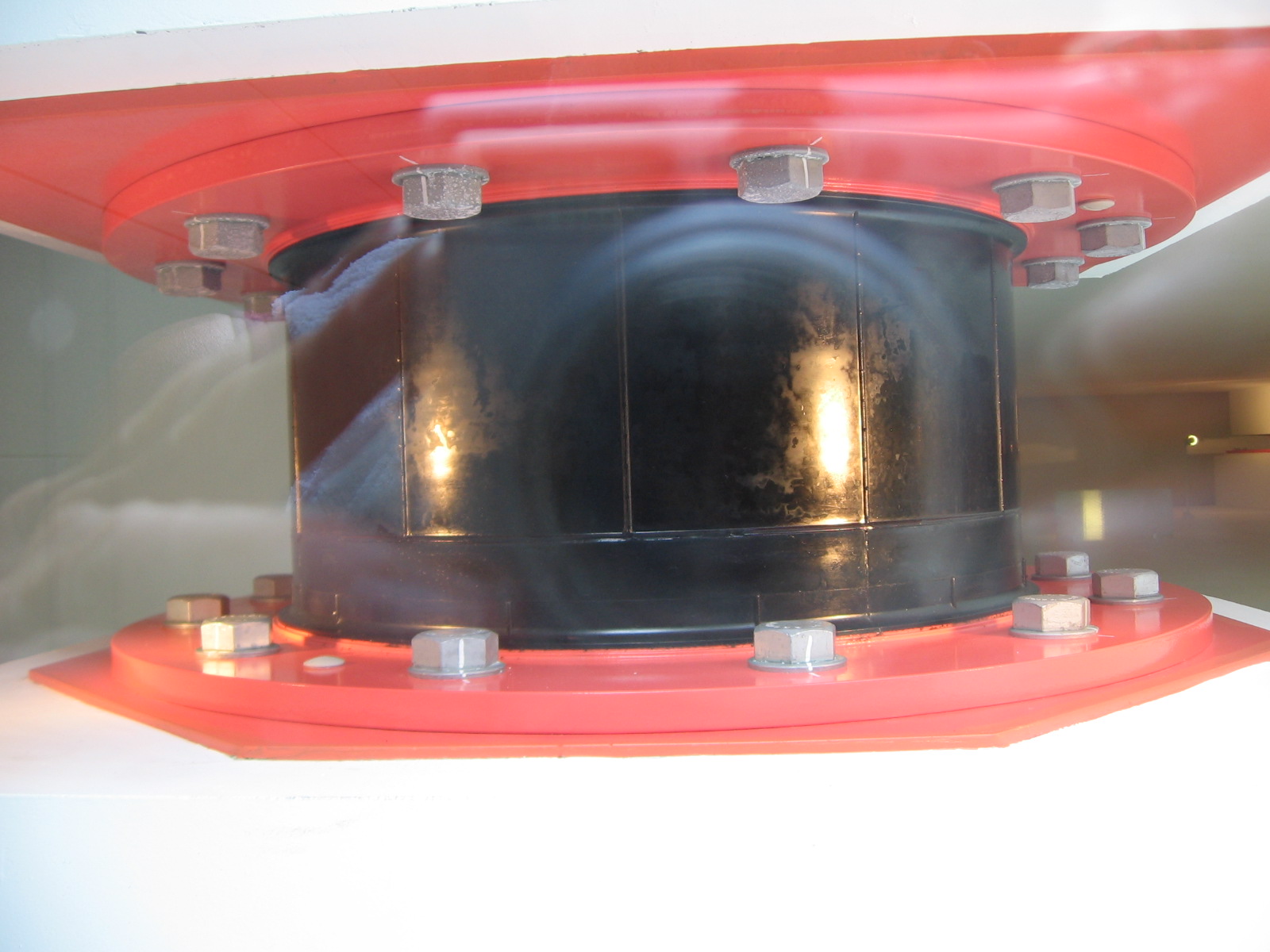
- Wikimedia Commons: Seismic isolator for buildings, based on Teflon, exhibited in Nara.jpg, photo by Syced (CC0), https://commons.wikimedia.org/wiki/File:Seismic_isolator_for_buildings,_based_on_Teflon,_exhibited_in_Nara.jpg
- S&P Global: fluoropolymers Chemical Economics Handbook, November 2025, https://www.spglobal.com/content/dam/spglobal/ci/en/documents/products/pdf/CI_ceh-fluoropolymers-abstract-TOC-november-2025.pdf
- AGC Chemicals Europe: fluoropolymer producers, https://www.agcce.com/?p=8814