Vinyl
Summary
Vinyl is polyvinyl chloride, about 57 percent chlorine by mass, compounded with stabilizers and, for flexible products, plasticizers. Rigid PVC serves as pipe, conduit, frames, and siding, and flexible PVC as flooring and roofing, with plasticizer content and fire and health behavior driving selection.
Cols
Terminology
- PVC: polyvinyl chloride
- Rigid / flexible (plasticized) PVC: unplasticized / with phthalate or other plasticizer
- Vinyl chloride monomer (VCM): the feedstock; a recognized carcinogen
- DEHP / BBzP: phthalate plasticizers
- Heat stabilizer: additive that prevents thermal degradation during processing and service
- Suspension polymerization: process producing about 80 percent of PVC
History and demand
Invention
- 1872: Eugen Baumann first synthesized PVC; early 20th-century processing attempts failed because the rigid polymer was hard to work
- 1926: Waldo Semon and B.F. Goodrich plasticized PVC; dibutyl phthalate in use by 1933
Sourcing
- 2024 production by one market overview: China 11 million tons, the United States 7.7 million, India 2.5 million, together 49 percent of world output; other editions put China at 12 to 16 million tons (IndexBox)
- About half of PVC capacity is in China
Demand trend
- Third most widely produced synthetic plastic, about 40 million tons per year
- Roughly half of world PVC resin goes to pipe; rigid PVC is used for window frames, sills, doors, and siding, and plasticized vinyl for flooring
- Recycling in Europe was 731,461 tonnes in 2020, down 5 percent from 2019
Composition and production
Raw materials
- Polymerized vinyl chloride, about 57 percent chlorine by mass
- Additives are almost always compounded in; flexible PVC can be over 85 percent plasticizer by mass
Properties
Physical
- Density: 1.4 g/cm³ (about 87 lb/ft³); rigid 1.3 to 1.45, flexible 1.1 to 1.35 g/cm³
Mechanical
- Yield strength: rigid 31 to 60 MPa (4.5 to 8.7 ksi); flexible 10.0 to 24.8 MPa (1.5 to 3.6 ksi)
- Modulus of elasticity (rigid): 3.4 GPa (about 490 ksi)
Thermal and moisture
- Coefficient of thermal expansion (rigid): 5 × 10⁻⁵ per °C, about 2.8 × 10⁻⁵ in./in./°F
- Glass transition: 82°C (180°F); heat distortion begins around 60°C (140°F) in traditional products; raw PVC degrades near 250°C (480°F)
Fire behavior
- Burning releases hydrogen chloride; chlorine content helps PVC-coated wire resist fire by scavenging free radicals
Standards
Material specifications
- ASTM D2665, F891, F1488: PVC drain, waste, and vent pipe
- ASTM D4434: PVC sheet roofing
- AAMA 303: rigid PVC profiles
Uses in buildings
Building elements
- Vinyl Windows, Fixed Windows, Casement Windows, Awning Windows, Double-Hung Windows, Horizontal Sliding Windows, Sliding and Folding Glass Wall Systems: extruded PVC frames and sashes
- PVC Roofing: flexible single-ply membrane
- Luxury Vinyl Flooring: luxury vinyl tile and plank
- Conduit and Raceways, Sanitary and Vent Piping, Floor Drains and Cleanouts: rigid PVC conduit, drain pipe, and drain bodies
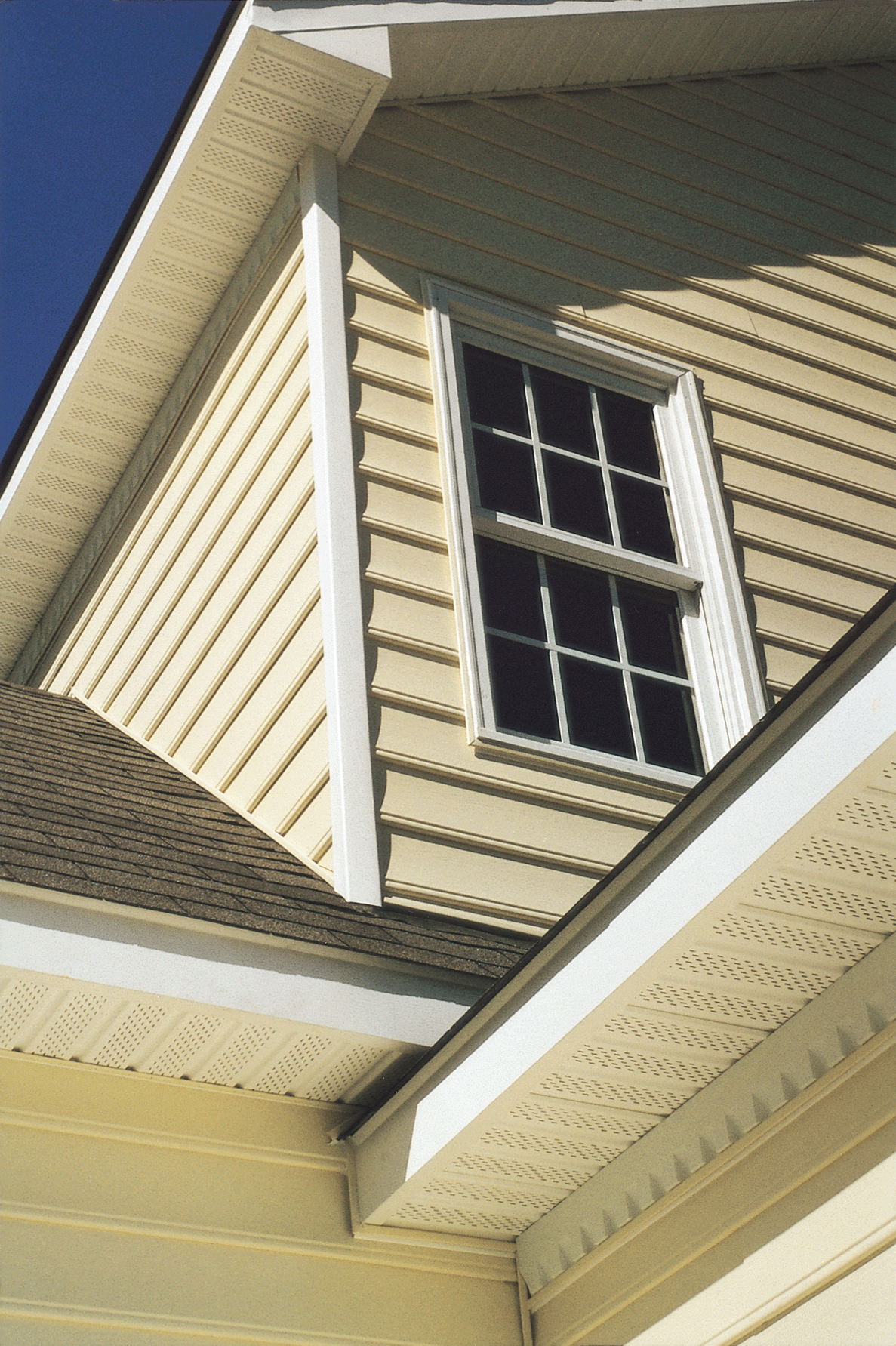
- Wall Cladding: vinyl siding
Pros and cons
Pros
- Rigid grades 31 to 60 MPa yield strength
- Plasticizer content tunes flexibility from rigid to flexible
- Used for pipe, frames, siding, and flooring
Cons
- Releases hydrogen chloride when burned
- High thermal expansion (2.8 × 10⁻⁵ in./in./°F)
- Heat distortion begins near 140°F in traditional products
- Phthalates are not chemically bound and can leach out
Design considerations
Movement
- Expansion about 0.34 in. per 10 ft for a 100°F swing (calculated from 2.8 × 10⁻⁵ in./in./°F)
Sustainability
Health
- VCM caused liver angiosarcoma in polymerization workers in the early 1970s and is accepted as a carcinogen
- Phthalates leach; a 2004 Swedish-Danish study linked indoor DEHP and BBzP to childhood allergies
- Lead stabilizers leached into drinking water from pipes; their use has been discontinued in Europe
- Dioxin formation from waste burning: studies are mixed
Manufacturing and cost
Main manufacturers and suppliers
Trade association: Vinyl Institute.
Sources
- Wikipedia: Polyvinyl chloride, https://en.wikipedia.org/wiki/Polyvinyl_chloride
- UpCodes: 2024 IBC Chapter 15 roof assemblies, Chapter 15 Roof Assemblies and Rooftop Structures: Department of Defense Building Code 2024 | UpCodes
- Wikimedia Commons: Vinyl-siding.jpg, photo by Peter Rockwood (CC BY-SA 4.0), https://commons.wikimedia.org/wiki/File:Vinyl-siding.jpg
- IndexBox: polyvinyl chloride world market overview 2024, https://www.indexbox.io/blog/polyvinyl-chloride-world-market-overview-2024-11/