Fiber Cement
Summary
Fiber cement is a cementitious composite of cement and reinforcing fibers, today mainly cellulose, formed into flat sheets, planks, and corrugated products. It is a noncombustible-class, rot-resistant cladding and backer option, but its fire classification depends on the product and the testing laboratory.
Cols
Terminology
- Fibre cement: British spelling; the usual term outside the US
- Cement board / backer board: fiber cement sheet used behind tile in wet rooms
- Hatschek process: sheet forming on a cardboard-making machine
- Type A (ASTM C1186): flat sheet for direct exterior exposure to sun, rain, or snow
History and demand
Invention
- Late 19th century: Austrian Ludwig Hatschek invented fiber cement, forming sheets on a cardboard-making machine
- Original mix: about 90 percent cement and 10 percent asbestos fiber, mixed with water
First uses in construction
- Asbestos-cement was common as low-cost residential siding
- Asbestos was linked to asbestosis and mesothelioma by the 1970s and phased out; cellulose fiber became the main alternative
Sourcing
- Market research names James Hardie, Etex, Nichiha, Cembrit, and CSR as the leading fiber cement makers; no country production shares were found
Composition and production
Raw materials
- Portland cement matrix with reinforcing fibers; cellulose is the main modern fiber
- Some boards also contain sepiolite or other inorganic fibers
Manufacturing process
- Fiber and cement slurry formed in thin layers on a Hatschek machine, then cured
Product forms
- Exterior: flat sheets, corrugated sheets, slates, planks, soffits, wall copings, underroofing
- Interior: tile backer boards, partitions, ceilings, floors, window sills, fire protection
Properties
Fire behavior
- Flat sheets can be classed A1, A1FL, or A2 under EN 12467:2012+A2:2018 (noncombustible or limited combustibility)
- Some sheets test less well, and some products are not tested by accredited laboratories; check the product's test report
Durability
- Rot- and insect-resistant cementitious body
Standards
Material specifications
- ASTM C1186: non-asbestos flat fiber-cement sheets; two types by exposure (Type A for direct exterior exposure), four grades by flexural strength; C1186-26 issued 2026
- EN 12467: fiber-cement flat sheets, including reaction-to-fire classes
Uses in buildings
Building elements
- Wall Cladding: siding planks, panels, and shingles
- Ceramic and Porcelain Tile: backer board in wet rooms
Pros and cons
Pros
- Rot-resistant, and classed noncombustible or limited combustibility in many products
- Replaces asbestos-cement with cellulose reinforcement
- Available as planks, panels, slates, and backer boards
Cons
- Fire performance varies by product and testing
- Asbestos fibers can be released when old asbestos-cement is machined or weathers
- Newer boards may contain other fibers or additives; check product data
Sustainability
Health
- Legacy asbestos-cement products release fibers during machining and weathering; modern non-asbestos boards avoid this, but dust control while cutting remains standard practice
Manufacturing and cost
Main manufacturers and suppliers
Sources
- Wikipedia: Fibre cement, https://en.wikipedia.org/wiki/Fibre_cement
- Normservis: ASTM C1186-26 listing, https://eshop.normservis.sk/norma/astm-c1186-26-1.4.2026.html
- Technické normy: ASTM C1186-22e01 listing, https://www.technickenormy.cz/en/astm-c1186-22e01-standard-specification-for-flat-fiber-cement-sheets
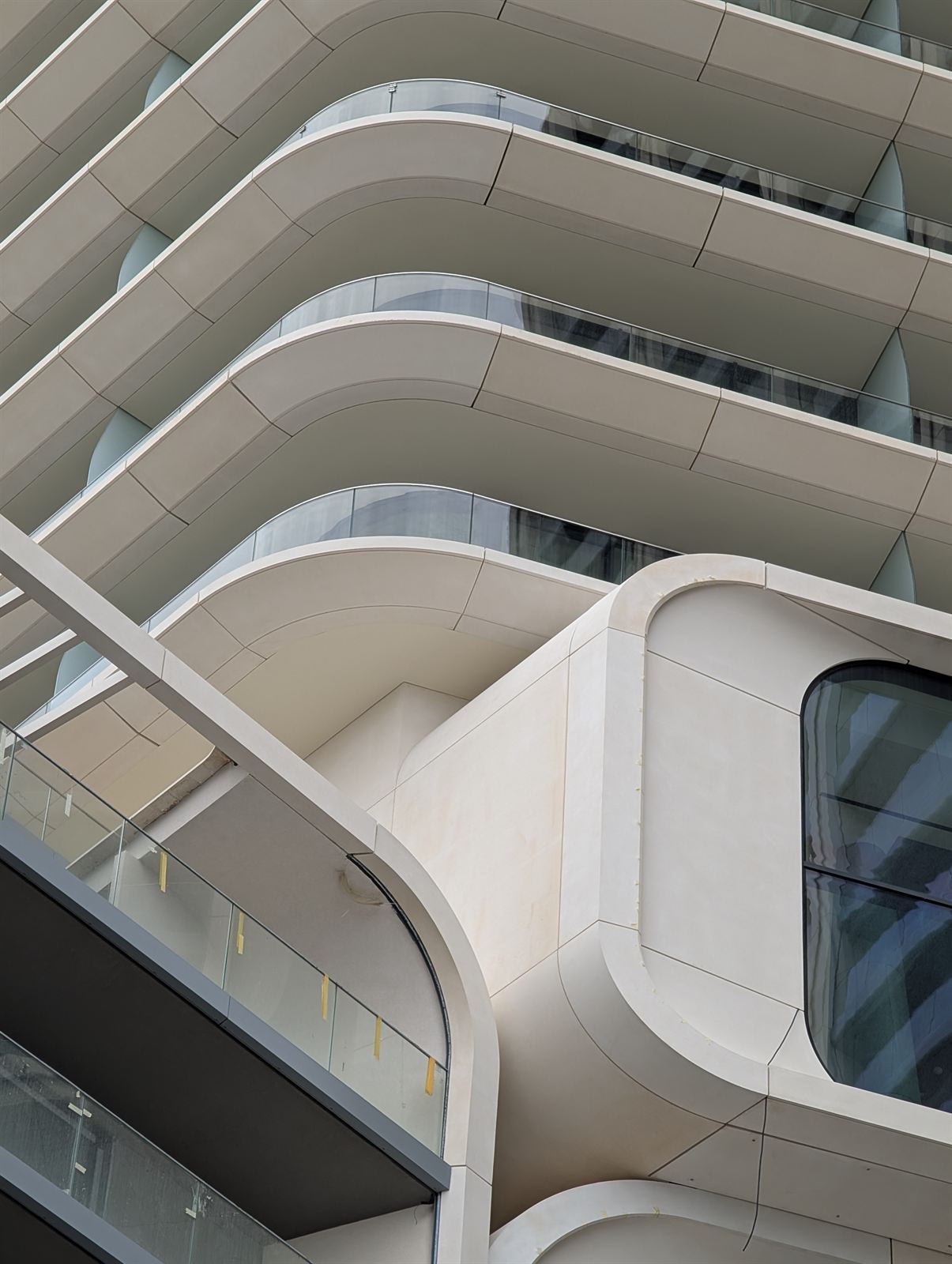
- Wikimedia Commons: Fiber Cement cladding on Mercury Tower.jpg, photo by Marcin Floryan (CC BY-SA 4.0), https://commons.wikimedia.org/wiki/File:Fiber_Cement_cladding_on_Mercury_Tower.jpg
- Spherical Insights: top 15 companies in the global fiber cement cladding and siding market, https://www.sphericalinsights.com/blogs/top-15-companies-in-global-fiber-cement-cladding-and-siding-market-2024-2035-spherical-insights-analysis