Flood Recovery
Summary
Flood recovery is the drying, cleaning, and replacement of materials after floodwater recedes. The first 24 to 48 hours decide mold growth, and porous materials that cannot be dried in that window usually have to be removed.
Cols
Scope
- Covers building materials and furnishings wet by floodwater
- Contaminated floodwater such as sewage needs a professional with experience
Selection
- Clean and dry within 24 to 48 hours: wet materials and furnishings that can be dried in this window may be kept
- Remove and discard: porous items wet for longer and not thoroughly dried, such as drywall, carpet, mattresses, and particleboard furniture
- Salvage after cleaning: hard, nonporous surfaces cleaned with soap and water and then disinfected
Detailing
- Open windows and run fans to speed drying
- Bag, seal, and remove anything wet with floodwater that cannot be cleaned and dried completely
- Check current CDC and EPA mold cleanup guidance for the project; cutoffs are given as 24 to 48 hours or as more than 48 hours depending on the source
Sources
- FEMA: cleaning up after a flood, https://fema.gov/print/pdf/node/674329
- Oklahoma State University Extension: preventing and cleaning mold after disasters, https://extension.okstate.edu/programs/emergency-and-disaster-preparedness/flooding/preventing-cleaning-mold-and-mildew-after-natural-disasters.html
- U.S. EPA: mold cleanup in your home, https://www.epa.gov/mold/mold-cleanup-your-home
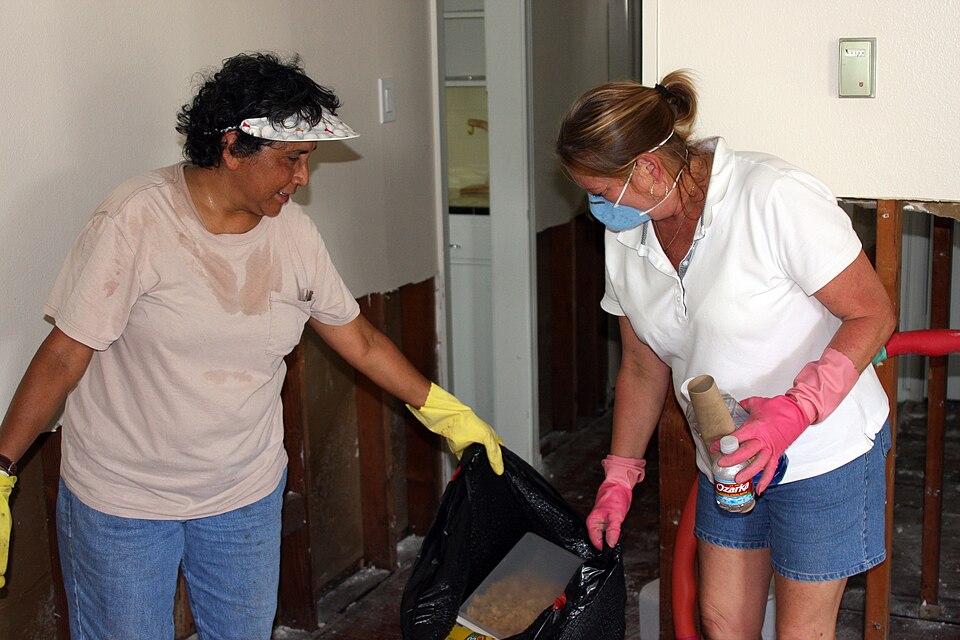
- Wikimedia Commons: FEMA - 39029 - Residents clean up their homes in Texas.jpg, by Robert Kaufmann (Public domain), https://commons.wikimedia.org/wiki/File:FEMA_-_39029_-_Residents_clean_up_their_homes_in_Texas.jpg