Particleboard
Summary
Particleboard is an engineered wood product made from wood chips and a mostly formaldehyde-based resin, hot-pressed at 2 to 3 MPa and 140 to 220°C. It is the lightest and weakest fiberboard except insulation board and swells with moisture, so it suits dry interiors, veneered cabinetry, and underlayment.
Cols
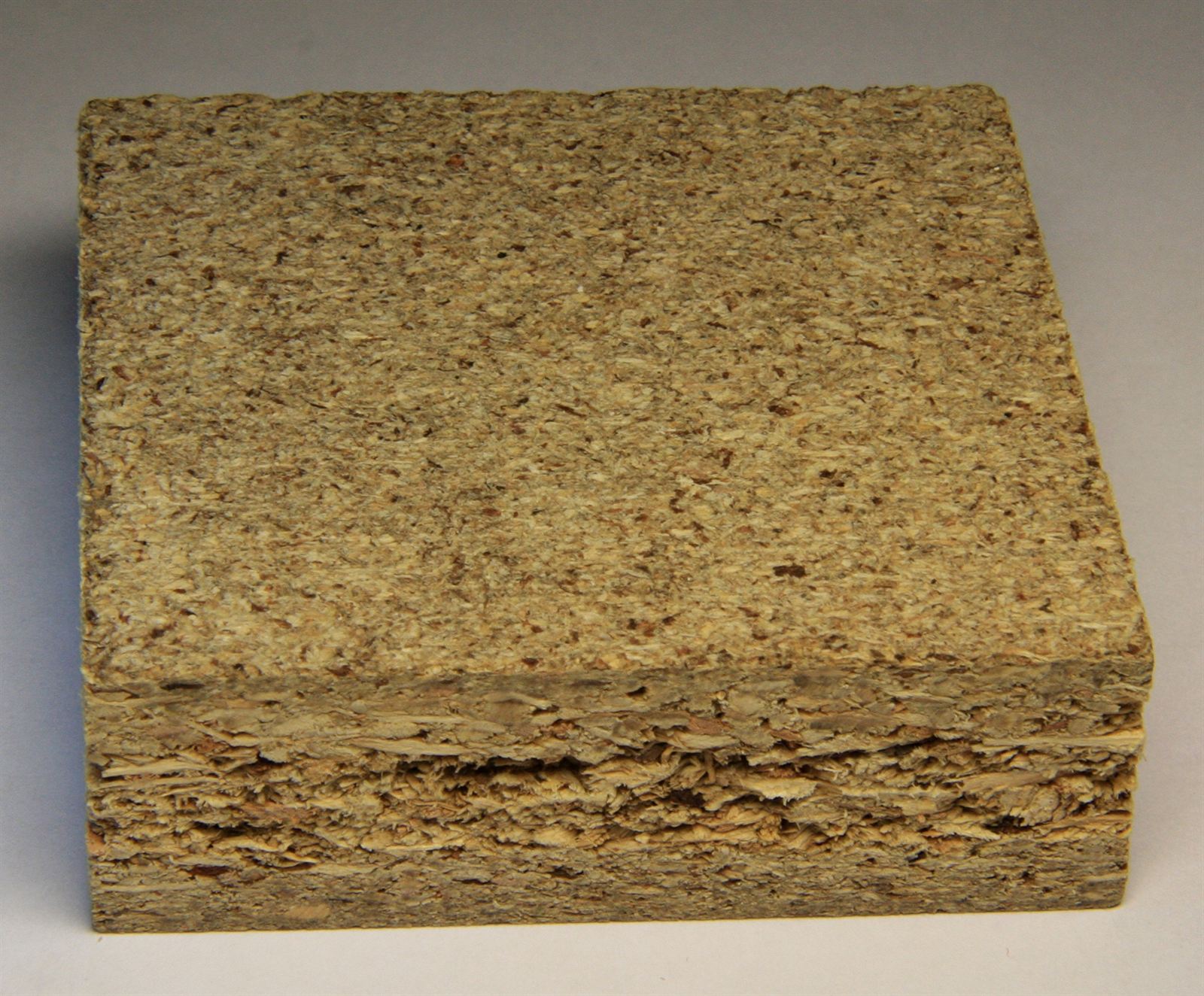
Terminology
- Particleboard / chipboard: chip-based panel; often confused with OSB, which uses machined flakes and is stronger
- Underlayment: particleboard under vinyl flooring in bathrooms, kitchens, and laundries
- Veneered particleboard: preferred over veneered plywood in dry environments for stability and cost
- ANSI A208.1: particleboard standard named in the building code
History and demand
Invention
- 1887: composite board concepts date to this year; 1932 Max Himmelheber patented a process; 1935 Farley and Loetscher Manufacturing Co. built the first particleboard plant; the industry grew in the 1940s
Sourcing
- Wood-based panels overall: China about 41 to 45 percent of world output, the United States about 8 to 12 percent, India and Russia about 4 to 5 percent each (FAO editions)
Composition and production
Manufacturing process
- Wood or jute-stick particles dried, screened, and sprayed with resin; formed into a mat, cold-pressed, then hot-pressed at 2 to 3 MPa and 140 to 220°C, cooled, trimmed, and sanded
Properties
Physical
- Denser than conventional wood; higher density gives greater strength and screw resistance
Thermal and moisture
- Susceptible to swelling and discoloration from moisture, especially when unpainted or unsealed; rarely used outdoors
Standards
Material specifications
- ANSI A208.1: particleboard
Uses in buildings
Building elements
- Flush Wood Doors: particleboard door cores
- Floor Underlayment: underlayment beneath vinyl flooring
- Cabinetry and Casework: core of veneered and laminated cabinets and furniture
Pros and cons
Pros
Cons
- Swells and discolors when wet
- Releases formaldehyde slowly over time; the WHO classifies formaldehyde as a known human carcinogen
- Weakest of the fiberboards other than insulation board
Sustainability
Health
- Particleboard, MDF, OSB, and laminate flooring are major formaldehyde emission sources; "no added formaldehyde" versions existed but were not in common use as of 2015
Manufacturing and cost
Main manufacturers and suppliers
Trade association: Composite Panel Association.
Sources
- Wikipedia: Particle board, https://en.wikipedia.org/wiki/Particle_board
- UpCodes: 2024 IBC Chapter 23 wood, https://up.codes/viewer/department-of-defense/ibc-2024/chapter/23/wood
- Wikimedia Commons: Particle board close up-horizontal-f22 PNr°0101.jpg, photo by D-Kuru (CC BY-SA 3.0 at), https://commons.wikimedia.org/wiki/File:Particle_board_close_up-horizontal-f22_PNr°0101.jpg