Peat
Summary
Peat is an accumulation of partially decayed vegetation formed in waterlogged, acidic, low-oxygen conditions; soils made mostly of peat are histosols. It compresses under minimal weight and cannot be compacted into stable support, so peat is removed or bypassed under foundations, roads, and slabs.
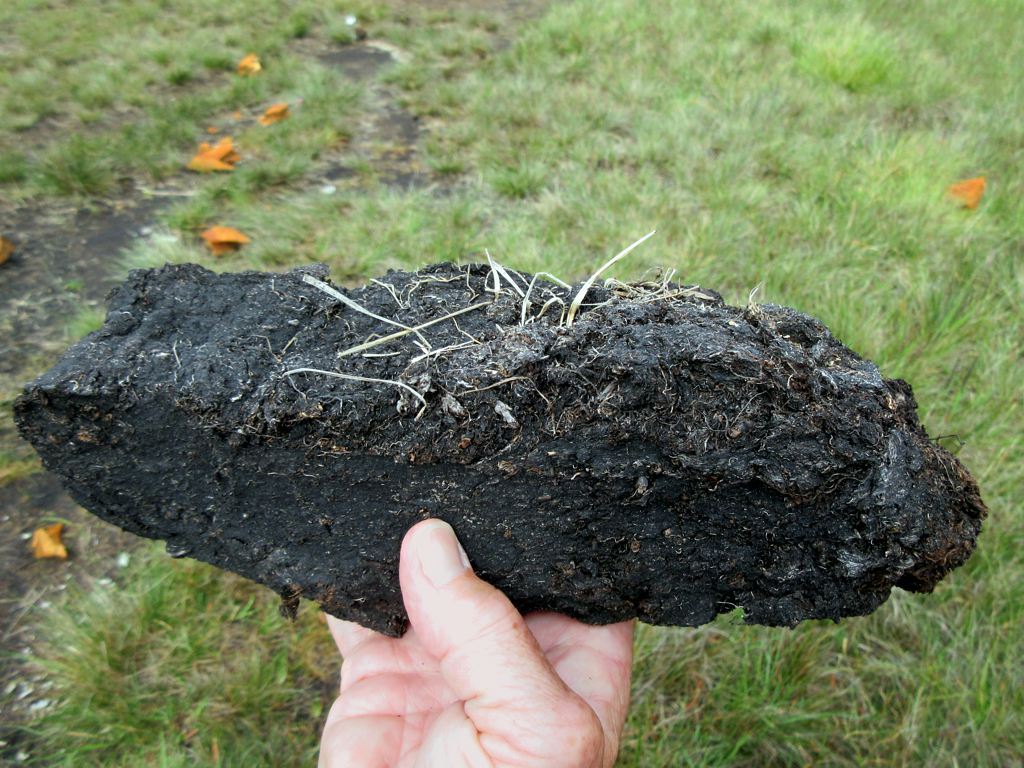
Terminology
- Histosol: soil made mostly of peat
- Pt: USCS group for highly organic soils
- Peatland: wetland storing carbon in peat
- Bog iron: iron ore formed in peat wetlands
History and demand
Sourcing
- 2025 world peat production was about 17 million tonnes; Finland about 2.5 million, Canada and Latvia about 2.0 million each, Belarus, Russia, and Sweden about 1.8 million each, Germany about 830,000 (USGS 2026 estimates)
- 2016 world production was about 26.1 million tonnes; Ireland has since ended peat harvesting
Demand trend
- Falling for fuel: Bord na Móna stopped all peat harvesting in 2021; selling peat for burning was banned in Ireland in 2022; Chile banned peat extraction in April 2024
- Horticulture persists: the Netherlands imported about 2.16 billion kg of peat in 2020; peat-free alternatives are gaining ground (the UK set a 90 percent peat-free horticulture target in 2010)
Properties
Mechanical
- Compressibility: poor consolidation properties; easily compressed under minimal weight; difficult to build structures, roads, and railways on (the West Highland railway across Rannoch Moor floated on a mattress of tree roots, brushwood, earth, and ash)
Standards
Test methods
- ASTM D2487: soil classification (Pt group)
Uses in buildings
Building elements
- Landscaping and Planting: horticultural growing medium
- Spread and Continuous Footings, Slab on Grade: not a bearing material; encountered as compressible subgrade that is removed or bypassed
Pros and cons
Pros
- Burns as fuel when dried
- Used as a horticultural growing medium
Cons
- Highly compressible and settles
- Regrows only about 1 mm per year
- Drained peatland emits about 4 percent of human-made greenhouse gases (excluding fires)
Sustainability
Embodied carbon
- Peatlands store up to 550 Gt of carbon, about 42 percent of all soil carbon; peat fires are a major emission source
Sources
- Wikipedia: Peat, https://en.wikipedia.org/wiki/Peat
- Wikipedia: Unified Soil Classification System, https://en.wikipedia.org/wiki/Unified_Soil_Classification_System
- Wikimedia Commons: Peat (49302157252).jpg, photo by David Stanley (CC BY 2.0), https://commons.wikimedia.org/wiki/File:Peat_(49302157252).jpg
- USGS: Mineral Commodity Summaries 2026, peat, https://pubs.usgs.gov/periodicals/mcs2026/mcs2026-peat.pdf