Marine Climates
Summary
Marine climates have a coldest month between 27 F and 65 F, a warmest month below 72 F, and a dry summer season, covering IECC zones 3C, 4C, and 5C such as San Francisco and Seattle. Mild temperatures hide a moisture problem, since cool rainy months leave walls little drying potential, so wetting and drying must be designed before insulation levels.
Cols
Definition
- Building America marine region requires all of: coldest month mean 27 F to 65 F; warmest month mean below 72 F; at least 4 months above 50 F; wettest cold-season month at least 3 times the driest warm-season month
- IECC and ASHRAE marine (C) shortcut from degree days: zone 3 with CDD50 4,500 or less, zone 4 with 2,700 or less, zone 5 with 1,800 or less
- Representative cities: Seattle, WA (4C), San Francisco, CA (4C), and Los Angeles, CA (3C)
Design implications
- Marine 4 climates have extremely low drying potential during the cool, rainy months
- Exterior insulation research for the zone uses the Marine 4 (4C) definition adopted by the Department of Energy
- Treat moisture management as the first design question and insulation thickness as the second
Example locations
Zones are from ANSI/ASHRAE Standard 169-2020, Addendum a (October 29, 2021), Tables A-3 to A-6. Marine (C) is a narrow definition: London (4A) and Amsterdam (4A) have oceanic climates by Koppen but are not marine in ASHRAE 169.
- North America: Los Angeles, CA (3C); San Francisco, CA (4C); Seattle, WA (4C); Portland, OR (4C); Vancouver, Canada (4C)
- South America: Santiago, Chile (3C, Pudahuel station); Concepcion, Chile (3C); Temuco, Chile (4C)
- Europe: Bilbao, Spain (3C); Porto, Portugal (3C); A Coruna, Spain (3C); Santiago de Compostela, Spain (4C)
- Africa: Cape Town, South Africa (3C); Nairobi, Kenya (3C, Dagoretti station)
- Asia: Kunming, China (3C)
- Oceania: Mount Gambier, Australia (3C); Warrnambool, Australia (3C)
Flora and fauna
- Marine West Coast forests: western hemlock, coast redwood, and red alder at low elevation; Douglas fir in rain-shadow areas; firs and spruces at high elevation; pines and cedars on lower slopes
- Wildlife: Pacific salmon, spotted owl, marbled murrelet, sea otter, gray wolf, grizzly bear
- Insect damage: spruce-bark beetle damages spruce stands
- Mediterranean California: a separate EPA Level I ecoregion covering the dry-summer coast
Sources
- Wikipedia: Oceanic climate, https://en.wikipedia.org/wiki/Oceanic_climate
- U.S. Department of Energy: Climate zones, https://www.energy.gov/eere/buildings/climate-zones
- ASHRAE Meteo: climate zone definitions for IECC and ASHRAE, https://ashrae-meteo.info/v2.0/help_IECC.php
- ASHRAE: ANSI/ASHRAE Addendum a to Standard 169-2020, Climatic Data for Building Design Standards (October 29, 2021), Tables A-3 to A-6
- USDA Forest Service Treesearch: exterior insulation in a Marine 4 climate, https://research.fs.usda.gov/download/treesearch/52589.pdf
- Wikipedia: Marine West Coast Forests, https://en.wikipedia.org/wiki/Marine_West_Coast_Forests
- U.S. EPA: Ecoregions of North America, https://www.epa.gov/eco-research/ecoregions-north-america
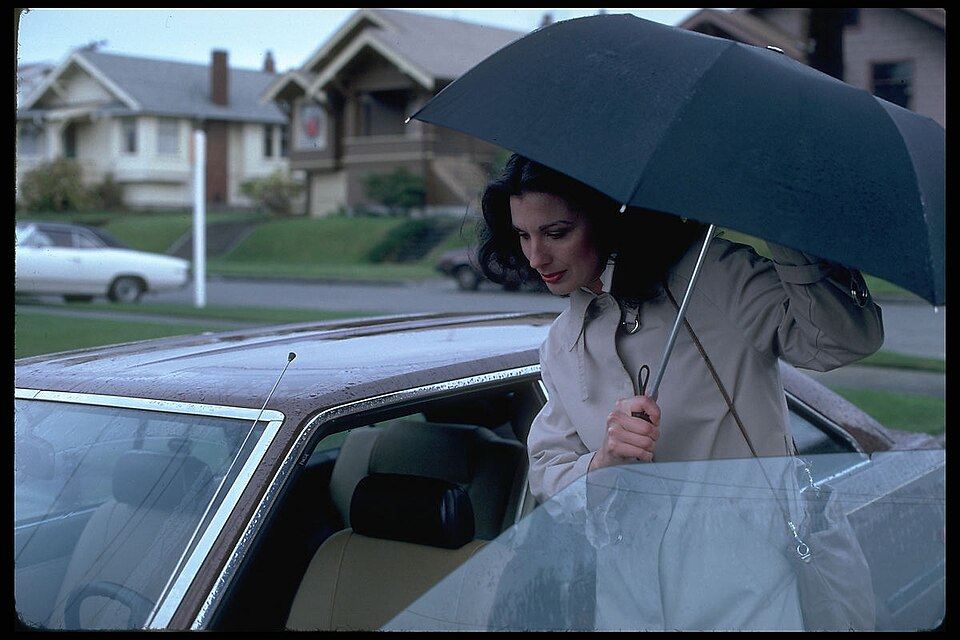
- Wikimedia Commons: Woman with umbrella on a rainy day, Seattle, 1980s.jpg, by Seattle Municipal Archives (CC BY 2.0), https://commons.wikimedia.org/wiki/File:Woman_with_umbrella_on_a_rainy_day,_Seattle,_1980s.jpg