Slag
Summary
Slag cement is blast furnace slag quenched in water or steam, dried, and ground to a fine powder. It replaces 30 to 85 percent of portland cement in concrete, improving durability and lightening color, with slower early setting.
Terminology
- GGBFS: ground granulated blast-furnace slag
- Slag cement: the name used for GGBFS in North American concrete specifications
- Supplementary cementitious material: cement replacement such as slag, fly ash, silica fume
Composition and production
Raw materials
- Molten iron slag from a blast furnace
- CaO 30 to 50 percent, SiO2 28 to 38, Al2O3 8 to 24, MgO 1 to 18, MnO also present
- Glass content 90 to 100 percent for slags suitable for blending with portland cement
Manufacturing process
- Slag must be quenched below 800°C (1,470°F) to prevent merwinite and melilite from crystallizing
- Dried and ground to a fine powder
Properties
Physical
- Color: near white, versus stony grey for portland cement concrete; smoother, more defect-free surface
Durability
- Reduced risk of alkali-silica reaction; better resistance to chloride ingress and sulfate attack
- Lower peak temperature and less total heat of hydration than portland cement
- Continues to gain strength over time
Standards
Material specifications
- ASTM C989: slag cement for use in concrete and mortars (C989/C989M-25)
Uses in buildings
Building elements
- Replaces 30 to 85 percent of cementitious material in all concrete elements, typically 40 to 50 percent, one for one by weight
- About 50 percent for chloride protection; 50 to 70 percent (up to 85) for lighter finishes; 50 to 60 percent to prevent efflorescence
Pros and cons
Pros
- Slightly less expensive than portland cement
- Sulfate resistance and lower heat of hydration
- Lighter, more uniform finish
Cons
- Sets more slowly, which may affect schedules needing quick setting
Sustainability
Recycled content and end of life
- By-product of iron making; recognized by LEED and BEAM Plus for improving project sustainability
Manufacturing and cost
Main manufacturers and suppliers
Trade association: Slag Cement Association.
Sources
- Wikipedia: Ground granulated blast-furnace slag, https://en.wikipedia.org/wiki/Ground_granulated_blast-furnace_slag
- ANSI: ASTM C989/C989M-25, https://webstore.ansi.org/standards/astm/astmc989c989m25
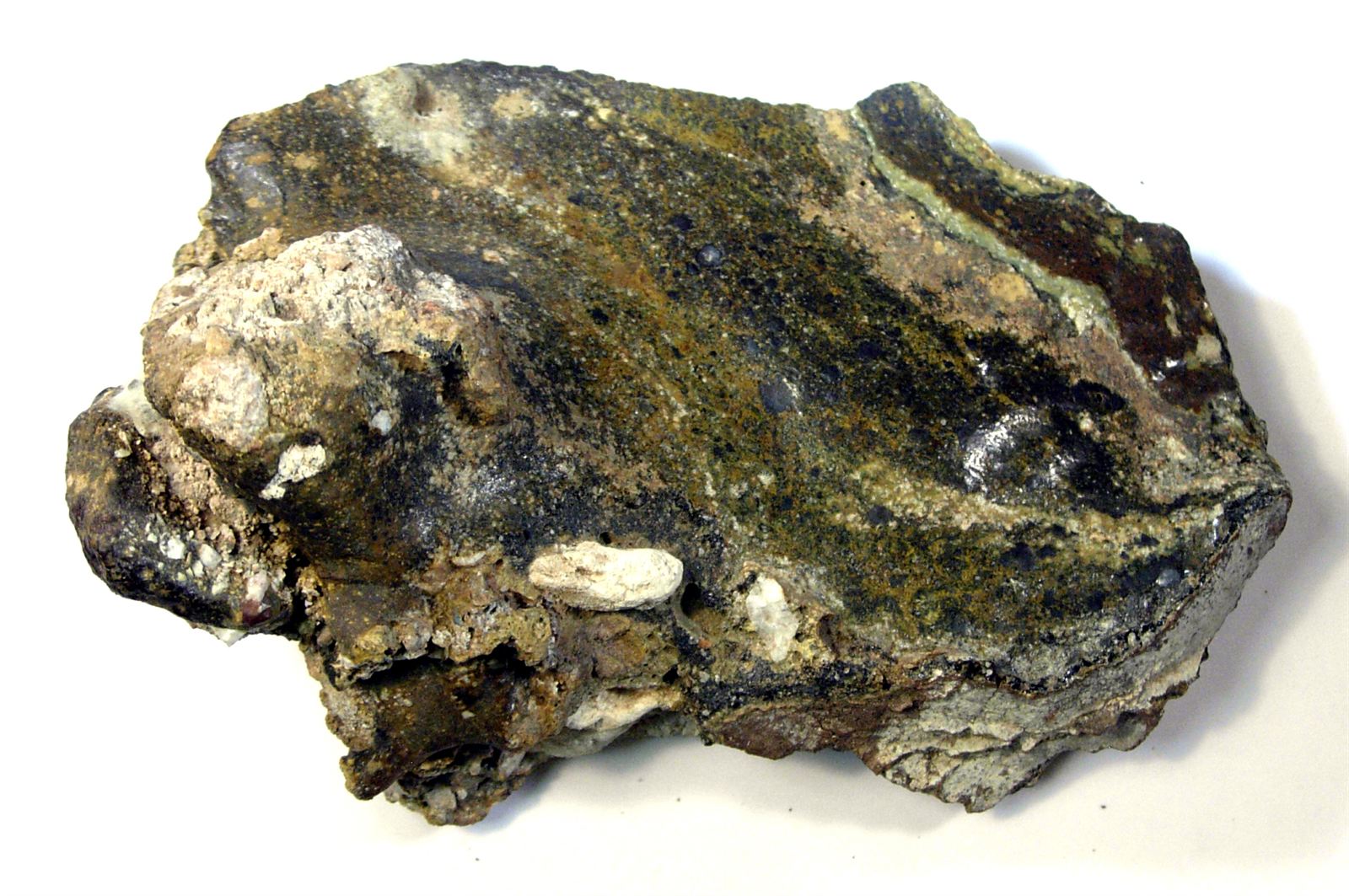
- Wikimedia Commons: Pieces of slag from glazing process MET vs22.1.1925b3.jpg, photo by unknown (CC0), https://commons.wikimedia.org/wiki/File:Pieces_of_slag_from_glazing_process_MET_vs22.1.1925b3.jpg