High-Pressure Laminate
Summary
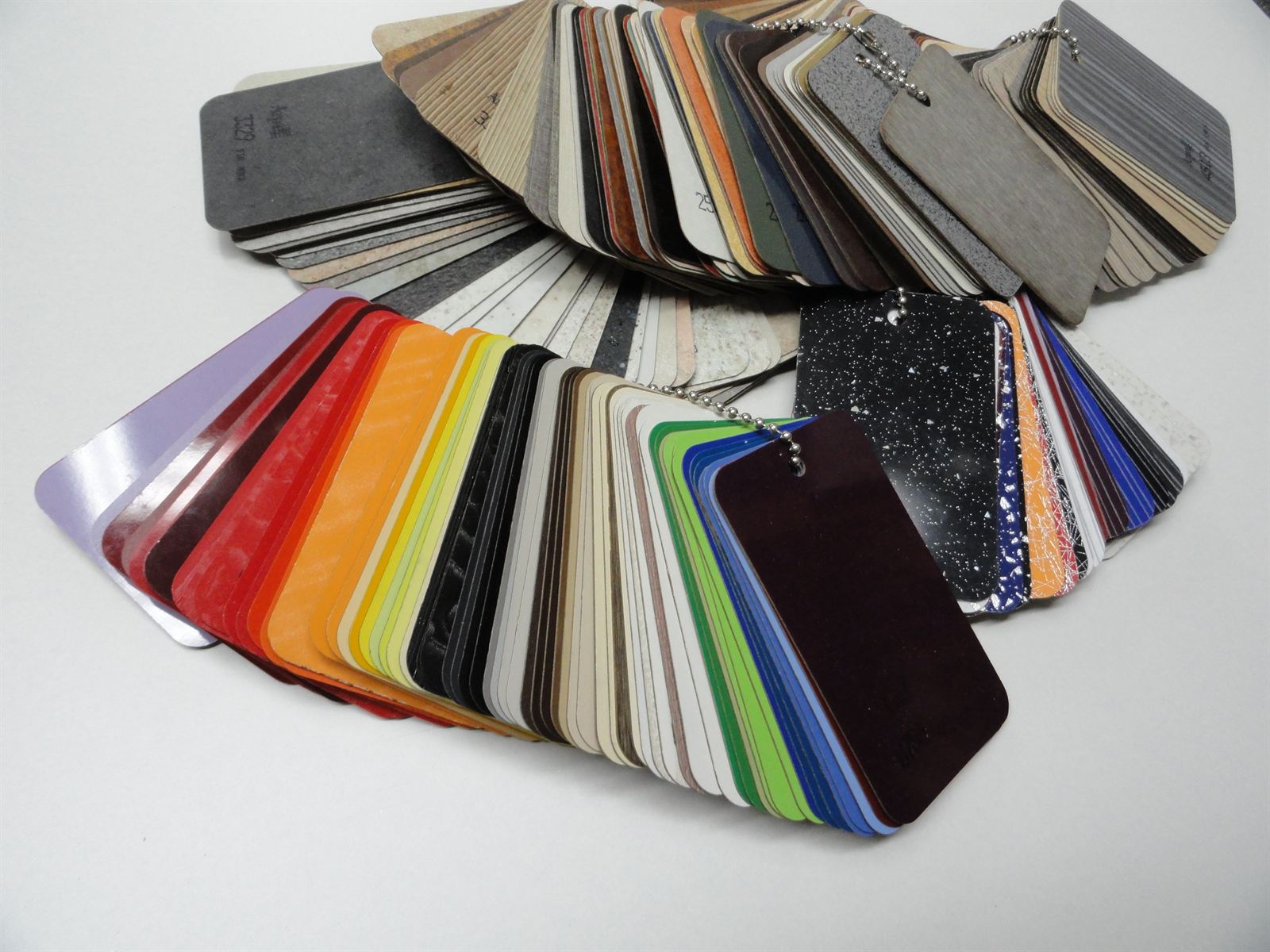
High-pressure laminate is a sheet of kraft paper core layers impregnated with phenolic resin, topped with decorative and overlay papers impregnated with melamine resin, and cured under heat and pressure. It gives a durable, cleanable surface for casework and wall panels, but it is a thin facing that must be bonded to a substrate.
Cols
Terminology
- HPL / LPL / CPL: high-pressure, low-pressure, and continuous-pressure laminate
- Overlay paper: top layer giving abrasion, scratch, and heat resistance
- Compact laminate: thick, self-supporting HPL (not a facing)
- Postforming: bending HPL to a radius under heat
Composition and production
Raw materials
- Roughly 60 to 70 percent kraft paper and 30 to 40 percent resin
- Phenol-formaldehyde resin in the core; melamine-formaldehyde resin in the surface layers
- Layers: overlay paper, decorative paper, kraft paper core
Manufacturing process
- Pressed at about 250°F (120°C) and over 70 bar (about 1,000 psi); commonly 1,200 to 2,000 psi
- Resulting density above 1.35 g/cm³ (about 84 lb/ft³)
- LPL is pressed at about 400 psi
Product forms
- Sheets bonded to particleboard, MDF, or plywood
- Compact laminate panels for self-supporting uses
Grades and types
- EN 438 Type S: standard; resists wear, scratching, impact, boiling water, and household chemicals
- EN 438 Type P: postforming
- EN 438 Type F: adds fire resistance
- NEMA general purpose: nominally 0.048 in. (horizontal surfaces needing high impact resistance)
- NEMA postforming: nominally 0.039 in. and 0.028 in.; 0.028 in. for lower-impact surfaces
Properties
Physical
- Density: above 1.35 g/cm³ (about 84 lb/ft³)
Durability
- Wear-, scratch-, and impact-resistant; antibacterial (ISO 22196) and antifungal (ASTM G21) versions available
Standards
Material specifications
- EN 438: decorative high-pressure laminates; nine parts, Part 3 covers sheets under 2 mm bonded to substrates
- ANSI/NEMA LD 3: high-pressure decorative laminates (2005 edition)
Test methods
- ISO 22196: antibacterial activity
- ASTM G21: antifungal resistance
Uses in buildings
Building elements
- Cabinetry and Casework, Countertops: surface facing
- Interior Millwork, Wall Cladding: wall panels
- Toilet Compartments: compact laminate partitions
Pros and cons
Pros
- Hard, cleanable surface in many colors and patterns
- Low-emission options certified to GREENGUARD and similar programs
Cons
- Thin facing; depends on substrate and adhesive
- Resins contain formaldehyde; select certified low-emitting products
Sustainability
Health
- Low-emission certifications: GREENGUARD, MAS Certified Green, Singapore Green Label
- Phenol- and melamine-formaldehyde resins; large-format inkjet alternatives with solvent inks have high VOCs
Manufacturing and cost
Main manufacturers and suppliers
Trade association: NEMA.
Sources
- Wikipedia: Decorative laminate, https://en.wikipedia.org/wiki/High-pressure_laminate
- Nevamar: technical sheet via Material Bank, https://www.materialbank.com/nevamar-limeade-1589097
- SAI Global: ANSI/NEMA LD 3:2005, https://infostore.saiglobal.com/en-gb/standards/nema-ld-3-2005-781673_saig_nema_nema_1880285/
- Wikimedia Commons: Decorative laminate 07827.jpg, photo by Андрей Перцев 1967 (CC0), https://commons.wikimedia.org/wiki/File:Decorative_laminate_07827.jpg