Climate Classification Systems
Summary
Climate classification systems sort locations by temperature, moisture, or vegetation so that design rules can be tied to a zone. Each system answers a different question, so pick the one that matches the decision: envelope and energy, moisture practice, planting, or regional context.
Cols
Types
IECC and ASHRAE thermal zones
- Zones 0 to 8 by heating and cooling degree days, plus a moisture letter: A (moist), B (dry), C (marine)
- Used for envelope insulation, fenestration, and energy modeling inputs
Building America regions
- Eight regions: hot-humid, hot-dry, mixed-humid, mixed-dry, marine, cold, very cold, subarctic
- Defined by precipitation, temperature, and heating degree days; boundaries follow county lines
- Used for moisture and construction practice guidance
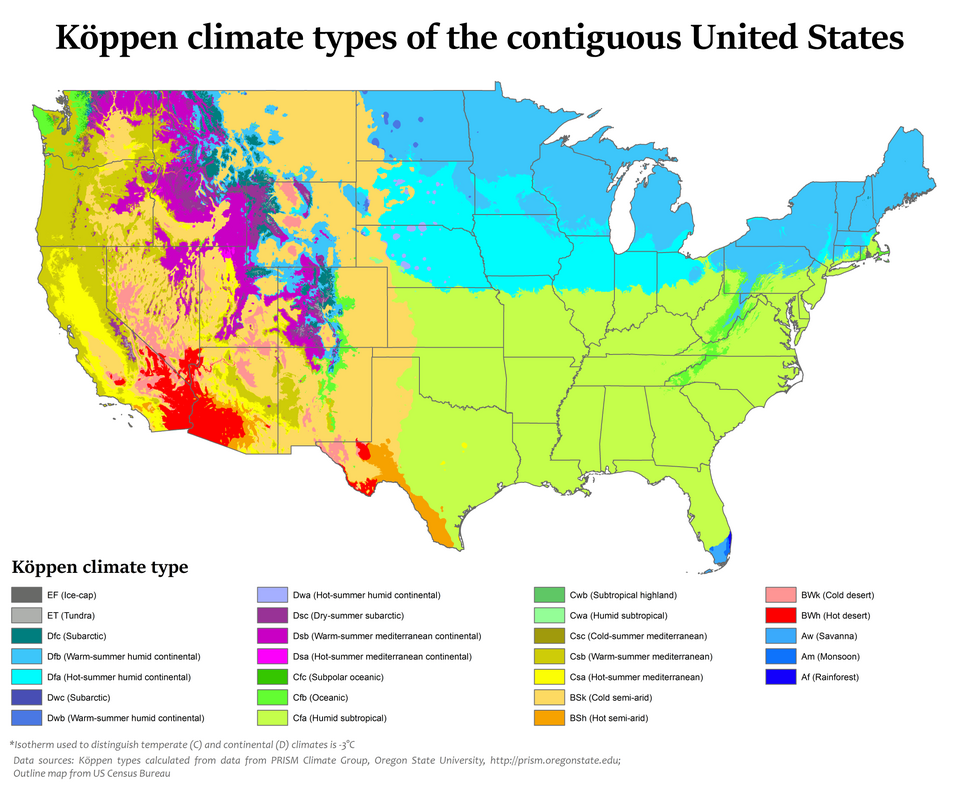
Koppen-Geiger
- Wladimir Koppen published it in 1884, revised in 1918 and 1936; Rudolf Geiger revised it in 1954 and 1961
- Five groups: A tropical (every month 64 F or higher), B arid, C temperate, D continental, E polar
- Global; a 2018 update maps present and future climate at 1 km resolution
- Used for regional and international comparison
USDA Plant Hardiness Zones
- 13 zones, each 10 F wide, split into A and B half-zones of 5 F, based on average annual extreme minimum winter temperature
- 2023 map released November 15, 2023, from 1991 to 2020 data at 13,412 stations (7,983 for the 2012 map)
- About half of the country moved to the next warmer half-zone, generally 0 to 5 F
- ZIP code lookup at the USDA site; used for plant selection, not building envelope
EPA ecoregions
- Level I: 15 North American regions; Level II: 50; Level III: 182
- Based on ecosystem and vegetation patterns
- Used for native planting and habitat context
Standards
Thermal zone criteria
Degree days: CDD50 and HDD65 in F-days (SI uses CDD10 and HDD18 in C-days).
| Zone | Criteria |
|---|---|
| 0 | CDD50 above 10,800 |
| 1 | CDD50 above 9,000 to 10,800 |
| 2 | CDD50 above 6,300 to 9,000 |
| 3 | CDD50 6,300 or less and HDD65 3,600 or less |
| 4 | CDD50 6,300 or less and HDD65 above 3,600 to 5,400 |
| 5 | CDD50 below 6,300 and HDD65 above 5,400 to 7,200 |
| 6 | HDD65 above 7,200 to 9,000 |
| 7 | HDD65 above 9,000 to 12,600 |
| 8 | HDD65 above 12,600 |
Moisture regimes
- Marine (C): all of: coldest month mean 27 F to 65 F; warmest month mean below 72 F; at least 4 months above 50 F; wettest cold-season month at least 3 times the driest warm-season month (cold season is October to March in the Northern Hemisphere)
- Marine shortcut from degree-day data: zone 3 with CDD50 4,500 or less, zone 4 with 2,700 or less, zone 5 with 1,800 or less
- Dry (B): not marine, and annual precipitation below a threshold that depends on mean annual temperature and the share of precipitation falling April to September (70 percent or more, 30 to 70 percent, 30 percent or less each use a different equation)
- Humid (A): neither marine nor dry
Representative cities
Zones are from ANSI/ASHRAE Standard 169-2020, Addendum a (October 29, 2021). Zone assignments change between editions, so cite the edition with the zone.
| Zone | City |
|---|---|
| 0A | Singapore |
| 0B | Dubai, UAE |
| 1A | Miami, FL |
| 1B | Phoenix, AZ |
| 2A | Houston, TX |
| 2B | Las Vegas, NV |
| 3A | Atlanta, GA |
| 3B | San Diego, CA |
| 3C | Los Angeles, CA |
| 4A | Baltimore, MD |
| 4B | Albuquerque, NM |
| 4C | Seattle, WA |
| 5A | Chicago, IL |
| 5B | Boulder, CO |
| 5C | San Carlos de Bariloche, Argentina |
| 6A | Minneapolis, MN |
| 6B | Helena, MT |
| 7 | Duluth, MN |
| 8 | Fairbanks, AK |
Selection
- Envelope and energy: IECC and ASHRAE zone for the project county
- Moisture and assembly practice: Building America region, then the A, B, C letter
- Planting: hardiness zone for cold tolerance; ecoregion for native plant communities
- Cross-border or international work: Koppen group
- Confirm the zone for the project location against the adopted code or standard edition
Sources
- ASHRAE Meteo: climate zone definitions for IECC and ASHRAE, https://ashrae-meteo.info/v2.0/help_IECC.php
- U.S. Department of Energy: Climate zones, https://www.energy.gov/eere/buildings/climate-zones
- ASHRAE: ANSI/ASHRAE Addendum a to Standard 169-2020, Climatic Data for Building Design Standards (October 29, 2021), Tables A-3 to A-6, Infrastructure/PDF resources/169_2020_a_20211029.pdf
- USDA Agricultural Research Service: USDA unveils updated Plant Hardiness Zone Map, https://www.ars.usda.gov/news-events/news/research-news/2023/usda-unveils-updated-plant-hardiness-zone-map/
- USDA: Plant Hardiness Zone Map, https://planthardiness.ars.usda.gov/
- U.S. EPA: Ecoregions of North America, https://www.epa.gov/eco-research/ecoregions-north-america
- Wikipedia: Koppen climate classification, https://en.wikipedia.org/wiki/Köppen_climate_classification
- Wikimedia Commons: United States Köppen.png, by Adam Peterson (CC BY-SA 4.0), https://commons.wikimedia.org/wiki/File:United_States_Köppen.png