Mortar
Summary
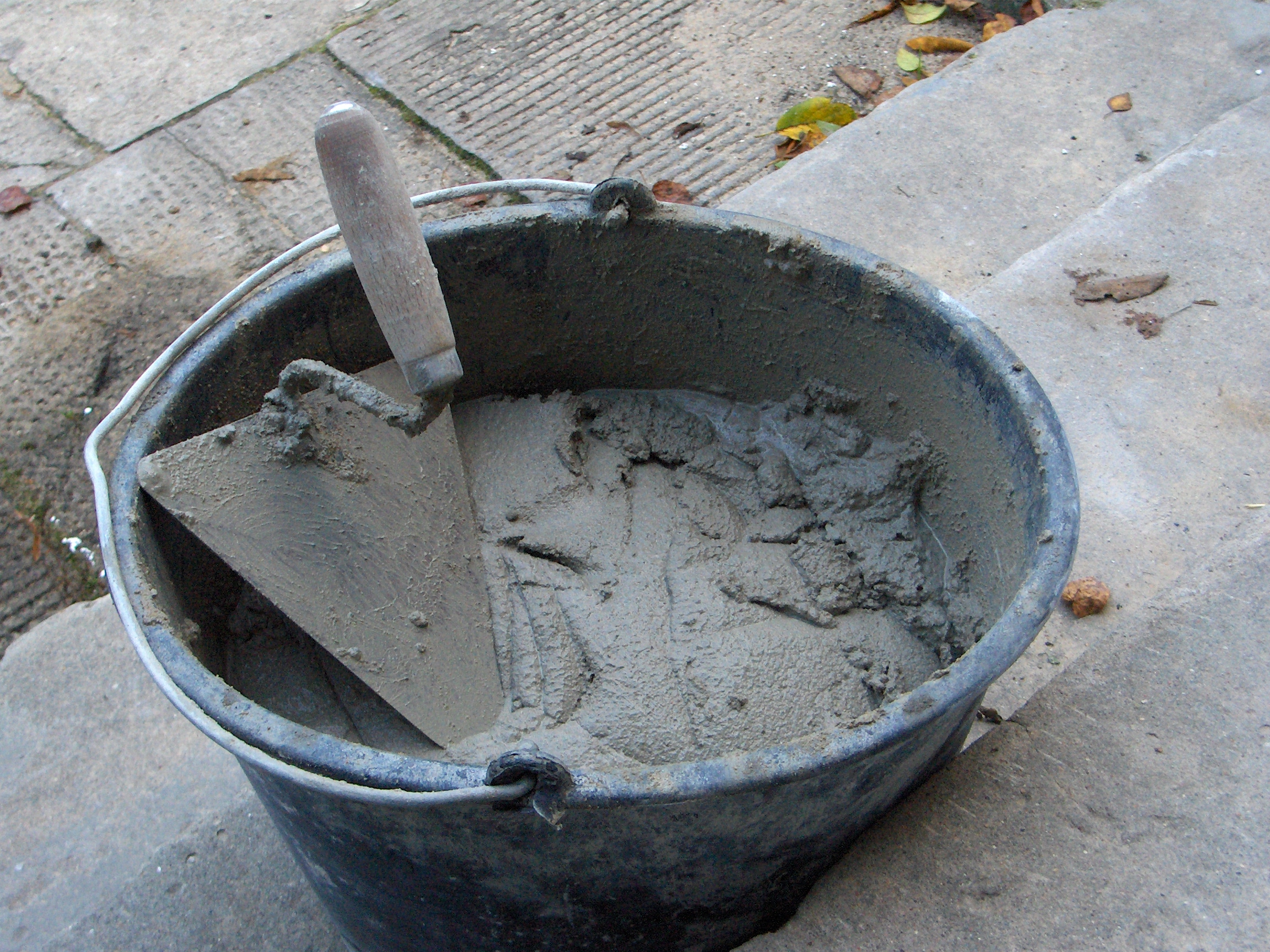
Terminology
- Type M, S, N, O, K: the five standard mortar types, M strongest and K weakest
- Lime mortar: lime and sand binder, hardens by carbonation
- Portland cement mortar: cement binder, overtook lime mortar by 1930
- Sacrificial joint: mortar is weaker and cheaper to repair than the units
History and demand
First uses in construction
- 10th millennium BC (Jericho) and 8th millennium BC (Ganj Dareh): earliest mud and clay mortars
- Circa 6500 BC: Mehrgarh sun-dried brick mortar
- Before 2600 BC: gypsum mortar at Mohenjo-daro
- 1824: Joseph Aspdin patented Portland cement, British Patent No. 5022 (21 October)
- By 1930: Portland cement mortar overtook lime mortar in popularity
Composition and production
Raw materials
Grades and types
| Type | Cement : lime : sand by volume | Approximate compressive strength |
|---|---|---|
| M | 1 : 1/4 : 3-1/2 | 2,500 psi |
| S | 1 : 1/2 : 4-1/2 | 1,800 psi |
| N | 1 : 1 : 6 | 750 psi |
| O | 1 : 2 : 9 | 350 psi |
| K | 1 : 3 : 12 | 75 psi |
Standards
Material specifications
- ASTM C270: mortar for unit masonry
- ASTM C887: surface-bonding mortar
Uses in buildings
Building elements
- Brick Veneer Walls: bed and head joints
- CMU Walls: bed joints and grouted cells
Pros and cons
Pros
- Weaker mortar is cheaper to repair than the units
Cons
- Type K reaches only about 75 psi; type M about 2,500 psi
Manufacturing and cost
Main manufacturers and suppliers
Trade association: The Masonry Society.
Sources
- Wikipedia: Mortar (masonry), https://en.wikipedia.org/wiki/Mortar_(masonry)
- Wikimedia Commons: Throwel in a bucket.JPG, photo by Stanisław Skowron (Public domain), https://commons.wikimedia.org/wiki/File:Throwel_in_a_bucket.JPG