Wood
Summary
Wood is a fibrous material of cellulose (40 to 50 percent), hemicellulose, and lignin, supplied as softwood and hardwood lumber and as engineered products such as LVL, glulam, and I-joists. Moisture content, species density, and decay exposure govern strength, shrinkage, and durability, so keep untreated wood below 19 percent in service.
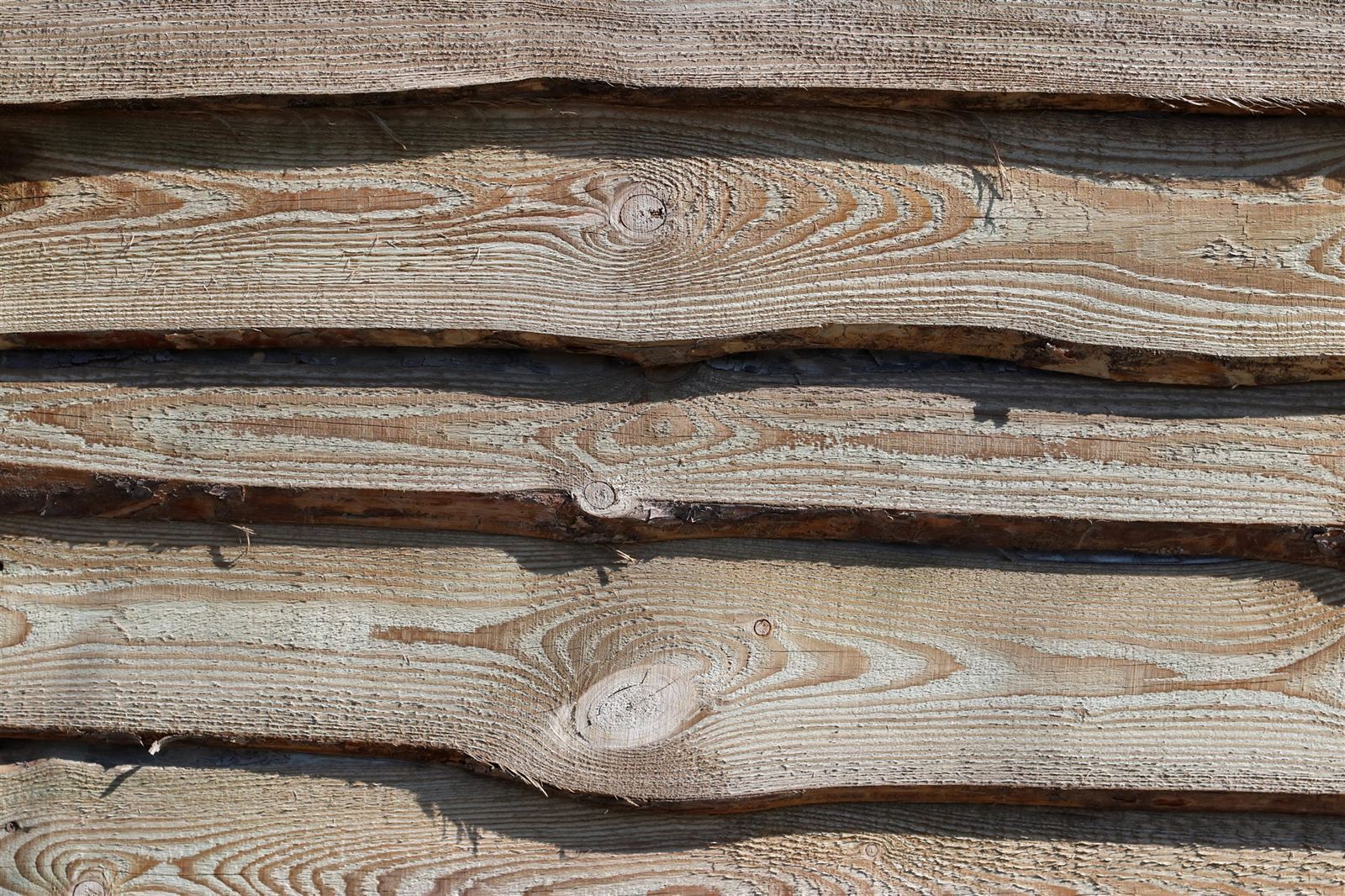
Terminology
- Softwood / hardwood: conifer wood of tracheids / broadleaf wood with vessels (ring-porous or diffuse-porous)
- Heartwood / sapwood: inner decay-resistant wood / outer less resistant wood
- Nominal size: historic rough size; a 2x4 is at least 1-1/2 by 3-1/2 in. dressed
- Specific gravity (G12): density relative to water at 12 percent moisture; density = 1,120 × G12 kg/m³
- LVL: laminated veneer lumber, typically 1-3/4 in. thick in depths of 9-1/2 to 24 in.
- Glulam: glued laminated timber made from 2x4 or 2x6 stock
- Kiln-dried / air-dried: drying methods; seasoning defects cause splits, bowing, and honeycombing
- EN 338 classes: European strength classes (C16 to C30 softwood, D24 to D70 hardwood)
History and demand
First uses in construction
- Wood has been used for construction for about 10,000 years; Neolithic European longhouses were mainly wood
- 1593: Cornelis Corneliszoon of Uitgeest invented the first wind-powered sawmill, about thirty times faster than hand sawing
- 1924: American Lumber Standard set dimension, grade, and moisture specifications; 1961: standard fixed dressed sizes (1-inch board 3/4 in., 2-inch lumber 1-1/2 in.)
Sourcing
- 2023 industrial roundwood removals were about 1.92 billion m3 and sawnwood output 445 million m3 (FAO)
- Industrial roundwood by country, FAO-derived listings: United States 18 to 19 percent, China 9 to 12, Russia 9 to 10, Brazil 7, Canada 6 to 7
Demand trend
- Almost 4 billion m³ of wood harvested in 2023; forest growing stock about 630 billion m³ in 2025; about 80 percent of lumber is softwood
- Timber framing has grown in United States popularity since the 1970s
Composition and production
Raw materials
- Cell walls: cellulose 40 to 50 percent, hemicellulose 15 to 25 percent, lignin 15 to 30 percent; cellulose microfibrils carry tension, lignin and hemicellulose matrix resist compression
Manufacturing process
- Logs sawn to lumber, kiln or air dried, planed
Product forms
- Dimension lumber, timber, LVL, wood I-joists, finger-jointed lumber (up to 36 ft in 2x6), glulam, trusses, plywood, and cross-laminated timber
Grades and types
- Softwood: about 80 percent of lumber; species table and Janka hardness in the Softwood note
- Hardwood: vessel-bearing wood; European classes D24 to D70; species table and Janka hardness in the Hardwood note
- Machine-graded lumber: for trusses and I-beams
- Engineered wood: LVL, I-joists, glulam, finger-jointed, trusses
Properties
Physical
- Density at 12 percent moisture: about 310 kg/m³ (19 lb/ft³, northern white cedar) to 880 kg/m³ (55 lb/ft³, live white oak)
Mechanical
- Compressive strength (12 percent moisture): about 27 MPa (3.9 ksi, northern white cedar) to 70 MPa (10.2 ksi, black locust)
- Flexural strength: about 45 MPa (6.5 ksi) to 139 MPa (20.2 ksi, hickory)
- Moisture effect: drying increases strength most in crushing strength; a dry spruce block carries about four times the permanent load of a green one
Thermal and moisture
- Moisture content: air-dried 8 to 16 percent; wood shrinks and densifies as it dries
Durability
- Decay: needs moisture above 25 percent; 19 percent is the maximum safe level for untreated wood in service
- Heartwood: more decay resistant than sapwood
Standards
Material specifications
- American Lumber Standard: dimension, grade, and moisture specifications with inspection (American Lumber Standard Committee)
- DOC PS 20: lumber grading
- ANSI/APA A190.1, ASTM D3737: glulam
- ASTM D5456: structural composite lumber
- ASTM D5055: I-joists
- ANSI/APA PRG 320: cross-laminated timber
- EN 14081, EN 338: European grading and strength classes
Uses in buildings
Building elements
- Wood-Framed Walls, Wood-Framed Floors, Wood Trusses, Wood I-Joists, Shear Walls: light-frame lumber, joists, trusses, and structural panels
- Glulam Beams, LVL and PSL, Mass Timber Walls: engineered and mass timber members
- Flush Wood Doors, Stile and Rail Wood Doors, Overhead Sectional Doors: wood door leaves
- Wood and Clad Wood Windows: wood sash and frames
- Hardwood Flooring: solid and engineered flooring
- Wall Cladding, Exterior Decking, Interior Millwork: siding, decking, and trim
Pros and cons
Pros
- About one cubic meter of lumber sequesters roughly one tonne of CO2
- Heartwood resists decay
- Engineered products extend spans and sizes
Cons
- Shrinks, swells, and loses strength when wet
- Decay when moisture exceeds 25 percent
- Resin-saturated "fat lighter" is very flammable
Design considerations
Movement
- Wood shrinks and densifies on drying
Sustainability
Recycled content and end of life
- United States wood waste (2018, EPA): 67 percent landfilled, 16 percent incinerated with energy recovery, 17 percent recycled
Manufacturing and cost
Main manufacturers and suppliers
Trade associations: APA – The Engineered Wood Association; American Wood Council.
Sources
- Wikipedia: Wood, https://en.wikipedia.org/wiki/Wood
- Wikipedia: Lumber, https://en.wikipedia.org/wiki/Lumber
- UpCodes: 2024 IBC Chapter 23 wood, https://up.codes/viewer/department-of-defense/ibc-2024/chapter/23/wood
- Wikimedia Commons: Pine plank fence 2019 G1.jpg, photo by George Chernilevsky (Public domain), https://commons.wikimedia.org/wiki/File:Pine_plank_fence_2019_G1.jpg