Cold and Very Cold Climates
Summary
Cold climates have roughly 5,400 to 9,000 heating degree days (IECC zones 5 and 6), very cold climates 9,000 to 12,600 (zone 7), and subarctic climates more than 12,600 (zone 8). Heating load, condensation control, and frozen ground govern the envelope and foundation, so continuous insulation and drying paths must be settled together.
Cols
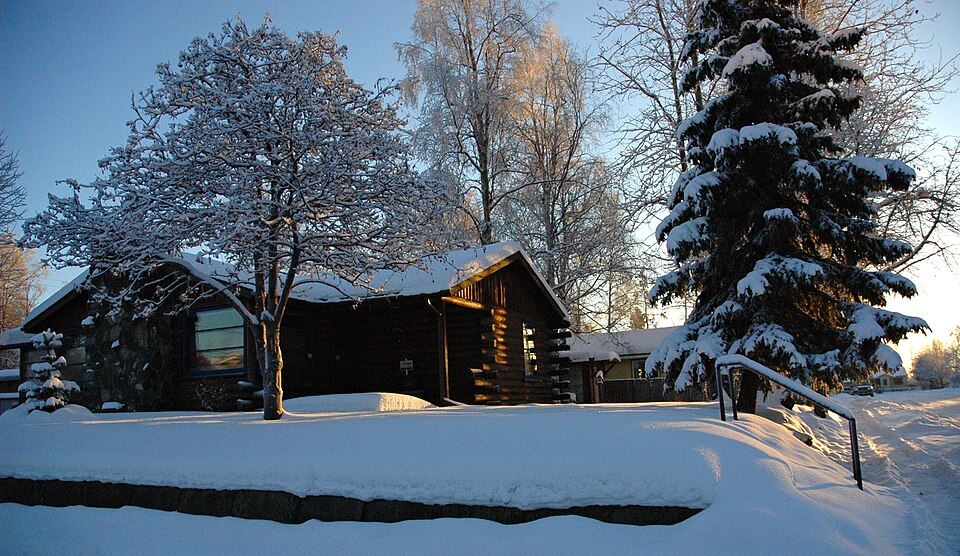
Definition
| Region | HDD65 (Building America) | IECC zone | Representative city |
|---|---|---|---|
| Cold | About 5,400 to 9,000 | 5 and 6 | Chicago, IL (5A); Boulder, CO (5B); Minneapolis, MN (6A); Helena, MT (6B) |
| Very cold | About 9,000 to 12,600 | 7 | Duluth, MN |
| Subarctic | About 12,600 or more | 8 | Fairbanks, AK |
Design implications
- Continuous insulation: rigid or semi-rigid board outside the wall cavity cuts thermal bridging through studs
- Drying: vapor-impermeable exterior foam cuts off outward drying
- Interior polyethylene: with a polyethylene vapor barrier inside the cavity, use no exterior insulation or a vapor-open continuous layer such as mineral wool
- Cavity versus continuous R-value: cavity insulation R-value ideally matches continuous exterior R-value to limit condensation risk
- Without exterior foam: Building America also published high-R wall guidance for climate zone 5 and colder using double-stud framing and dense-pack cellulose
- Passive solar: collect, store, and distribute solar heat in winter and reject it in summer; thermal mass such as concrete, stone, brick, and tile stores heat in floors and walls
- Frozen ground: where mean annual temperature is below freezing, discontinuous permafrost occurs; continuous permafrost limits roots to shallow species and constrains foundations
Example locations
Zones are from ANSI/ASHRAE Standard 169-2020, Addendum a (October 29, 2021), Tables A-3 to A-6.
Cold (zones 5 and 6)
- North America: Chicago, IL (5A); Boulder, CO (5B); Toronto, Canada (5A); Minneapolis, MN (6A); Helena, MT (6B); Montreal, Canada (6A)
- Europe: Berlin, Germany (5A); Warsaw, Poland (5A); Moscow, Russia (6A); Stockholm, Sweden (6A); Helsinki, Finland (6A)
- Asia: Sapporo, Japan (5A); Almaty, Kazakhstan (5A); Shenyang, China (6A)
- South America: Ushuaia, Argentina (6A); Punta Arenas, Chile (6A)
- Africa and Oceania: no major city among the stations checked; Oceania entries are remote islands or alpine sites
Very cold and subarctic (zones 7 and 8)
- North America: Duluth, MN (7); Anchorage, AK (7); Winnipeg, Canada (7); Fairbanks, AK (8); Yellowknife, Canada (8)
- Europe: Murmansk, Russia (7); Oulu, Finland (7); Umea, Sweden (7); Tromso, Norway (7)
- Asia: Harbin, China (7); Novosibirsk, Russia (7); Ulaanbaatar, Mongolia (8); Yakutsk, Russia (8); Norilsk, Russia (8)
- Africa, South America, Oceania: no zone 7 or 8 city among the stations checked, excluding Antarctica
Flora and fauna
- Boreal forest (taiga): white and black spruce, balsam fir, tamarack, jack pine, trembling aspen, paper birch
- Wildlife: moose, caribou, Canada lynx, snowshoe hare, wolverine, wolves, black and grizzly bear; few reptiles and amphibians
- Birds: of about 300 nesting species only about 30 overwinter
- Climate: winters 5 to 7 months, summers 1 to 3 months; mean annual temperature generally -5 C to 5 C (23 F to 41 F)
- Northern plains: very cold winters and strong winds, with prairie vegetation on the Great Plains
Sources
- Wikipedia: Humid continental climate, https://en.wikipedia.org/wiki/Humid_continental_climate
- Wikipedia: Subarctic climate, https://en.wikipedia.org/wiki/Subarctic_climate
- U.S. Department of Energy: Climate zones, https://www.energy.gov/eere/buildings/climate-zones
- ASHRAE Meteo: climate zone definitions for IECC and ASHRAE, https://ashrae-meteo.info/v2.0/help_IECC.php
- ASHRAE: ANSI/ASHRAE Addendum a to Standard 169-2020, Climatic Data for Building Design Standards (October 29, 2021), Tables A-3 to A-6
- Building America Solution Center: walls in cold climates with interior polyethylene, https://basc.pnnl.gov/images/walls-cold-climates-polyethylene-vapor-barrier-interior-wall-cavity-should-have-either-no
- U.S. Department of Energy: guide to passive solar home design, https://www.energy.gov/sites/prod/files/guide_to_passive_solar_home_design.pdf
- Wikipedia: Taiga, https://en.wikipedia.org/wiki/Taiga
- Wikimedia Commons: Log house in Anchorage Alaska sits up in deep crisp snow, around Christmas.jpg, by Wonderlane (CC BY 2.0), https://commons.wikimedia.org/wiki/File:Log_house_in_Anchorage_Alaska_sits_up_in_deep_crisp_snow,_around_Christmas.jpg